
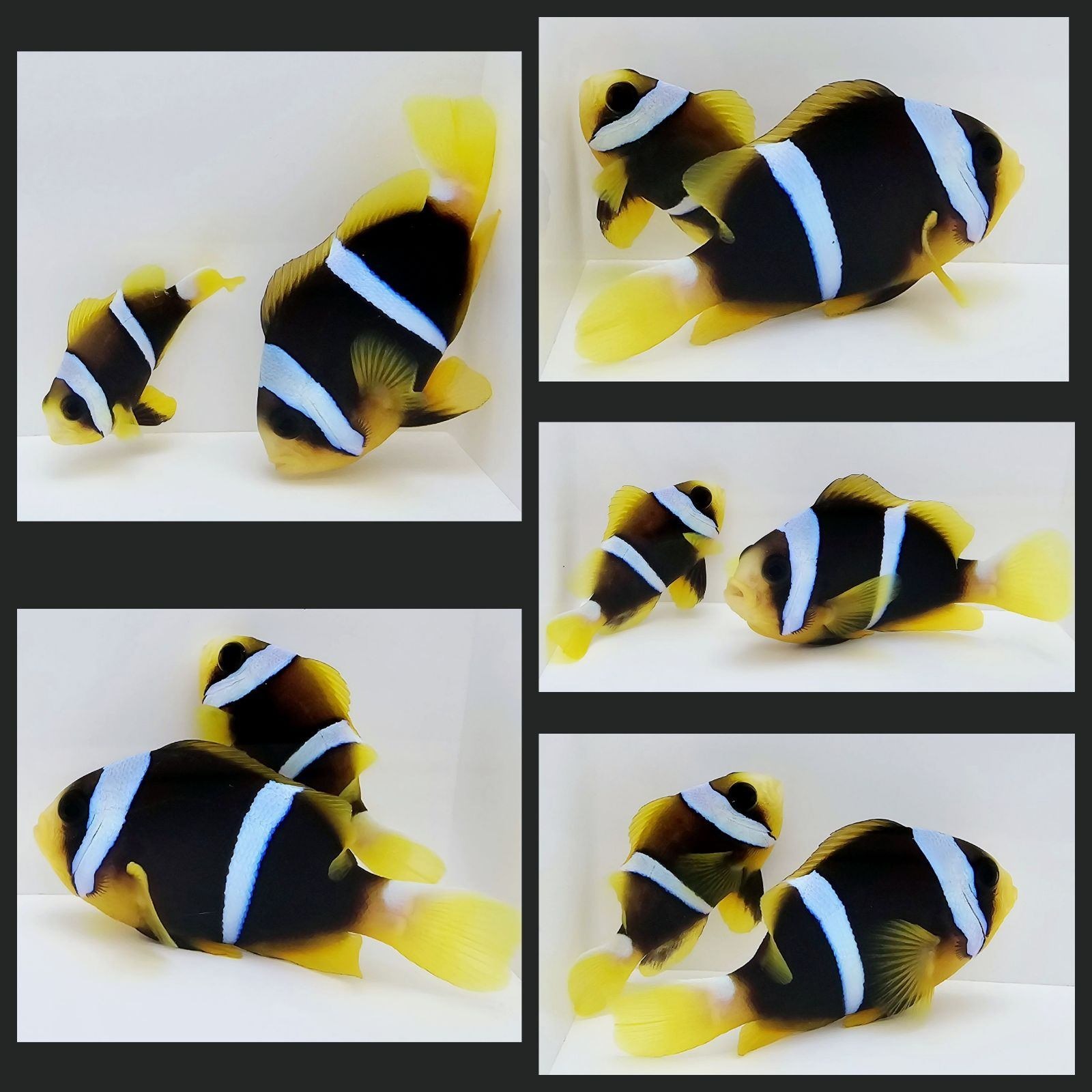
Black Clarkii Bonded Pair
$249.99
Amphiprion clarkii
| Care Level | Beginner to intermediate |
| Temperament | Semi-aggressive |
| Color Form | Black body with white bands and yellow tail |
| Diet | Omnivore |
| Reef Compatible | Reef-safe |
| Water Conditions | sg 1.023–1.025, 74–80°F, pH 8.1–8.4 |
| Max Size | 5.5“ |
| Family | Pomacentridae |
| Minimum Tank Size | 25 gallons |
3-Day Guarantee
Approximate Purchase Size: Small: 1″ to 1.25″; Medium: 1.25″ to 1.75″; Large: 1.75″ to 2.25″
Black Clarkii Bonded Pair
Also known as Clark’s Clownfish or Yellowtail Clownfish (Melanistic Variant)
The Black Clarkii Clownfish represents one of the most dramatic and sought-after color morphs in the clownfish world. This melanistic variant displays deep black to charcoal coloration instead of the typical orange-yellow base, creating a stunning contrast with their bright white bands and yellow-orange fins. Offering a bonded pair provides aquarists with an established social hierarchy and the exciting potential for breeding behavior. Hardy, bold, and larger than most clownfish species, Black Clarkii pairs make impressive centerpiece fish for reef and FOWLR aquariums.
Key Features
Scientific Name: Amphiprion clarkii (Melanistic/Black variant)
Common Names: Black Clarkii Clownfish, Black Clark’s Clownfish, Sebae Clownfish (Black morph)
Adult Size: 4–5.5 inches (10–14 cm)
Lifespan: 8–15+ years with proper care
Temperament: Semi-aggressive to moderately aggressive; territorial around host area
Reef Compatibility: Reef-safe
Minimum Tank Size: 25 gallons
Experience Level: Beginner to Intermediate
Pair Status: Bonded – established social hierarchy with larger female and smaller male
Habitat & Tank Requirements
Natural Habitat: Found across the Indo-Pacific from the Persian Gulf to Western Australia and Melanesia, typically in coastal reefs and lagoons at depths of 3–200 feet. They are associated with the widest range of host anemones of any clownfish species.
Tank Environment:
- Provide host anemone or suitable coral substitute for pair bonding and territorial establishment
- Substantial live rock structure with caves and swimming space
- Moderate to strong water flow with calmer zones near host
- Stable, established aquarium (2–3 months minimum recommended)
- Open swimming areas as Clarkii are active swimmers
Water Parameters:
- Temperature: 74–80°F (23–27°C)
- Salinity: 1.023–1.025 specific gravity
- pH: 8.1–8.4
- Ammonia/Nitrite: 0 ppm
- Nitrate: <20 ppm (lower is better for breeding behavior)
- Alkalinity: 8–12 dKH
Essential Equipment:
- Quality protein skimmer
- Robust filtration system (pairs produce more waste than single fish)
- Moderate to high-quality lighting if hosting anemone
- Regular water changes (15–20% biweekly minimum)
- Stable parameters critical for maintaining pair bond and potential breeding
Diet & Feeding
Black Clarkii Clownfish are vigorous omnivores with hearty appetites. Bonded pairs often feed together and may exhibit competitive feeding behavior.
Recommended Foods:
- Pellets/Flakes: High-quality marine pellets, spirulina-enriched formulas, color-enhancing foods
- Frozen Foods: Mysis shrimp, enriched brine shrimp, cyclops, finely chopped krill, chopped clams
- Meaty Foods: Marine fish flesh, squid (small pieces)
- Plant Matter: Nori sheets, spirulina, marine algae (occasional grazing)
- Prepared Mixes: Omnivore blends, breeding formulas (high in protein and fatty acids)
- Enrichment: Vitamin-soaked foods, garlic-enriched preparations, astaxanthin for color enhancement
Feeding Schedule:
- Feed 2–3 times daily for optimal health and breeding condition
- Offer variety to maintain vibrant coloration and immune health
- Provide enough food for both pair members without overfeeding
- Consider target feeding if other tankmates are competitive
Note: Well-fed pairs in optimal condition are more likely to exhibit spawning behavior. Quality nutrition directly impacts egg production and male fertilization success.
Behavior & Compatibility
Temperament:
- Bold and confident; more assertive than Ocellaris or Percula species
- Highly territorial around chosen host anemone or territory
- Bonded pairs display fascinating social interactions and hierarchy
- May become aggressive toward other clownfish or similarly colored fish
- Female (larger fish) is dominant; male (smaller) is submissive but attentive
Pair Dynamics:
- Established social hierarchy with clear size difference
- Female controls territory; male tends eggs and maintains host area
- Display synchronized swimming and communication behaviors
- May become more territorial during spawning cycles
- Strong pair bonds rarely break once established
Tank Mates:
- Compatible with: Larger tangs, peaceful wrasses, gobies, dartfish, cardinalfish, peaceful angels, most peaceful to semi-aggressive species
- Caution with: Other clownfish species (will likely be aggressive), timid fish that may be bullied, dottybacks
- Avoid: Other Clarkii clownfish, aggressive triggers, large predatory fish, very small or shy fish in smaller tanks
Territory Size:
- Pairs claim 12–18 inch radius around host
- May patrol entire tank if no host present
- Less aggressive in larger aquariums (75+ gallons)
Reef Compatibility:
- Completely reef-safe; will not harm corals or invertebrates
- May rearrange small rocks or substrate near host
- Excellent choice for mixed reef systems
- Compatible with all coral types and clean-up crew invertebrates
Acclimation & Care Tips
Initial Acclimation:
- Use drip acclimation method over 60–90 minutes for pairs
- Float bag for temperature equalization (15–20 minutes)
- Dim tank lights during introduction and for first 24 hours
- Add pair together to maintain bond
- Minimize disturbance while they establish territory
Introducing to Established Tanks:
- Add pair simultaneously to prevent territorial disputes
- Introduce to anemone or host coral after initial acclimation (24–48 hours)
- May take 1–3 days to fully settle and claim host
- Initially may hide more than expected; this is normal
Health Considerations:
- Generally very hardy but can experience stress from shipping
- Susceptible to marine ich (Cryptocaryon) and marine velvet (Amyloodinium) when stressed
- Quarantine for 3–4 weeks before adding to display tank
- Watch for rapid breathing, flashing, or loss of appetite
- Pairs may support each other through minor stress
Signs of a Healthy Pair:
- Both fish active and swimming together
- Clear, bright eyes on both specimens
- Deep black coloration with crisp white bands
- Eager feeding response from both fish
- Obvious size difference (female noticeably larger)
- Swimming in proximity; synchronized movements
- No visible spots, lesions, or damaged fins on either fish
- Female displays dominant posture; male shows submissive behavior
Color & Development
Coloration Characteristics:
- Body: Deep jet-black to charcoal black (melanistic morph)
- Bands: Two bright white vertical bands (head and mid-body)
- Tail: Bright yellow to yellow-orange
- Fins: Dorsal and anal fins typically black with yellow-orange highlights
- Eyes: Orange to golden iris
- Variation: Some individuals show yellow-orange on pelvic fins
Color Intensity Factors:
- High-quality diet with color-enhancing ingredients maintains deep black
- Proper lighting showcases contrast between black body and white bands
- Stress may cause temporary darkening or slight fading
- Yellow tail coloration intensifies with astaxanthin-rich foods
Size Differentiation in Pairs:
- Female: 4.5–5.5 inches; noticeably robust and deeper-bodied
- Male: 3–4 inches; smaller and more slender
- Size difference becomes more pronounced with age
- Female may continue slow growth throughout life
Anemone Hosting Behavior
Natural Host Range (Widest of Any Clownfish):
- Bubble Tip Anemone (Entacmaea quadricolor) – most popular aquarium choice
- Magnificent Anemone (Heteractis magnifica)
- Sebae Anemone (Heteractis crispa)
- Carpet Anemones (Stichodactyla spp.)
- Leathery Anemone (Heteractis coriaceae)
- Delicate Anemone (Heteractis malu)
- Adhesive Anemone (Cryptodendrum adhaesivum)
- Beaded Anemone (Heteractis aurora)
- Long Tentacle Anemone (Macrodactyla doreensis)
Coral Substitutes:
- Hammer Coral (Euphyllia ancora)
- Frogspawn Coral (Euphyllia divisa)
- Torch Coral (Euphyllia glabrescens)
- Large Toadstool Leather (Sarcophyton sp.)
- Duncan Coral (Duncanopsammia axifuga)
Hosting Behavior:
- Bonded pairs typically share the same host
- May vigorously defend host from other fish
- Both members participate in “cleaning” and maintaining host
- Captive-bred pairs may or may not host immediately; patience is key
- An anemone encourages natural behavior but is not required
Breeding Potential & Spawning Behavior
Why Bonded Pairs Are Valuable:
- Established hierarchy eliminates aggression during pair formation
- Already display courtship and pre-spawning behaviors
- Higher likelihood of successful spawning in home aquariums
- Skip the risky pairing process that can result in aggression or rejection
Spawning Indicators:
- Increased territorial behavior around chosen surface
- Female’s abdomen becomes noticeably fuller
- Male meticulously cleans flat surface (rock, tank glass, flowerpot)
- Pair performs synchronized swimming displays
- Both fish become more vibrant in coloration
Egg Care:
- Female lays 200–500+ eggs on cleaned flat surface near host
- Eggs are orange to reddish-brown
- Male guards and fans eggs continuously for 6–9 days
- Pair becomes extremely protective during egg-guarding period
Larval Rearing:
- Eggs hatch at night, usually 6–9 days post-spawning
- Larvae are planktonic and extremely small (challenging to raise)
- Rearing requires separate system with rotifers and copepods
- While challenging, many dedicated hobbyists successfully raise Clarkii larvae
Note: Even if not interested in raising larvae, witnessing spawning behavior and parental care is one of the most rewarding aspects of keeping bonded pairs.
Special Considerations
Bonded Pair Advantages:
- Eliminates risk and time involved in pairing two individuals
- Established social structure reduces aggression
- Immediate display of natural pair behaviors
- Higher probability of spawning activity
- Both fish support each other during acclimation and stress
Size & Personality:
- Clarkii are larger and more assertive than Ocellaris/Percula species
- Require adequate tank space (40+ gallons minimum)
- May dominate smaller, timid tankmates
- Personality makes them interactive and engaging with owners
- Well-suited for community tanks with other confident species
Quarantine is Essential: While Black Clarkii are hardy, quarantine ensures both pair members are healthy before introduction to your display tank. Quarantined pairs have been:
- Observed together for 3–4 weeks minimum
- Monitored for signs of stress, illness, or pair compatibility issues
- Acclimated to diverse prepared aquarium foods
- Treated prophylactically if needed for common parasites
- Confirmed as established pair with appropriate size differential
Long-Term Commitment:
- Bonded pairs can live together 10–15+ years
- Require stable conditions and consistent care
- May spawn regularly (every 2–4 weeks) once established
- Pair bond is strong; losing one member is stressful for remaining fish
Tank Setup Recommendations for Pairs
Ideal Configuration:
- 50+ gallon aquarium for comfortable long-term housing
- Single large Bubble Tip Anemone (8–10 inch diameter when expanded)
- Substantial live rock aquascape with caves and ledges
- Flat surfaces for potential spawning sites (terracotta tile, slate, PVC cave)
- Moderate flow areas for egg guarding
- Stable parameters with minimal fluctuation
Aquascaping Tips:
- Position host anemone in stable location with good light and flow
- Provide spawning surfaces near but not directly under intense flow
- Create visual barriers to reduce aggression toward tankmates
- Ensure adequate swimming space for active fish
Why Choose a Quarantined Black Clarkii Bonded Pair?
When you purchase a properly quarantined Black Clarkii bonded pair, you’re investing in two healthy, compatible fish with an established relationship. Our quarantine protocol includes:
- Pair Verification: Confirmed size differential and established hierarchy
- Health Observation: Both fish monitored for 3–4 weeks minimum
- Dietary Conditioning: Both specimens readily accept all foods offered
- Behavioral Assessment: Pair displays appropriate bonding behaviors
- Preventative Care: Treatment protocols when necessary
- Stress Reduction: Proper acclimation and optimal holding conditions
This comprehensive approach gives you the best possible start with these magnificent fish and maximizes your chances of witnessing natural spawning behavior in your home aquarium.
| Service Level | Quarantined |
|---|
You must be logged in to post a review.
Related products
Chromis
Price range: $19.99 through $39.99
Coral Beauty Angelfish
$79.99
Mandarin – Blue/Green (Wild Caught)
$79.99
Ocellaris Clownfish
Price range: $29.99 through $49.99
Pajama Cardinal (Captive Bred)
$39.99
Reviews
There are no reviews yet.