
Longhorn Cowfish

Longhorn Cowfish for Sale: Everything You Need to Know Before Buying
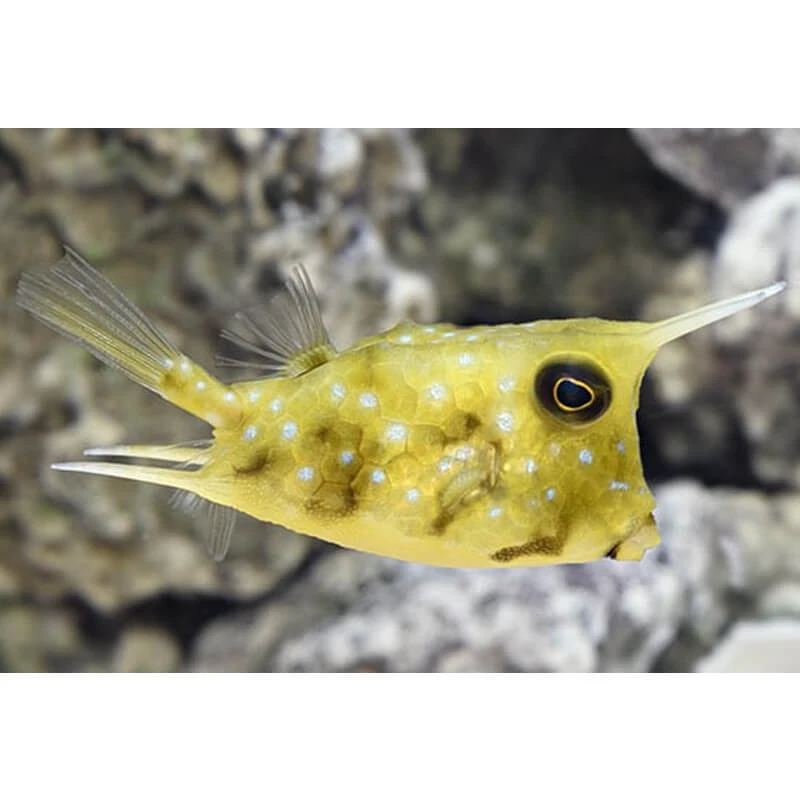
The Longhorn Cowfish (Lactoria cornuta) is one of those fish that genuinely stops people mid-scroll. Those unmistakable horn-like projections extending from above the eyes, the boxy armored body, the slow deliberate fin movements, and the almost comical waddle through the water column make it one of the most distinctive animals in the entire marine aquarium hobby. But behind that charming exterior is a fish that demands real preparation, genuine commitment, and above all, a healthy quarantined specimen from a source you can trust. Dr. Reef’s Quarantined Fish is that source, and this guide will walk you through everything you need to know before bringing one home.
What Is the Longhorn Cowfish?
The Longhorn Cowfish belongs to the family Ostraciidae, the same boxfish family that includes the Cubicus Boxfish and the Blue Boxfish, though it sits in its own genus Lactoria. The defining feature of this species is the pair of long rostral horns projecting forward from above the eyes and a second pair of shorter horns near the base of the tail, giving the fish its bovine nickname. The body itself is encased in a rigid bony carapace, similar to all members of the family, with only the fins, eyes, mouth, and tail free to move.
Wild Longhorn Cowfish are found across the Indo-Pacific, from the Red Sea and East Africa through to Japan and Australia, typically inhabiting sandy lagoons, seagrass beds, and sheltered reef slopes at depths ranging from just below the surface to around 50 meters. In these environments they move slowly across the substrate, picking at sponges, small crustaceans, worms, and other benthic invertebrates with a distinctive puffing jet of water from their mouth to expose buried prey.
Coloration in the Longhorn Cowfish is variable but typically involves a yellow to olive-brown base covered in blue or white spots and reticulations. Some individuals display more vivid yellow tones, particularly younger fish, while adults can develop more complex blue-grey patterning over time. The horns themselves are generally pale or whitish and can reach impressive lengths on mature specimens.
How Large Do Longhorn Cowfish Get?
This is a question every prospective buyer needs to take seriously. In the wild, Longhorn Cowfish can reach up to 20 inches in total length. In aquarium conditions with proper care, specimens regularly reach 12 to 16 inches, sometimes more. Juveniles available for sale are often only 2 to 4 inches long, which can give a misleading impression of how much space this fish will ultimately require.
Buying a Longhorn Cowfish without planning for its adult size is one of the most common mistakes new keepers make. Growth rate depends on feeding, water quality, and tank size, but this is not a fish that stays small. Planning for a fully grown adult from day one is the only responsible approach.
The Ostracitoxin Risk: What Every Buyer Must Know
No article about Longhorn Cowfish would be complete without an honest discussion of ostracitoxin. Like all members of the Ostraciidae family, the Longhorn Cowfish is capable of releasing a potent skin toxin called ostracitoxin when severely stressed or at the point of death. This mucus-based substance disperses rapidly through a closed aquarium system and can kill every fish and invertebrate in the tank within hours.
This is not a rare edge-case scenario. It is a well-documented reality of keeping this species, and it is the single biggest reason why the condition and history of your specimen at the point of purchase matters so much. A Longhorn Cowfish that has been subjected to rough handling, poor shipping conditions, starvation, or disease during transit is a significantly higher toxin risk than one that has been properly quarantined, fed consistently, and allowed to settle into captive life before reaching your display tank.
At Dr. Reef’s Quarantined Fish, every Longhorn Cowfish is held through a structured quarantine period before being made available for sale. During this time each fish is observed for behavioral stability, monitored for disease, and confirmed to be feeding reliably on prepared foods. This process does not eliminate all risk, no responsible seller would claim that, but it reduces it dramatically. A settled, healthy, eating Longhorn Cowfish is a manageable and rewarding animal. A stressed, compromised one is a liability.
Tank Size Requirements
Given the adult size of the Longhorn Cowfish, tank size requirements are among the most demanding of any commonly kept marine fish. A minimum of 150 gallons is the starting point for a single adult specimen, and larger is genuinely better both for the fish’s wellbeing and as a dilution buffer in the unlikely event of a toxin release. The tank footprint matters as much as total volume: a long, wide aquarium gives the cowfish room to move naturally, as these fish patrol broad areas in the wild and do not thrive in tall, narrow tanks with limited horizontal swimming space.
Juvenile specimens can be housed in smaller systems temporarily, but this should always be viewed as an intermediate arrangement. Committing to a Longhorn Cowfish means committing to the tank size its adult form will require, ideally from the beginning.
Water Flow and Filtration
Longhorn Cowfish are not built for turbulent water. The rigid carapace and fin-based propulsion system that make them such distinctive swimmers also make them poorly equipped to handle strong, chaotic flow. Powerheads and wavemakers should be positioned to create gentle, broad circulation rather than direct high-velocity jets. The goal is consistent water turnover and oxygenation without creating currents the fish has to actively fight.
Filtration needs to be robust. A sump-based system with a quality protein skimmer and adequate biological filtration capacity is strongly recommended. Given the toxin risk, having excellent water processing capability is not only good husbandry practice but also provides the best possible chance of surviving a minor toxin event without catastrophic losses. The larger the biological buffer your system carries, the better positioned you are.
Water parameters should remain stable at all times. Target salinity of 1.025 to 1.026 specific gravity, temperature between 72 and 78 degrees Fahrenheit, and ammonia and nitrite permanently at zero. Longhorn Cowfish are more sensitive to ammonia spikes than many commonly kept marine fish, and even brief excursions in water quality can trigger the stress response that elevates toxin risk.
Tank Setup and Decor
A well-designed Longhorn Cowfish tank balances open swimming space with shelter options. These fish appreciate caves, overhangs, and recesses in the rockwork where they can retreat when they want to rest or feel secure. At the same time, overly dense aquascaping limits their ability to move naturally and can create dead spots in water circulation.
A sandy substrate suits the Longhorn Cowfish well, reflecting its natural habitat and giving it a surface to interact with during feeding. Live rock provides biological filtration and natural grazing opportunities, though the cowfish should not be expected to subsist on what it can find in the rockwork. Active, regular feeding of prepared foods is essential.
Compatibility: Tankmates and Reef Safety
The Longhorn Cowfish is not reef-safe in the traditional sense. It is well known for nipping at soft corals, clam mantles, tubeworms, small crustaceans, and other invertebrates, and should not be housed in a system where these animals are valued. A fish-only with live rock setup is the most appropriate environment for long-term success.
Tankmate selection requires careful thought. The toxin risk means that any animal sharing a tank with a Longhorn Cowfish is potentially vulnerable in a worst-case scenario, so stocking choices should be made with that in mind. Avoid housing the cowfish with aggressive, nippy, or harassing species that might stress it. Calm, larger fish such as tangs, angelfish, larger wrasses, and similarly sized non-aggressive species can work in a well-planned system. Do not house a Longhorn Cowfish with other boxfish species unless the tank is exceptionally large and introductions have been managed very carefully.
The cowfish itself is generally not aggressive toward tankmates and is more likely to be the victim of bullying than the instigator. Protecting it from harassment is one of the most important aspects of compatible stocking.
Feeding the Longhorn Cowfish
In the wild, Longhorn Cowfish are active and varied predators of benthic invertebrates, using a jet of water expelled from their mouth to uncover buried prey. In captivity, a similarly varied diet produces the best results. High-quality frozen foods including mysis shrimp, brine shrimp, chopped seafood, and marine-based prepared blends form the core of a good captive diet. Sponge-based foods formulated for boxfish and similar species are a valuable supplement given the natural reliance on sponge material in the wild diet.
Feeding small amounts multiple times per day mirrors the natural grazing behavior of the species and tends to produce better feeding responses than one large daily meal. Many keepers find that Longhorn Cowfish become enthusiastic and responsive feeders once settled, approaching the glass and tracking the keeper’s movements at feeding time. This responsiveness is one of the most endearing traits of the species and a clear sign of a healthy, settled animal.
One of the most important things to verify before purchasing any Longhorn Cowfish is that it is already eating prepared foods. At Dr. Reef’s Quarantined Fish, this is confirmed during the quarantine period. A fish that is not eating is a fish under stress, and a stressed Longhorn Cowfish is not an animal you want to introduce to your display tank.
Why Quarantine Is Non-Negotiable for This Species
The combination of stress sensitivity, toxin risk, and the disease susceptibility common to many wild-caught marine fish makes quarantine more important for Longhorn Cowfish than for almost any other commonly available species. Ich (Cryptocaryon irritans) and marine velvet (Amyloodinium ocellatum) are both documented in this species, and treating either condition in a display tank is complicated by the same toxin risk that makes cowfish handling such a careful process.
Treating these parasites in a separate quarantine tank, before the fish ever enters your display system, is the only approach that does not put your existing livestock at risk. Dr. Reef’s Quarantined Fish conducts exactly this kind of proactive health management, monitoring each specimen throughout their holding period and addressing any concerns before the fish is offered for sale.
The information Dr. Reef’s provides about each individual fish, including quarantine duration, feeding history, and any observations made during the holding period, gives buyers a level of confidence that simply cannot be matched by purchasing from a source with no quarantine protocol.
What to Expect When Your Longhorn Cowfish Arrives
Even a healthy, quarantined Longhorn Cowfish will need time to settle into a new environment. Drip acclimation over 60 to 90 minutes is strongly recommended to account for any differences in temperature, salinity, and pH between the shipping water and your display tank. Keep the lights off or dimmed for the first several hours after introduction, and avoid disturbing the tank while the fish explores its new surroundings.
Do not be alarmed if the fish does not eat on the first day or two. A brief period of adjustment is normal. If the fish has not resumed feeding within four to five days of arrival, that warrants closer attention. A fish sourced from Dr. Reef’s established quarantine process is far more likely to settle quickly and resume feeding reliably than one that has not had the benefit of that preparation.
Pricing and Value
Properly quarantined Longhorn Cowfish carry a higher price point than specimens shipped directly from wholesale sources, and for good reason. The time, expertise, and resources invested in the quarantine process are reflected in the cost, and that investment translates directly into a healthier, more stable animal with a dramatically better chance of long-term survival in your care.
When you factor in the potential cost of losing tankmates to a toxin event caused by a stressed, unquarantined specimen, the economics become straightforward. Purchasing a properly quarantined Longhorn Cowfish from Dr. Reef’s Quarantined Fish is not a premium. It is the responsible baseline.
Is the Longhorn Cowfish Right for You?
If you have a large, established fish-only system with calm, compatible tankmates, the experience to manage a species with unique risks, and the commitment to long-term care for an animal that may live a decade or more in captivity, the Longhorn Cowfish is one of the most rewarding fish the marine hobby has to offer. Its personality, interactivity, and sheer visual novelty make it a genuine centerpiece animal.
If you are newer to the hobby, working with a smaller tank, or maintaining a reef with valued corals and invertebrates, there are better starting points. Come back to the Longhorn Cowfish when your setup and experience level are genuinely ready for it.
When that time comes, Dr. Reef’s Quarantined Fish is where the journey should start.