
Blue Sided Fairy

Blue Sided Fairy Wrasse for Sale – A Vibrant and Peaceful Wrasse for Well-Established Reef Systems
The fairy wrasses of the genus Cirrhilabrus are widely and correctly regarded as some of the best fish available for the reef aquarium: small enough for a range of system sizes, peaceful enough for most community setups, active enough to animate the mid-water column continuously, and colorful enough to anchor visual attention throughout the day. Within that already outstanding genus, the Blue Sided Fairy Wrasse (Cirrhilabrus cyanopleura) occupies a distinctive position. Its coloration is variable by location, sex, and mood in a way that makes individual specimens genuinely unique, and a male in full courtship display produces a color intensity that few fish of any size or price can match under modern reef lighting.
At Dr. Reef’s Quarantined Fish, every Blue Sided Fairy Wrasse we offer has completed our full quarantine protocol and is confirmed eating prepared foods before being made available. Fairy wrasses can be sensitive during the initial settling period, and our quarantine process establishes the stable foundation that gives each fish the best possible start in its new home.
The Visual Appeal of the Blue Sided Fairy Wrasse
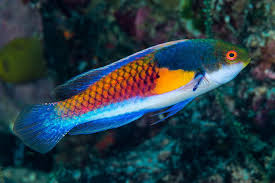
The Blue Sided Fairy Wrasse presents a color palette that shifts considerably depending on the fish’s origin, sex, age, and current mood. Males carry the most intense coloration: a reddish-maroon body suffused with vivid blue-violet scaling along the sides and flanks, with a pale underside that creates a dramatic contrast between the dark upper and lighter lower body. Some locale variants express additional orange or yellow patches behind the pectoral fins, adding further complexity to a color pattern that already rewards extended observation. Females are more subdued in pattern but still attractive, with a lighter red along the dorsal surface and a softer purplish suffusion where the male carries deeper blue.
The male’s colors intensify visibly during courtship and dominance displays, shifting from their resting pattern toward a more saturated, almost electric version of themselves as the fish erects its fins and performs for females or asserts itself toward competing males. In a well-lit reef system, these display moments are among the most visually rewarding things a small fish can produce.
The species reaches approximately 5 to 6 inches at full adult size, a size that gives it real presence in the display while remaining appropriate for a wide range of system sizes.
Tank Requirements and Care
The Blue Sided Fairy Wrasse should be kept in an established aquarium of at least 90 gallons, with generous open swimming space in the mid-water column balanced against complex rockwork that provides defined shelter zones, resting crevices, and visual territory breaks. This is an active, perpetually moving fish that covers the tank continuously throughout the day, and the system needs to provide enough space for that movement to feel natural rather than compressed.
A sandy substrate is important. Blue Sided Fairy Wrasses sleep by burrowing into or resting near the substrate under a self-secreted mucus cocoon, a behavior shared across the Cirrhilabrus genus. Without sand available, the fish cannot complete this natural resting behavior and will be chronically stressed. A tightly fitting lid is essential. Fairy wrasses are accomplished jumpers that can clear small gaps with accuracy when startled, and the investment in a secure cover is non-negotiable.
Water parameters should be maintained at 75 to 80 degrees Fahrenheit, salinity at 1.025 to 1.026 SG, and pH between 8.1 and 8.4. The species performs best in stable, well-established water chemistry rather than systems that are still cycling through early fluctuations.
Feeding the Blue Sided Fairy Wrasse
The Blue Sided Fairy Wrasse is a carnivore that accepts a varied diet of frozen mysis shrimp, enriched frozen brine shrimp, copepods, and amphipods. It will also take quality flake and pellet foods once properly acclimated. Feed multiple small portions daily rather than one or two large offerings, as this is an active, high-metabolism fish that benefits from continuous access to small food items throughout the day. A refugium producing a steady supply of copepods supplements frozen feeding and supports the fish’s natural hunting behavior during the hours between scheduled feedings.
Reef Compatibility and Tank Mates
The Blue Sided Fairy Wrasse is fully reef-safe with respect to corals and sessile invertebrates. It will not disturb coral polyps, anemones, or rock structures, making it an unconditionally safe choice for any coral-focused display. The one compatibility caveat that applies to this and most Cirrhilabrus species is with small ornamental shrimp and crustaceans, which the wrasse may view as prey. Cleaner shrimp of adequate size are generally left alone, but small ornamental shrimp species are at risk.
As a community fish, the Blue Sided Fairy Wrasse is peaceful toward the broad majority of unrelated species. It integrates well alongside clownfish, cardinalfish, gobies, dartfish, anthias, and other peaceful reef inhabitants. It can be kept in schools of four or more individuals in larger systems, where the social dynamics of a mixed-sex group produce the most frequent and impressive display behavior from the male. When keeping multiple Cirrhilabrus species together, introduce them simultaneously to prevent any single individual from claiming the entire tank as exclusive territory. Add the largest or most dominant males last to minimize aggression during establishment.
Avoid housing with aggressive, fast-moving, or predatory species that will stress or outcompete this peaceful wrasse. In a calm, well-balanced community built around compatible temperaments, the Blue Sided Fairy Wrasse is a long-lived, consistently beautiful, and endlessly active addition that rewards the aquarist every time the lights come on.
Browse our current Blue Sided Fairy Wrasse availability at Dr. Reef’s Quarantined Fish and add a properly quarantined, confirmed-feeding specimen to a system that is ready to showcase it properly.