
Red Coris Wrasse

How Do Tank Requirements and Compatibility Change as a Red Coris Wrasse Matures from Juvenile to Adult?
Few fish in the marine hobby undergo a transformation as dramatic as the Red Coris Wrasse (Coris gaimard). The juvenile and adult forms look so different from one another that they are regularly mistaken for entirely separate species by aquarists unfamiliar with the fish’s development. What begins as a compact, orange-bodied fish covered in black-edged white saddles evolves, over the course of months and years, into a large, powerful, speckled blue-green fish with a vivid yellow tail, orange and green-striped face, and the muscular, authoritative presence of a predator that has fully grown into its role. That transformation is not just visual. The tank requirements, dietary needs, compatibility considerations, and reef suitability of the Red Coris change fundamentally as the fish matures, and aquarists who do not anticipate those changes often find themselves unprepared when the fish they thought they understood becomes something quite different.
The Juvenile Stage: Appearance and Initial Requirements
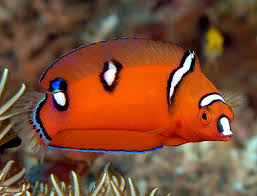
Juvenile Red Coris Wrasses have a bright red to orange body with several large white saddles along the dorsal surface, each outlined in black, and a clear caudal fin that has not yet developed the characteristic yellow of the adult. The pattern is striking and eye-catching, and combined with a compact size of one to three inches at purchase, makes the juvenile a visually appealing fish that is easy to underestimate.
Even at the juvenile stage, the Red Coris Wrasse has specific requirements that make it unsuitable for very small or newly established systems. A minimum tank size of 75 gallons with a deep, fine sand substrate of at least four to five inches is the starting point for a juvenile. This sand depth is not optional. Like all members of the Coris genus, the Red Coris Wrasse buries itself completely in the sand at night to sleep and will dive into the substrate immediately when frightened during the day. Without sufficient sand depth for this behavior, the fish cannot complete its natural sleep cycle and will be chronically stressed.
At this stage, the juvenile’s temperament is relatively passive. Young fish are generally peaceful toward unrelated species and may even occasionally perform cleaning behavior on other fish, picking at parasites and dead tissue. They require multiple feedings per day due to their high metabolism, and very small juveniles under two inches are genuinely fragile, often refusing food after the stress of collection and shipping. Purchasing juveniles in the sub-adult range, already established on prepared foods, is significantly more reliable than acquiring the smallest available specimens.
The Transition: What Changes as the Fish Grows
The Red Coris Wrasse begins losing its juvenile white saddle markings as it grows, gradually replacing them with the blue-spotted, speckled patterning of the adult phase. The caudal fin begins taking on yellow, the face develops alternating orange and green stripes, and the body elongates and deepens. By the time the fish reaches four to six inches, it looks substantially different from the juvenile sold at one to two inches, and by full adult size the resemblance to the juvenile phase is minimal.
The behavioral changes accompanying this physical transformation are equally significant. Adults become progressively more assertive, more territorial, and more destructive in their hunting behavior. An adult Red Coris Wrasse regularly flips over coral rubble, dislodges rock pieces, and excavates the substrate while hunting for crustaceans and mollusks, behaviors that are absent or minimal in juveniles. This active, physically disruptive foraging is natural to the species but incompatible with a carefully arranged reef display.
Adult Tank Requirements
A fully grown adult Red Coris Wrasse requires a minimum system of 125 gallons, with many experienced keepers recommending 150 gallons or more to accommodate the fish’s size, activity level, and foraging behavior. The deep sand substrate requirement remains in place regardless of the fish’s age, and the aquascape needs to account for the adult’s tendency to rearrange it. Lightweight coral frags and unstably positioned rocks will be moved or knocked over. Rockwork in an adult Red Coris system needs to be substantially anchored or deliberately arranged with the expectation of disturbance.
A tightly fitting lid is essential at every stage. Red Coris Wrasses are known jumpers, and the risk is present from juvenile through adult. Two feedings per day of meaty preparations including mysis shrimp, krill, clams, mussels, and chopped seafood will maintain the adult fish’s condition and color. Soaking foods in a quality vitamin and fatty acid supplement is worthwhile given the species’ high metabolic demands.
Reef Compatibility: A Fundamental Shift
Perhaps the most important change aquarists need to anticipate is the shift in reef compatibility between juvenile and adult. A juvenile Red Coris Wrasse kept in a reef tank with caution and monitoring can sometimes coexist with the reef environment, though even juveniles will eat ornamental shrimp, feather duster worms, small crabs, and other invertebrates. As the fish matures into adulthood, reef compatibility becomes essentially untenable. Adults consume virtually all small invertebrates, physically disturb corals through their foraging, and should be considered fish-only or fish-only-with-live-rock inhabitants rather than reef fish.
Aquarists who purchase a juvenile Red Coris for a reef system need to plan for this transition from the outset, either with a separate grow-out system for the adult or with the understanding that the fish will eventually need to move.
Compatibility with Other Fish
The Red Coris Wrasse generally coexists well with unrelated species of similar or larger size as an adult. It should not be housed with small, passive fish that could be harassed or intimidated, and two male Red Coris Wrasses in the same system will conflict. Suitable adult tank mates include larger tangs, substantial angelfish, robust hawkfish, and larger grouper species that can hold their own in a community where the wrasse asserts its position with confidence.
The Red Coris Wrasse is a fish of genuine spectacle at every stage of its life, but it is a fish that requires planning and adaptability from the aquarists who choose it. Understanding what it will become is as important as appreciating what it is when first purchased.