
Valentini Puffer Care

Valentini Puffer Care: Diet, Tank Setup, and Behavior
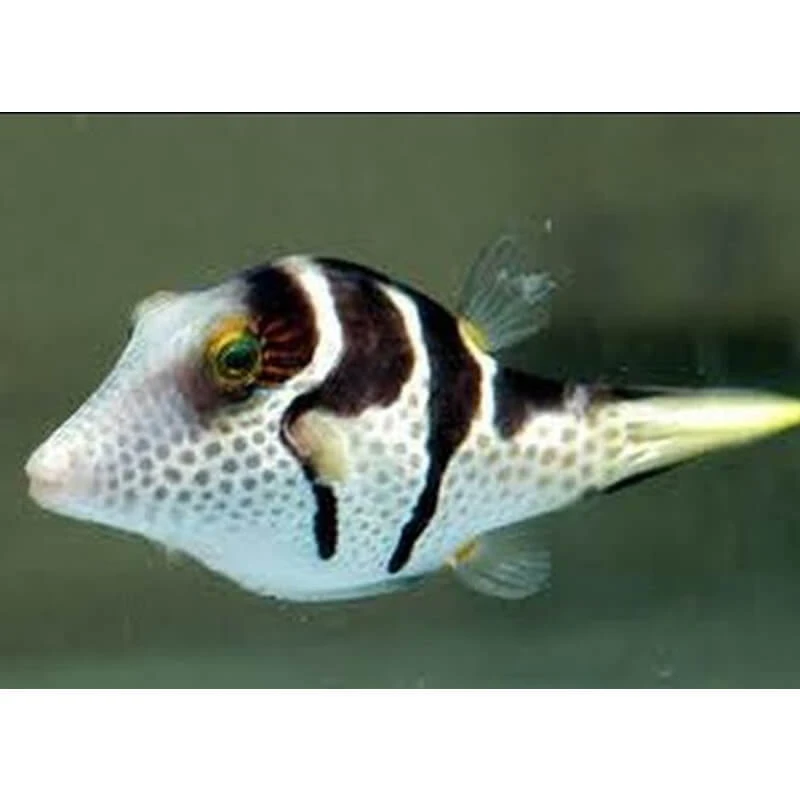
The Valentini Puffer (Canthigaster valentini) is one of the most personable and visually distinctive fish available in the saltwater hobby. Also known as the Black Saddle Puffer, Saddled Toby or Sharpnose Puffer, it stands out with its white body, dark brown saddle-like bands across the back, blue facial markings and vivid yellow tail. At around 4 inches as an adult, it is a far more practical choice than the large puffer species that require hundreds of gallons, while still delivering everything hobbyists love about pufferfish in personality and appearance.
Tank Setup
A minimum tank size of 30 gallons is recommended for a single Valentini Puffer. The aquarium should include plenty of live rock with crevices and caves, giving the fish territory to explore, claim and retreat to when resting. Open swimming space should also be maintained alongside the rockwork. Water parameters should be stable at temperature 72 to 78°F, pH 8.1 to 8.4 and specific gravity 1.020 to 1.025. Strong filtration is important because Valentini Puffers are messy eaters that produce significant waste. A protein skimmer and regular water changes are essential to keep nitrates in check.
Only one Valentini Puffer should be kept per tank. They are highly intolerant of their own kind and will fight with other Canthigaster species. Transfer this fish using a container of water rather than a net, as netting can cause the fish to gulp air while inflating, which is harmful and difficult to reverse.
Diet
The Valentini Puffer is a carnivore requiring a varied diet of meaty foods. Offer frozen mysis shrimp, frozen brine shrimp, krill, chopped squid, mussel and clam. Feed small portions once or twice daily, only what the fish can consume within a few minutes. One of the most critical dietary considerations unique to pufferfish is dental health. Their beak-like teeth grow continuously and must be worn down regularly through hard foods. Offer hard-shelled foods such as snails, whole shell-on shrimp or clams on the half shell two to three times per week. Failure to include hard foods leads to tooth overgrowth, which impairs eating and eventually requires manual trimming under sedation, a stressful procedure best avoided through prevention.
Behavior
The Valentini Puffer has a personality that consistently earns it a devoted following among hobbyists. It is an active, curious swimmer that investigates every corner of its tank and learns to recognize its keeper at feeding time. Many owners report that their Valentini will swim to the front of the glass when they approach, an endearing and interactive quality. When threatened it can inflate its body slightly, and it is capable of releasing a toxin called tetrodotoxin into the water under extreme stress, which is one reason it should be transferred carefully and never kept with fish that might harass it relentlessly.
The Valentini Puffer is semi-aggressive. It coexists reasonably well with larger, robust fish such as tangs, larger wrasses and angelfish, but should not be kept with small or slow-moving fish that could be bullied or nipped. It will consume ornamental shrimp, crabs and snails, and may nip at fleshy LPS corals if hungry, making it a fish best suited to a FOWLR system rather than a full reef tank.
When sourcing a Valentini Puffer, look for an active specimen with clear eyes and a full body. Dr. Reef’s Quarantined Fish ensures every fish is quarantined and confirmed eating before reaching your system, which is particularly important for pufferfish given their sensitivity to shipping stress.