
Rock Beauty Angelfish
$249.99
Holacanthus tricolor
| Care Level | Expert |
| Temperament | Semi-aggressive |
| Color Form | Bright yellow head and tail with black body |
| Diet | Omnivore |
| Reef Compatible | Not reef-safe |
| Water Conditions | sg 1.020–1.025, 72–82°F, pH 8.1–8.4 |
| Max Size | 14″ |
| Family | Pomacanthidae |
| Minimum Tank Size | 125 gallons |
3-Day Guarantee
Approximate Purchase Size: Small: 1-2.5″; Medium: 2.5-3.75″; Large: 4-5″
Rock Beauty Angelfish
Also known as the Rocky Beauty, Yellow Nanny, Rock Beasty, Corn Sugar, or Coshubba
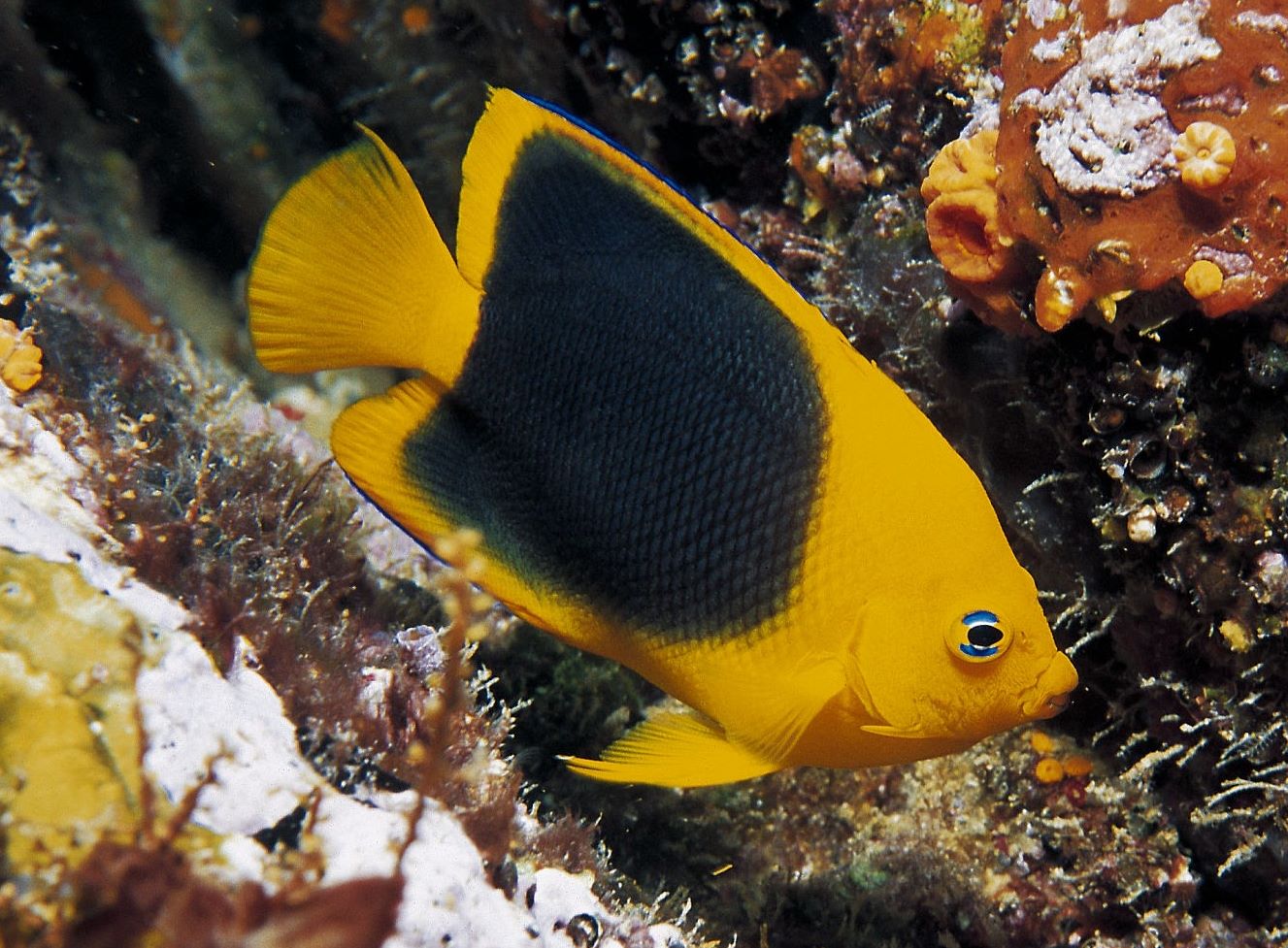
The Rock Beauty Angelfish is one of the most striking and recognizable angelfish species, known for its dramatic contrasting coloration of bright yellow head and tail with a bold black body. Native to the tropical Western Atlantic Ocean, this elegant species is the most common large angelfish on Caribbean and Western Atlantic reefs. However, its stunning beauty comes with significant care challenges, the Rock Beauty has one of the most specialized diets among marine angelfish, requiring substantial amounts of sponges to maintain long-term health and immune system function.
Key Features
- Scientific Name: Holacanthus tricolor
- Common Names: Rock Beauty Angelfish, Rocky Beauty, Yellow Nanny, Rock Beasty, Corn Sugar, Coshubba
- Adult Size: Up to 8 inches (20 cm) in captivity; can reach 14 inches (35 cm) in the wild
- Lifespan: 10–20 years with proper care
- Temperament: Semi-aggressive; territorial but easily bullied
- Reef Compatibility: Not reef-safe – will nip at soft corals, stony polyp corals, sessile invertebrates, and clam mantles
- Minimum Tank Size: 100–125 gallons (for 3-4 inch specimens); larger tanks for adults
- Experience Level: Expert only
Habitat & Tank Requirements
- Tank Environment: Requires an XXL mature, well-established tank (6+ months old) with an abundance of live rock for continuous grazing on sponges, tunicates, zoanthids, and algae. Provide plenty of caves, rocky crevices, and hiding places that mimic natural rock jetties and coral reef habitats. The aquarium should be extra wide as well as lengthy to accommodate extensive live rock while maintaining open swimming space.
- Water Parameters:
- Temperature: 72–82°F (22–28°C)
- Salinity: 1.020–1.025
- pH: 8.1–8.4
- Nitrates: Keep as close to zero as possible
- Aquascape: Extensive live rock, preferably from the Western Atlantic, is absolutely essential, not just for aesthetics but for survival. Live rock provides ongoing grazing opportunities on sponges and allows the fish to carry out natural browsing behavior. Macro-algae growth should be strongly encouraged. A fishless refugium can be utilized to grow suitable foodstuffs (sponges, tunicates) on small pieces of live rock, rotating them into the main tank regularly.
- Compatibility: Despite its size, this species is easily bullied and timid compared to other Holacanthus species. Tankmates must not be aggressive, do not house with triggers or other aggressive species. Should not be combined with other marine angelfish (including members of its own species) due to territorial aggression. Deaths can easily occur from angelfish conflicts. Keep only one Rock Beauty per tank. Best added first to establish territory. Compatible with peaceful, similar-sized fish that are not boisterous feeders.
Diet & Feeding
The Rock Beauty’s specialized diet is the primary reason this species is considered extremely difficult to keep:
- Natural Diet: Primarily sponges (65%+ of diet), supplemented by tunicates, zoantharians, bryozoans, gorgonians, algae, and occasionally corals. Larvae feed on plankton. Juveniles may nibble slime coats from eels and other fish.
- Critical Dietary Requirements: This species MUST receive foods containing sponges to maintain a strong immune system. Specimens that do not receive a proper diet may appear to feed well initially but will gradually fade away after a few months due to lack of proper nutrition.
- Captive Diet:
- Specialty Items: High-quality angelfish preparations containing sponge matter (absolutely essential, now available from several manufacturers specifically for angelfish)
- Meaty Foods (up to 35% of diet): Mysis shrimp, vitamin-enriched brine shrimp, finely chopped clams, oysters, mussels, prawns, squid, krill
- Plant Matter: Marine algae, spirulina, nori sheets, dried seaweed, macro-algae
- Natural Foods: Sponge and sea squirt products (sometimes available at oriental shops or health food stores for human consumption)
- Feeding Schedule: Feed small portions multiple times per day (3-5 times daily). Avoid too protein-rich foods as this prevents adequate vitamin A absorption. Remove uneaten food promptly to maintain water quality.
- Feeding Challenges: The fish has a powerful beak-like mouth with sharp outer teeth and spends most of its time searching for food. Providing a continuous supply of natural browsing opportunities on live rock is critical.
Notes & Considerations
- Appearance Details: Adults display a dramatic oblong, flat, deep body that is predominantly black (especially on the back half) with a bright yellow head, front portion of the body, and completely yellow caudal fin. The eyes feature striking sapphire-blue accents, and the outer perimeters of the anal and dorsal fins are darker blue. The front edge of the anal fin and gill cover edge are orange. Black lips may be present in some adults.
- Juvenile Coloration: Juveniles initially have a rounder body that is predominantly bright yellow with a large black spot ringed in blue toward the top rear of the flanks near the caudal peduncle. As they mature (3-4 inches is ideal acquisition size), the black spot gradually enlarges and spreads throughout the body, overwhelming the yellow coloration except for the head, area just behind the head, and caudal fin. The blue ring disappears as the fish matures.
- Size Selection Critical: Choose specimens that are 3-4 inches—neither too small nor too large. Tiny specimens and full adults tend to be reluctant feeders and do not cope well with the stress of capture and transport. Males are typically larger than females.
- Behavioral Traits: More timid than other Holacanthus species and can be easily stressed. Very territorial and rarely ventures more than a few feet from protective shelter. Does not participate in cleaning station activities with cleaner wrasses or shrimp (unlike other large angelfish). In captivity, juveniles may nibble and nip at other tankmates—this is a natural response from their wild diet of eating slime from eels and other fish.
- Social Structure: In the wild, found in pairs or small harems consisting of 1 male with 2-5 females defending territories. This species is a protogynous hermaphrodite, all are born female with the ability to change to male during spawning. Males and females are not visually distinguishable (not sexually dichromatic).
- Dealer Verification Essential: NEVER purchase a Rock Beauty that will not eat. Check with your dealer that the fish is feeding well on correct foods (specifically sponge-based preparations) and ask to see this demonstrated. The fish should appear bright, inquisitive, and healthy, not hovering, breathing heavily, or showing signs of stress.
- Survival Statistics: This species has one of the worst survival records in captivity among marine angelfish. Easily half are lost within a month of capture in the wild, primarily due to lack of acceptable food and collection/shipping trauma.
- Health Sensitivity: Extremely sensitive to water quality and vulnerable to parasitic attack (especially cryptocaryon/marine ich). Requires pristine water conditions with stable parameters. Can be easily stressed—keep in low-traffic, quiet areas of the home. Swim bladders sometimes get damaged during collection—ensure fish can remain still in water without needing to swim downwards to avoid rising to the surface.
- Reef Incompatibility: Not reef-safe. Will consume sponges (which are incompatible with most reef setups), and nip at soft corals, stony corals, zoanthids, clam mantles, and sessile invertebrates.
- Breeding: Has not been bred in captivity. Reproduction occurs by spawning, usually at dusk or night. Parents do not care for offspring. When larvae settle to the ocean floor at 3-4 weeks old, they are approximately 15-20mm in length.
- Geographic Range: Found from Georgia, USA, to Bermuda, through the northern Gulf of Mexico, and down to Rio de Janeiro and Santa Catarina in Brazil. Depth range: 3-92 meters (10-300 feet). Inhabits rocky reefs, rock jetties, and environments with prolific coral growth. Non-migratory species.
- Conservation Status: Listed as Least Concern (LC) by the IUCN. This is the most common large angelfish species among tropical Western Atlantic reefs. Also marketed fresh as a food fish, though consumption has been linked to ciguatera poisoning.
- Biotope Recommendation: For best results, create a biotopic shallow tropical West Atlantic presentation/setup. Culture the animal’s living foodstuffs in a refugium system.
Why Choose a Quarantined Rock Beauty Angelfish?
Our quarantined Rock Beauty Angelfish are carefully checked, monitored, and prepared before sale. We choose only mid-sized fish (3-4 inches) that are healthy and eating well, especially sponge-based foods important for their health. They are kept in mature tanks with live rock and sponge growth to ensure proper nutrition. This helps them arrive healthy, parasite-free, and ready to thrive in your tank. Our quarantine process makes sure you get a strong, healthy fish that can live happily for a long time.
| Service Level | Quarantined |
|---|
You must be logged in to post a review.
Related products
Achilles Tang
Price range: $549.99 through $649.99
Chromis
Price range: $19.99 through $39.99
Flame Hawkfish
$99.99
Midas Blenny
$99.99
Moorish Idol
$179.99
Nassarius Snail Large
Price range: $19.99 through $69.99
Reviews
There are no reviews yet.