
Pintail Fairy Wrasse

Pintail Fairy Wrasse: Care Guide and Tank Compatibility
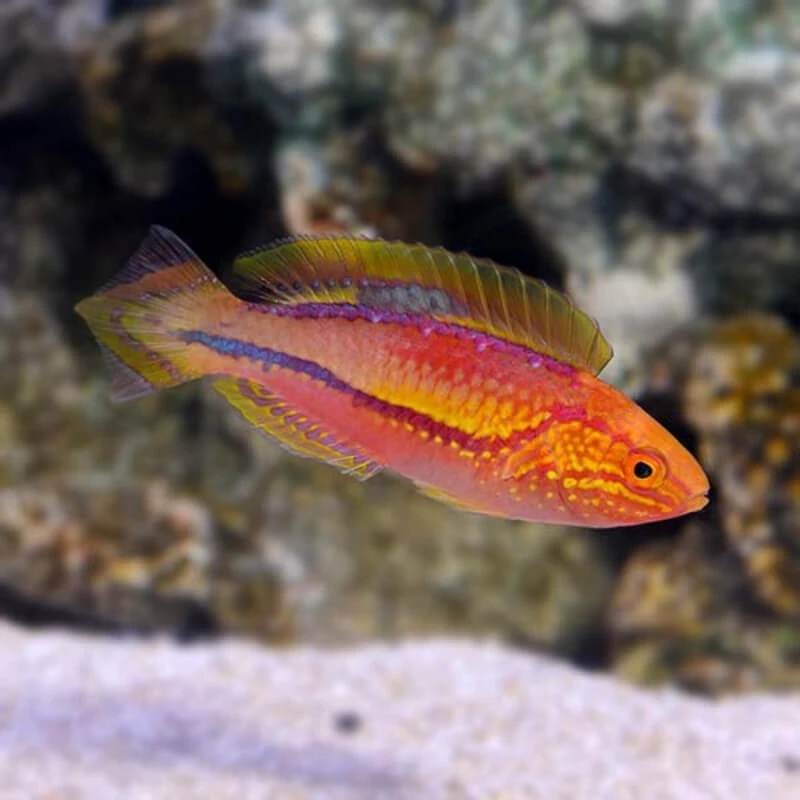
Among the many species in the Cirrhilabrus fairy wrasse genus, the Pintail Fairy Wrasse (Cirrhilabrus isosceles) occupies a special position. Once rarely available and formerly known in the hobby as C. cf. lanceolatus, it was formally described and named isosceles in recognition of the distinctive triangular shape formed by its characteristic elongated tail. It is one of the most elegant and sought-after fairy wrasses in the hobby, combining spectacular coloration with a relatively peaceful temperament that makes it a prized addition to mixed reef wrasse collections.
Natural Habitat
The Pintail Fairy Wrasse is collected primarily from the northern Philippines. In the wild it inhabits deeper lagoon and reef environments, typically found at moderate depths where it swims in small groups among coral rubble, soft coral and rocky structures. Its relatively limited collection area contributes to its periodic scarcity in the aquarium trade, and availability can vary significantly between seasons.
Appearance and Sexual Dimorphism
The Pintail Fairy Wrasse displays the pronounced sexual dimorphism characteristic of the Cirrhilabrus genus. Males are the show-stopper of the pair, displaying a spectacular purple-violet body with red markings, yellow accents and the signature elongated pintail that extends from the caudal fin and gives the species both its common name and scientific designation. During courtship and social display, males intensify these colors dramatically, producing a flashing behavior that is one of the most visually compelling displays available from any reef fish.
Females display a more subdued coloration, typically pink to peach tones, and are noticeably smaller. As with all Cirrhilabrus wrasses, this species is a protogynous hermaphrodite, and individuals will transition from female to male given the right social conditions. In smaller tanks with multiple individuals, all females may eventually transition to male, which can lead to conflict.
Tank Requirements
A minimum of 90 gallons is recommended for a single Pintail Fairy Wrasse, with larger systems providing more space for natural swimming behavior and social display. The aquarium should be well-established with abundant live rock providing caves, overhangs and visual breaks, along with open swimming areas in the mid and upper water column where this species spends most of its active time.
A fully gapless, secure lid is essential without exception. Fairy wrasses in the Cirrhilabrus genus are renowned jumpers, and the Pintail is no different. Many hobbyists have lost specimens through small gaps in eggcrate tops or around equipment openings. Treating lid security as a primary setup requirement rather than an afterthought is strongly advised.
Standard reef water parameters apply: temperature 72 to 78°F, pH 8.1 to 8.4, specific gravity 1.020 to 1.025. Moderate water flow and stable, well-oxygenated water suit the species well.
Diet
The Pintail Fairy Wrasse is a carnivore that feeds on small planktonic invertebrates in the wild. In the aquarium it accepts a variety of prepared foods readily once settled. Offer vitamin-enriched frozen mysis shrimp, frozen brine shrimp, high-quality marine pellets and flake food formulated for carnivores. Feed multiple small portions per day to support the high metabolic rate of this active species. A well-fed Pintail displays its best coloration and shows the most active courtship flashing behavior.
Tank Compatibility
The Pintail Fairy Wrasse is one of the more peaceful members of the Cirrhilabrus genus and is generally placed in the lower aggression tier of the fairy wrasse compatibility spectrum. It can be kept with flasher wrasses such as Paracheilinus species, and with a range of other Cirrhilabrus species that fall outside its own complex group, provided the tank is large enough and fish are introduced simultaneously or with an acclimation box.
The critical rule is that only one male should be kept per system. Two males of the same or closely related fairy wrasse species will almost invariably fight, often seriously. A single male with one or several females introduced at the same time is the ideal social structure for this species. Add the male last or simultaneously with other fairy wrasse species to minimize territorial establishment issues.
The Pintail is fully reef safe and will not harm corals or sessile invertebrates. It coexists peacefully with most community reef fish including clownfish, gobies, blennies, tangs, cardinalfish and dartfish. Avoid housing it with aggressive fish that may bully this docile species or with large predatory fish that could view it as prey.
When sourcing a Pintail Fairy Wrasse, a quarantined specimen confirmed eating prepared foods is the ideal starting point. Dr. Reef’s Quarantined Fish carries this species and puts every fish through a full quarantine process so the fish you receive arrives in excellent health and settles quickly into your reef.