
Favia Coral Care

Favia Coral Care: Lighting, Feeding, and Placement Tips
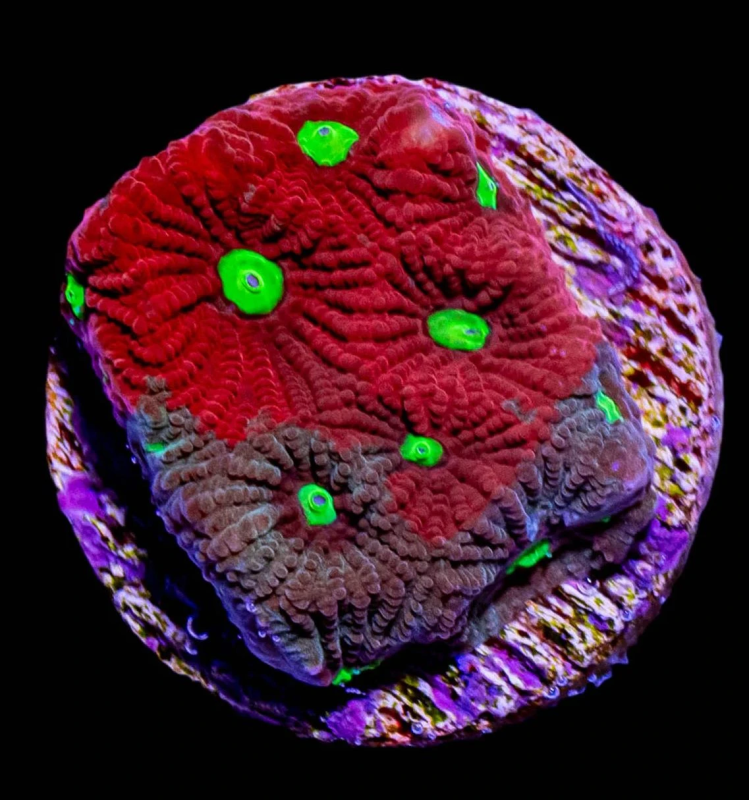
The Favia coral is one of the most widely kept and universally recommended LPS corals in the reef hobby. Known by common names including Brain Coral, Moon Coral, Pineapple Coral and Closed Brain Coral, this robust and colorful species is found throughout the Indo-Pacific and appears in an impressive range of colors including vivid greens, deep reds, blues, oranges, purples and multicolored combinations. It is hardy, forgiving of minor parameter fluctuations, and rewards consistent care with steady growth and striking display. Here is everything you need to know.
What Is Favia Coral?
Favia (Favia sp.) is a large polyp stony coral in the family Faviidae. Its colonies typically grow in a rounded or dome-shaped formation with individual corallites, each housing a single polyp, arranged across the surface in a pattern that gives the coral its brain-like appearance. A useful visual distinction between Favia and the closely related Favites is that each Favia corallite has its own independent walls, while Favites corallites share fused walls between neighboring polyps. Both share very similar care requirements, so the distinction matters more for identification than for husbandry.
Favia is found in a wide range of depths and reef environments in the wild, from shallow lagoons to deeper reef slopes, which is part of why it adapts well to varying tank conditions.
Lighting
Favia coral performs best under moderate lighting in the range of 80 to 150 PAR. It is forgiving of slight deviations but does not tolerate intense high-PAR lighting well. Excessive light causes bleaching, a process where the coral expels its photosynthetic zooxanthellae and loses color, potentially fatally. Too little light results in dull coloration and slowed growth. Starting a new frag or colony at lower PAR and gradually acclimating upward over two to three weeks is the safest approach.
A 10 to 12 hour photoperiod with gradual dawn and dusk transitions works well. Actinic blue spectrum light helps bring out fluorescent color tones in many Favia varieties. Green varieties of Favia tend to tolerate slightly higher light intensity, while red and blue morphs perform better at the lower end of the moderate range.
Water Flow
Moderate indirect flow is ideal. The goal is enough water movement to prevent detritus and debris from settling in the grooves between polyps, which can cause irritation and tissue recession, without the flow being so direct or strong that it prevents the polyps from expanding fully. Randomized turbulent flow from multiple powerheads produces the best results. Avoid strong direct jets aimed at the coral surface, which can peel tissue from the skeletal edges over time. When polyps are fully extended during the day, that is the best indicator that flow conditions are right.
Placement
Place Favia in the lower to middle portion of the aquascape on stable rockwork, a ledge or a sandy island position. Attaching it securely with reef-safe gel glue prevents the colony from being knocked over, which is a stress event that can cause tissue recession in the days that follow. Avoid sandy areas where the coral base cannot grip a stable surface.
Leave at least 3 to 6 inches of clearance between Favia and neighboring corals. Favia is known to extend sweeper tentacles at night to defend its space and can sting nearby LPS or soft corals that are placed too close. If you notice white burn marks on a neighbor, increase spacing immediately.
Feeding
Favia is primarily photosynthetic and will survive on light alone in most reef tanks, but target feeding significantly boosts growth rate, coloration and overall health. Feed two to three times per week with small meaty foods delivered directly to the polyp mouths: frozen mysis shrimp, frozen brine shrimp, Reef Roids, amino acids or similar fine coral foods work well. Target feeding at night when polyps are more extended produces the best response. Reduce flow briefly during feeding and use a pipette or turkey baster to place food directly on the mouths. Clean up any uneaten food after 10 to 15 minutes to prevent water quality issues.
Water Chemistry
Favia builds a calcium carbonate skeleton and consumes calcium and alkalinity as it grows. Target calcium at 400 to 420 ppm, alkalinity at 8 to 9.5 dKH and magnesium at 1260 to 1350 ppm. Stability is more important than hitting any single number perfectly. Sudden swings in alkalinity are one of the most common causes of tissue recession in LPS corals, so consistent dosing or a calcium reactor helps maintain the steady conditions Favia responds best to.