
Anthias Fish Care Guide

Anthias Fish Care Guide: Species, Feeding, and Tank Setup
Anthias are among the most visually spectacular schooling fish available for the saltwater aquarium. These vibrant reef fish from the subfamily Anthiinae are found in large numbers across Indo-Pacific coral reefs, hovering in the water column above the reef and feeding continuously on zooplankton. In the aquarium they bring unmatched color and movement, but their specific care requirements mean they reward attentive hobbyists far more than casual ones.
Popular Species
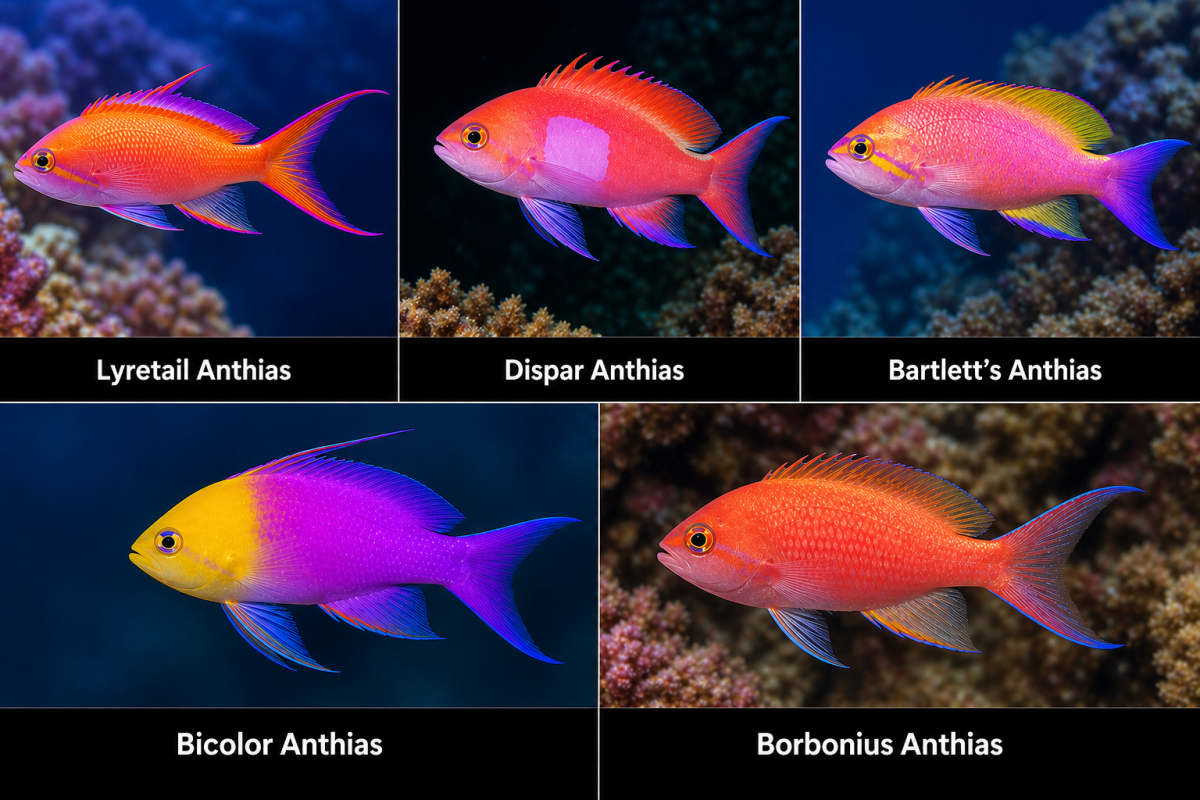
Several Anthias species are commonly available in the hobby. The Lyretail Anthias (Pseudanthias squamipinnis) is the most widely kept and one of the more forgiving species, making it a good starting point. Dispar Anthias (Nemanthias dispar) are small, vivid and relatively hardy. Bartlett’s Anthias (Pseudanthias bartlettorum) display stunning orange and purple coloration and adapt well to captive feeding. Bicolor Anthias (Pseudanthias bicolor) and Borbonius Anthias (Plectranthias sp.) attract advanced collectors. All anthias share the same fundamental care requirements, though hardiness varies by species.
Social Structure and Sexing
All anthias are protogynous hermaphrodites, meaning they are all born female and the dominant individual in a group transitions to male. This results in one male overseeing a harem of females. In the aquarium, keeping a group of one male with several females is the most natural and stable social structure. If the male is lost, the largest female will change sex within days or weeks. Two males of the same species will fight, often fatally in a confined space.
Tank Setup
Anthias require a minimum of 75 to 100 gallons for a small group, with larger tanks preferred. They are open-water midwater swimmers that need horizontal swimming space, moderate to strong flow and highly oxygenated water. Live rock is important for shelter but should not dominate the tank to the point of eliminating swimming room. Maintain temperature 72 to 78°F, pH 8.1 to 8.4 and specific gravity 1.020 to 1.025. Anthias are reef safe and will not harm corals or invertebrates.
Feeding
Feeding is the single most challenging aspect of anthias care. These fish have extremely high metabolisms and must be fed three to five times per day in small amounts. In the wild they feed continuously on zooplankton drifting past. In the aquarium, offer vitamin-enriched frozen mysis shrimp, frozen brine shrimp, copepods and high-quality marine pellets. An automatic feeder set to deliver small amounts multiple times daily is a worthwhile investment. Anthias that are underfed waste away rapidly, and underfed females can fade in color and cease eating within days.
At Dr. Reef’s Quarantined Fish, every anthias specimen is quarantined and confirmed eating prepared foods before sale, giving you the best possible start with this demanding but spectacular group of fish.