
Miniatus Grouper

Miniatus Grouper for Sale: Care, Tank Size, and Feeding Guide
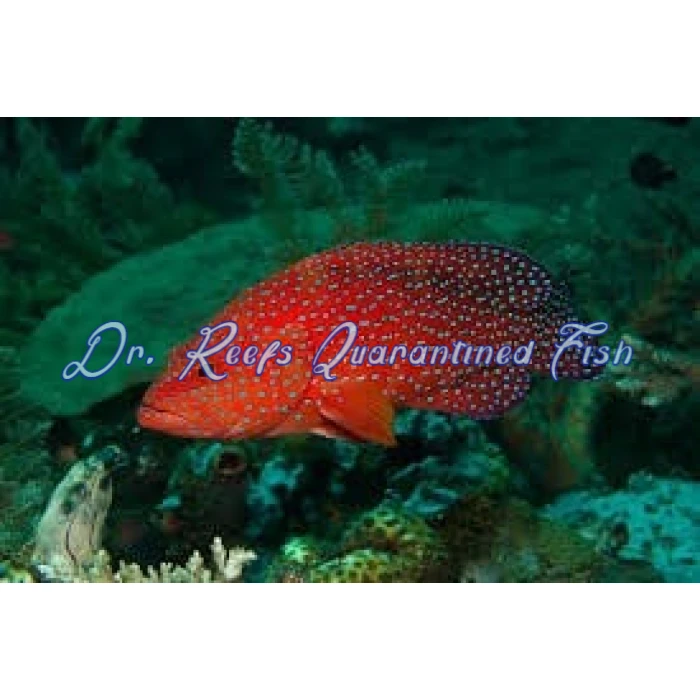
The Miniatus Grouper (Cephalopholis miniata) is one of the most visually commanding fish available in the marine aquarium hobby. A body covered in vivid orange-red with a dense constellation of electric blue spots, a powerful stocky build, and the bold, predatory confidence that defines the grouper family make this species an extraordinary display animal for the right keeper. It is not a community reef fish, and it is not a beginner species. But for experienced aquarists with appropriate systems and the patience to source a properly quarantined specimen from Dr. Reef’s Quarantined Fish, the Miniatus Grouper delivers a level of visual impact and personality that few other marine fish can match.
Species Overview
The Miniatus Grouper, also commonly called the Coral Grouper or Coral Hind, is a member of the family Serranidae, which includes the groupers, sea basses, and their relatives. It is widely distributed across the Indo-Pacific, from the Red Sea and East Africa through the Indian Ocean to the Pacific, inhabiting coral-rich reef environments at depths from shallow reef flats down to around 150 meters. In the wild it is a sit-and-wait ambush predator, positioning itself among coral outcroppings and darting out to take small fish and crustaceans with remarkable speed for an animal that otherwise appears so still.
Adult Miniatus Groupers typically reach 14 to 16 inches in captivity, with some individuals approaching 18 inches in very large, well-maintained systems. The coloration that makes this species so desirable, the rich orange-red base overlaid with hundreds of small vivid blue spots, is present from juvenile stage and intensifies as the fish matures. Juveniles display slightly more orange tones that deepen toward red in adults, and the blue spotting becomes more defined and densely packed with age.
Temperament and Behavior
The Miniatus Grouper is a predator in every sense of the word, and its behavior in captivity reflects that reality fully. It is not aggressive toward fish it cannot eat, and in a well-chosen community of appropriately sized tankmates it will generally coexist without conflict. But anything small enough to be considered prey will be consumed, often with a speed that surprises keepers who underestimate how quickly a grouper can move when motivated.
In terms of personality, the Miniatus Grouper is one of the more engaging predatory fish available in the hobby. It learns to recognize its keeper quickly, developing a responsive awareness of activity outside the tank that many owners describe as almost dog-like in its attentiveness. Feeding responses become increasingly bold and confident as the fish settles into its environment, and the combination of that visual presence with genuine interactive behavior makes it a centerpiece animal in the truest sense.
Tank Size Requirements
Given the adult size of the Miniatus Grouper and its need for territory and open swimming space, a minimum tank size of 120 gallons is the starting point for a single specimen. Larger is always better, and a system of 150 gallons or more gives the fish room to establish its territory comfortably while leaving adequate space for compatible tankmates. The tank footprint should prioritize length over height, as this is a fish that patrols horizontally along the reef structure rather than moving vertically through the water column.
Attempting to keep a Miniatus Grouper in an undersized system produces predictable results: elevated stress, suppressed immune function, increased disease susceptibility, and the behavioral frustration that comes from a territorial predator confined to inadequate space. Planning for the adult size of this fish from the outset, rather than upgrading reactively as the fish grows, is the only responsible approach.
Water Quality and Filtration
Miniatus Groupers are robust fish by marine aquarium standards, but they are also large, active predators with a correspondingly substantial waste output. A high-capacity filtration system is non-negotiable. A sump-based setup with a quality protein skimmer rated well above actual tank volume, generous biological filtration media, and a consistent water change schedule forms the baseline requirement.
Target water parameters of 1.023 to 1.025 specific gravity, temperature of 72 to 78 degrees Fahrenheit, and ammonia and nitrite permanently at zero. Nitrate should be managed through regular water changes and export mechanisms, as chronically elevated nitrate compromises immune function over time and contributes to the long-term decline seen in groupers kept in poorly maintained systems. The large body size and active metabolism of the Miniatus Grouper means that nitrate accumulation occurs faster than in smaller fish systems and requires active management rather than passive acceptance.
Tank Setup and Aquascape
A Miniatus Grouper tank should reflect the species’ natural reef habitat. Substantial live rock arranged to create caves, overhangs, and defined territories gives the fish the structural complexity it uses in the wild for ambush positioning and shelter. The grouper will select a preferred resting location within the aquascape and return to it consistently, making that area the visual focal point of the tank.
Open swimming space between and in front of the rockwork is equally important. The Miniatus Grouper needs room to patrol and to display its full coloration in open water, and an overly cramped aquascape limits both the fish’s comfort and the keeper’s ability to appreciate it. A balance of structured rockwork and generous open water produces the most functional and visually compelling setup.
Substrate choice is largely a matter of preference for this species, as the Miniatus Grouper spends relatively little time on the substrate compared to bottom-dwelling species. Sand or crushed coral both work well. The priority is rockwork stability: a large, active grouper moving through the aquascape can dislodge poorly secured rocks, and any collapse poses a serious injury risk to the fish.
Reef Compatibility
The Miniatus Grouper is not reef-safe in the conventional sense and should not be housed in a system with small fish, ornamental shrimp, small crabs, or other invertebrates it can consume. Corals themselves are generally left alone, and in a fish-only live rock system the grouper coexists perfectly well with the live rock ecosystem it inhabits. The distinction is between coral polyps, which the grouper ignores, and mobile invertebrates, which it will treat as food.
A dedicated fish-only live rock system designed around the Miniatus Grouper, with compatible large fish tankmates and robust live rock for biological filtration, is the most practical and rewarding setup for this species.
Compatible Tankmates
Choosing tankmates for a Miniatus Grouper requires honest assessment of size, temperament, and the specific dynamics of your system. The guiding principle is straightforward: no fish small enough to be swallowed. Beyond that, avoid highly aggressive species that will stress the grouper through constant harassment, and avoid timid species that will be outcompeted for food.
Fish that work well alongside Miniatus Groupers in appropriately sized systems include large angelfish, large tangs, lionfish of comparable size, substantial wrasse species such as dragon wrasses or larger Coris species, and other robust medium to large fish with calm or assertive but non-aggressive temperaments. Triggers can work in larger systems but carry a risk of aggression toward the grouper that requires careful monitoring. Avoid housing multiple groupers of the same species together unless the system is exceptionally large and introductions have been managed with great care.
Feeding the Miniatus Grouper
Feeding is one of the most straightforward aspects of Miniatus Grouper care once the fish is settled, and one of the most visually rewarding. In the wild this species subsists primarily on small reef fish and crustaceans. In captivity the goal is a varied diet of high-quality marine proteins that replicates this nutritional profile without relying on live feeder fish, which carry disease risk and contribute to the development of feeding preferences that complicate long-term husbandry.
Suitable foods include fresh or frozen silversides, squid, shrimp, scallop, and prepared marine carnivore foods. Feeding via tongs or a feeding stick allows direct presentation to the fish and helps build the interactive feeding response that many keepers find so rewarding with this species. Most settled Miniatus Groupers become enthusiastic and bold feeders, tracking the feeding stick with focused attention and striking with the decisive speed characteristic of the family.
Feed adults two to three times per week in portions appropriate to the fish’s size. Overfeeding generates excess waste, stresses filtration, and can contribute to fatty deposits and long-term health decline. The goal is a fish with a full, rounded body profile that is not visibly heavy or lethargic.
Live feeder fish should be avoided for all the reasons applicable to predatory fish husbandry in general: disease introduction risk, nutritional imbalance, and the reinforcement of feeding preferences that make transitioning to prepared foods more difficult. A Miniatus Grouper from Dr. Reef’s Quarantined Fish has already made this transition during the quarantine period, arriving at your tank ready to accept prepared foods from the outset.
Disease Susceptibility and the Case for Quarantine
The Miniatus Grouper is a generally hardy species once established, but like all marine fish it is susceptible to ich, marine velvet, and bacterial infections, particularly during the stress of collection, shipping, and introduction to a new system. The stress response triggered by these events suppresses immune function and creates a window of vulnerability that unquarantined fish often do not survive without incident.
At Dr. Reef’s Quarantined Fish, every Miniatus Grouper is held through a structured quarantine period covering health observation, disease screening, and feeding establishment before being offered for sale. The fish that reaches your tank has already navigated the most vulnerable phase of captive life under professional care, demonstrating the stable health and reliable feeding behavior that predict long-term success.
The transparency Dr. Reef’s provides about quarantine duration, feeding history, and individual behavioral observations gives buyers the confidence to make a genuinely informed purchase rather than hoping for the best with an unknown history specimen. For a fish of this size, this value, and this visual significance in a display system, that informed confidence is not a luxury. It is the baseline standard every buyer should demand.
A Final Word for Prospective Keepers
The Miniatus Grouper rewards the keepers who respect its requirements with years of exceptional display and genuine interactive engagement. It is a fish that commands attention in any system it inhabits and develops a presence and personality that make it genuinely irreplaceable once established.
Get the tank size right, invest in filtration capacity appropriate to a large predator, choose tankmates with honest attention to compatibility, and source your specimen from Dr. Reef’s Quarantined Fish. Those four decisions, made correctly from the start, are the foundation of everything that follows.