
Lamarck’s Angelfish

Lamarck’s Angelfish: Reef Compatibility and Care Guide
Of all the angelfish families available in the saltwater hobby, the Lamarck’s Angelfish (Genicanthus lamarck) holds a rare and enviable distinction. It is genuinely and reliably reef safe. For aquarists who have wanted an angelfish in their reef tank but held back due to the coral-nipping risk common to most species, the Lamarck’s offers a compelling solution. Here is a full care guide for this elegant and underappreciated species.
What Is the Lamarck’s Angelfish?
The Lamarck’s Angelfish belongs to the genus Genicanthus, the only group of angelfish whose diet in the wild is based on zooplankton rather than sponges, corals and encrusting organisms. This critical dietary difference is the reason they are trusted in reef systems where other angels would not be. The species is native to the coral reefs and steep rocky drop-offs of the Indo-West Pacific, ranging from the Indo-Malayan waters east to Vanuatu, north to southern Japan and south to Australia’s Great Barrier Reef. In the wild they are found at depths of 10 to 50 meters, typically living in harems of 3 to 7 individuals feeding in midwater above the substrate.
The species can reach approximately 8 to 10 inches in length and is longer-lived in captivity than many hobbyists might expect given proper care.
Appearance and Sexual Dimorphism
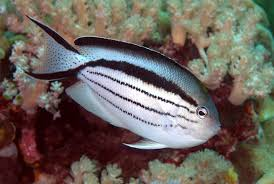
Lamarck’s Angelfish is one of the few angelfish with clear and consistent visual differences between males and females. Both sexes share a silvery-gray to white base coloration with horizontal black stripes running from the head toward the caudal fin. Females have a notably bolder primary stripe that extends prominently into and along the length of the tail fin. The dorsal fin in females is large and black-edged. Males often display a yellow-orange blotch on the forehead and sharper, more elongated caudal fin edges. So distinct are the differences between sexes that the male and female were once described as two separate species by early taxonomists.
Reef Compatibility
The Lamarck’s Angelfish is one of the few angelfish that can genuinely be described as reef safe without significant caveats for corals. As members of the Genicanthus genus feed on zooplankton rather than sessile invertebrates, they reliably ignore stony corals, soft corals, LPS, and clam mantles. They also leave most ornamental invertebrates and the tank’s cleanup crew completely alone.
The one compatibility consideration to keep in mind is their tendency to occasionally chase small and docile planktivorous fish that occupy a similar feeding niche. Species such as fairy wrasses, anthias, flasher wrasses and firefish may be harassed by a Lamarck’s that views them as food competition. Pair the Lamarck’s with fish of equal or larger size, or robust species that can hold their own. The species is notably non-confrontational with other angelfish genera including Pomacanthus and Centropyge, which makes it relatively flexible in large mixed-species systems.
Tank Requirements
A minimum of 125 gallons is needed for a single Lamarck’s Angelfish, with 150 gallons or more preferred. Groups of one male and two or more females require proportionally larger systems of 200 gallons or above. The aquarium should provide a healthy balance of open swimming space and live rock formations with shady overhangs and crevices. As a midwater swimmer, the Lamarck’s spends most of its time cruising the open areas of the tank rather than grazing on rock surfaces.
Good water movement and high oxygen levels are important. The species is sensitive to nitrite and ammonia spikes and should only be introduced to a well-cycled and stable aquarium. Maintain standard reef parameters: temperature 72 to 78°F, pH 8.1 to 8.4, salinity 1.020 to 1.025.
Only one male should be kept per system. Two males together will fight. A single male with several females can work well in a sufficiently large tank with multiple distinct territories and visual breaks in the rock work.
Diet and Feeding
As planktivores, Lamarck’s Angelfish prefer to pick food from the water column rather than graze from surfaces. In the aquarium they should be offered a varied diet of vitamin-enriched frozen mysis shrimp, frozen brine shrimp, chopped krill, squid, clams and mussels, spirulina-based flake and pellet foods, marine algae and high-quality angelfish preparations. Feed at least three small meals per day to replicate their continuous midwater feeding behavior in the wild. Fish that are slow to accept prepared foods during acclimation can often be enticed with live brine shrimp or ghost shrimp as a bridge food.
When sourcing Lamarck’s Angelfish, a quarantined specimen already eating prepared foods is the ideal starting point. Dr. Reef’s Quarantined Fish carries this species and ensures each fish arrives health-screened, disease-free and actively feeding before it reaches your display tank, giving it the best possible transition into reef life.