
Micromussa Holy Grail Coral

Micromussa Holy Grail Coral: Care, Lighting, and Placement
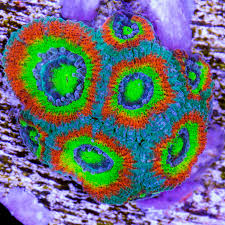
Few corals in the reef hobby generate as much excitement among collectors as the Micromussa Holy Grail. With its intensely fluorescent polyps displaying concentric rings of neon green, vivid purple, orange, red and blue, it is one of the most visually striking LPS corals available. Once a coral that commanded enormous prices in the collector market, it has become more accessible over the years while losing none of its prestige. Whether you are adding your first frag or expanding an established LPS collection, here is everything you need to know about caring for this gem.
What Is the Micromussa Holy Grail?
The Holy Grail is a named designer morph of Micromussa lordhowensis, a large polyp stony coral originally classified as Acanthastrea lordhowensis before being reclassified in 2016. In the hobby, these corals are still widely referred to as Acan Lords or simply Lords. The Micromussa lordhowensis species is native to the Indo-Pacific, found throughout the reefs of Australia, Indonesia, the Solomon Islands and surrounding regions, typically on deeper reef slopes and shaded areas of lagoons where light intensity is lower.
The Holy Grail designation refers specifically to specimens displaying the signature multi-ring coloration pattern. Each polyp radiates outward in distinct color bands from a vivid center, creating an eye that shifts under reef lighting in a way that few other corals can replicate. Individual polyps on Micromussa lordhowensis are notably larger than those of the related Micromussa amakusensis species, typically around 0.5 inches across when fully extended, making the color rings even more dramatic and visible in the aquarium.
The species is an LPS coral, meaning it builds a hard calcium carbonate skeleton beneath its fleshy tissue and will consume calcium and alkalinity as it grows.
Lighting Requirements
Getting the lighting right is arguably the single most important aspect of Holy Grail Micromussa care. This species is highly sensitive to light intensity and will respond to changes in its environment dramatically and rapidly. Under excessive light, the coral can bleach, lose its multi-ring color pattern and shift toward a dominant red or orange tone. Under too little light it may recede and lose vibrancy over time.
The ideal PAR (Photosynthetically Active Radiation) range for Holy Grail Micromussa is 75 to 150 PAR, with many experienced keepers targeting the lower end of that range or even below. Some specialist growers report the best color and polyp extension at as low as 25 to 50 PAR, noting that specimens kept in dimmer conditions consistently outperform those placed in brighter zones. If you are running a high-powered LED or T5 setup optimized for SPS corals, the Holy Grail should be placed well away from the light’s peak intensity zones.
A stronger blue spectrum in your lighting schedule helps preserve the multi-ring color pattern and prevents rainbow varieties from morphing toward a single dominant color. When first introducing the coral to your tank, always begin with the lowest light area available and acclimate gradually over two to three weeks rather than placing it at its intended final position immediately. This light acclimation period is critical to avoiding shock and tissue recession.
Water Flow
Low to moderate flow is ideal for Holy Grail Micromussa. Enough gentle movement should be present to prevent detritus from settling between the fleshy polyps, which can cause tissue irritation and create conditions for bacterial issues. However, strong or direct flow causes the polyps to contract and may result in tissue tearing over time. Use a wavemaker or powerhead positioned to create indirect, gentle movement around the coral rather than pointing directly at it. When polyps are fully extended and open, that is the clearest sign that flow conditions are appropriate.
Placement in the Aquarium
Position your Holy Grail Micromussa in the lower to middle third of the aquarium on stable rockwork or a ledge, or alternatively on an island position on the sandbed where it can be viewed easily. The lower placement naturally reduces light intensity and creates the shaded conditions this coral prefers.
Leave adequate space around the colony. Micromussa lordhowensis possesses sweeper tentacles that it extends particularly at night to defend territory and sting neighboring corals. A spacing of at least 4 to 6 inches from other LPS corals and fast-growing neighbors is a sensible starting point. Keep it away from corals known for aggressive chemical warfare or long sweeper tentacles such as hammer corals or elegance corals unless sufficient distance is maintained.
Attach the frag securely to its position using reef-safe gel glue or putty. Once placed and settled, avoid moving it unnecessarily as relocation is a source of stress for this species.
Water Parameters
As an LPS coral with a calcified skeleton, the Holy Grail Micromussa requires consistent maintenance of the major chemical parameters that support skeletal growth and tissue health.
Target the following ranges: temperature 75 to 80°F, salinity 1.025 to 1.026, pH 8.1 to 8.4, calcium 420 to 450 ppm, alkalinity 8 to 9.5 dKH, magnesium 1260 to 1350 ppm, nitrates below 10 ppm and phosphates below 0.10 ppm. Stability is more important than hitting any single number perfectly. Fluctuations in alkalinity in particular are a common cause of tissue recession in LPS corals, so consistent dosing or a two-part system to maintain steady levels is strongly recommended.
The Holy Grail Micromussa is notably tolerant of slightly elevated nutrients compared to SPS corals, and may even benefit from a small amount of dissolved organic matter in the water column. However, allowing nitrates to climb above 20 to 30 ppm for sustained periods will negatively affect its health and coloration.
Feeding
While the Holy Grail Micromussa is primarily photosynthetic, drawing nutrition through its zooxanthellae like most reef corals, supplemental feeding makes a significant difference to its growth rate and coloration. Target feed two to three times per week with small meaty foods that the polyps can actually capture and process. Frozen mysis shrimp, finely chopped krill, brine shrimp and high-quality coral pellets are all effective. Reef Roids, Oyster Feast and similar fine coral foods broadcast into the water column are also beneficial.
To feed effectively, reduce flow in the tank briefly to allow the polyps time to fully extend and capture food. Do not overfeed with pellet-based foods as overloading a single polyp can cause chemical burns to the tissue. A small amount per polyp per feeding session is the right approach.
Regular feeding accelerates growth, which in the case of Holy Grail Micromussa means new polyps budding around the edges of established ones over time. For anyone looking to build a colony from a small frag, consistent feeding combined with proper lighting and stable parameters will yield the best results.
Why It Remains a Collector Favorite
The Holy Grail Micromussa has earned its name and reputation through genuine visual impact. Its concentric color rings are unlike almost any other coral in the hobby and respond beautifully to the blue wavelengths that dominate a well-designed reef lighting spectrum. For collectors maintaining LPS-focused systems or anyone looking to add a true centerpiece piece to their rockwork, it remains one of the most rewarding corals to keep and grow.
At Dr. Reef’s Quarantined Fish, we stock high-quality corals alongside our fish selection because we understand that a thriving reef is built on both. Every coral we offer goes through the same care and attention to water quality and quarantine practices that we apply to our fish, giving you the confidence that what you receive is healthy and ready to settle into your display.