
Bristletooth Tang

What role does the Bristletooth Tang play in controlling algae in a saltwater reef aquarium?
If you run a saltwater reef aquarium, algae management is one of the most constant and consequential challenges you face. Unwanted algae does not just look bad. It competes directly with corals for light and space, disrupts water chemistry, and signals underlying imbalances in the system that will compound over time if left unchecked. Choosing the right biological algae control is one of the most impactful decisions a reef keeper can make, and among the most consistently effective options available in the hobby is the Bristletooth Tang.
Bristletooth Tangs belong to the genus Ctenochaetus, a group of surgeonfish specifically adapted for a style of feeding that makes them uniquely valuable in a reef environment. Where most herbivorous fish graze opportunistically, Ctenochaetus tangs are precision instruments designed by evolution to clean reef surfaces in ways that no other commonly kept fish can match. Understanding exactly what they do, how they do it, and why it matters will help you get the most from one of the hobby’s most underappreciated workhorses.
What Makes Bristletooth Tangs Different from Other Herbivores?
The defining feature of every Ctenochaetus tang is the structure of its mouth and teeth. Unlike the sharp, blade-like teeth of Zebrasoma tangs, which bite and tear macroalgae from rock surfaces, Bristletooth Tangs possess rows of fine, flexible, comb-like bristle teeth that function more like a brush than a cutting tool. These bristles are designed to rasp and scrub across substrate surfaces, dislodging and consuming the thin organic films that accumulate on rockwork, coral skeletons, sandbed surfaces, and aquarium glass.
This is the key distinction that sets them apart in any algae management strategy. Zebrasoma species, blennies, and urchins all make meaningful contributions to algae control, but most of them target visible, established algae growth. The Bristletooth Tang operates at a different scale entirely, working at the microscopic film level before algae has the opportunity to establish itself as a visible problem.
The Specific Types of Algae Bristletooth Tangs Target
Bristletooth Tangs are particularly effective against diatom films, the brown, silica-based microalgae that coat rockwork and glass in both new and established reef systems. They are equally effective against the thin green microalgae films that give rocks and substrate a dull, dirty appearance over time. These are the algae forms that most other herbivores simply walk past without addressing, and they are the forms that most frequently frustrate reef keepers who struggle to maintain the clean, vibrant appearance of a well-kept reef.
Ctenochaetus tangs are also among the most effective fish for suppressing cyanobacteria, commonly called red slime algae, which is one of the most persistent and problematic nuisance organisms in reef aquariums. While the long-term solution to a cyanobacteria outbreak always involves addressing the underlying nutrient imbalance driving it, a Bristletooth Tang actively disturbs and consumes cyanobacteria mats during its continuous grazing, slowing their spread and giving the aquarist time to correct the conditions fueling the bloom.
In addition to algae itself, Bristletooth Tangs ingest significant quantities of detritus, the fine organic particulate matter that settles on rockwork surfaces and sandbed and contributes to nutrient accumulation in the system. By constantly disturbing and consuming this material during normal grazing behavior, they provide a form of nutrient export that is easy to overlook but genuinely meaningful in a closed reef system.
How Bristletooth Tangs Graze: Constant, Methodical, and Thorough
One of the most impressive things about Bristletooth Tangs is the sheer duration and consistency of their grazing activity. These are not fish that eat at feeding time and rest. They are active grazers for the majority of their waking hours, methodically working across every available surface in the aquarium throughout the day. A healthy, established Bristletooth Tang in a reef with good rockwork coverage will cover essentially every accessible surface in the tank on a daily basis.
This behavior mirrors what Ctenochaetus tangs do on natural coral reefs, where they play a critical ecological role as surface cleaners. On wild reefs, the continuous grazing activity of these fish is one of the primary mechanisms by which reef surfaces are kept clean enough for coral larvae to settle and grow. In a home reef system, they perform the same ecological service, keeping surfaces clean and biologically active in ways that benefit corals, coralline algae growth, and overall system health.
The Best Bristletooth Tang Species for Reef Aquariums
Several Ctenochaetus species are commonly available in the hobby, each with its own characteristics that make it more or less suited to different reef situations. The Kole Tang (Ctenochaetus strigosus) is the most compact of the group, reaching around 5 inches at full adult size. It is an excellent choice for tanks in the 75 to 120 gallon range, and its smaller size makes it one of the few effective herbivores accessible to aquarists without very large systems. The Kole is a relentless grazer and one of the most frequently recommended tangs for reef keepers focused on algae management.
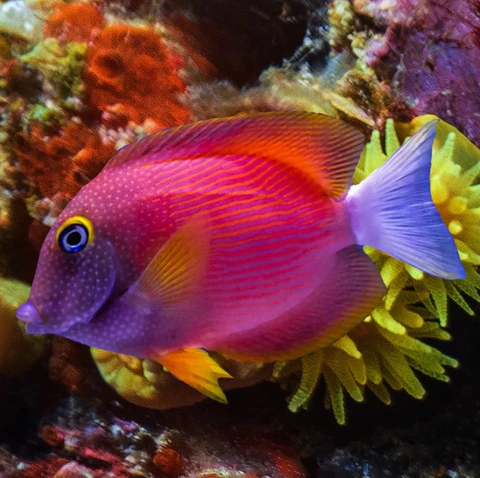
The Tomini Tang (Ctenochaetus tominiensis) is a step larger, reaching around 6 inches, and is widely regarded as one of the best all-around tangs available in the hobby. It shares the same methodical grazing behavior as the Kole but adds striking coloration with its yellow-tipped dorsal and caudal fins that make it a visual standout in any display. The Tomini is peaceful, reef-safe, and exceptionally effective at surface cleaning.
The Chevron Tang (Ctenochaetus hawaiiensis) is among the most visually dramatic of the group as a juvenile, with vivid orange and black chevron patterning that fades as the fish matures into a more subdued adult coloration. It grows somewhat larger than the Kole and Tomini and performs the same algae control function admirably in systems with adequate space.
What Bristletooth Tangs Cannot Do: Understanding Their Limitations
It is important to be clear about what Bristletooth Tangs are and are not capable of. They are maintenance and prevention fish, not remediation fish. A Bristletooth Tang in a well-run system with stable nutrients and good husbandry practice will keep surfaces remarkably clean and contribute meaningfully to the overall biological balance of the reef. A Bristletooth Tang introduced into a system with serious underlying nutrient problems, chronically elevated nitrates and phosphates, or inadequate skimming and water flow will be quickly overwhelmed.
They also do not target macroalgae in any meaningful way. If you have a Bryopsis, Caulerpa, or hair algae problem, a Ctenochaetus tang is not the solution. Those situations call for a Zebrasoma tang, a sea hare, or aggressive manual removal combined with nutrient correction. The Bristletooth Tang’s value lies in preventing those problems from establishing by keeping surfaces continuously clean at the microscopic film level.
Tank Requirements and Care for Long-Term Success
To get genuine algae control value from a Bristletooth Tang, the tank must provide adequate rockwork for sustained grazing. A sparsely aquascaped system with minimal rock surface area will not support one long-term. The more natural reef rock surface available, the more effectively the tang can do its job and the more nutritional resources it has access to throughout the day.
Supplement natural grazing with regular offerings of nori on a clip and quality herbivore-focused frozen foods. Even in a tank with abundant algae growth, supplemental feeding ensures the fish maintains peak body condition and the vigorous energy levels that drive effective grazing behavior. A well-fed Bristletooth Tang is an active Bristletooth Tang, and an active fish is doing its job continuously throughout the day.
Water quality parameters should be kept within standard reef ranges, with stable temperature between 74 and 80 degrees Fahrenheit and salinity at 1.025 SG. Strong flow throughout the system suits these fish well and encourages the kind of active, exploratory grazing behavior that makes them so effective.
Why a Quarantined Bristletooth Tang Is the Only Bristletooth Tang Worth Adding
Tangs as a family are among the most susceptible fish in the hobby to ich and other parasitic infections. Introducing an unquarantined tang into a display reef is one of the most reliable ways to trigger a system-wide disease crisis. Once ich is established in a reef tank containing corals and invertebrates, treatment options become severely limited. Leaving a display fallow for several weeks to break the parasite cycle disrupts a reef system in ways that can take months to fully recover from.
At Dr. Reef’s Quarantined Fish, every Bristletooth Tang we offer completes a minimum four to six week quarantine protocol before being made available for sale. During that time, each fish receives preventative treatment for ich, flukes, and common marine parasites, is monitored daily, and is confirmed eating prepared foods confidently before leaving our facility.
We document the quarantine process thoroughly and never rush fish to availability simply to meet demand. When your Bristletooth Tang arrives from Dr. Reef’s Quarantined Fish, it is healthy, parasite-free, eating well, and ready to begin doing exactly what it was built for in your reef system.
One of the Most Valuable Fish in the Reef Hobby
The Bristletooth Tang’s contribution to algae control in a reef aquarium is quiet, continuous, and easy to underestimate until you see the difference a healthy, established specimen makes to the cleanliness and visual quality of a display. It does not perform dramatic clean-ups. It prevents the need for them. For any aquarist serious about maintaining a healthy, beautiful reef with minimal algae intervention, a Bristletooth Tang is not optional. It is one of the most important fish the system can have.
Browse our current Ctenochaetus availability at Dr. Reef’s Quarantined Fish and add a true reef partner to your system. Your rockwork, your corals, and your overall water quality will reflect the difference.