
Banggai cardinalfish for Sale: Care Guide, Breeding Tips, and Tank Compatibility

Banggai Cardinalfish for Sale: Care Guide, Breeding Tips, and Tank Compatibility
Some fish make a reef tank look complete. The Banggai Cardinalfish is one of them. Elegant, peaceful, and genuinely fascinating to observe, this is a fish that brings something truly special to any saltwater aquarium. It is also one of the few marine fish that breeds readily in home aquariums, making it a favorite among hobbyists who want more from their reef than just a pretty display. Dr. Reef has healthy, quarantined Banggai Cardinalfish ready for your tank right now.
What Is a Banggai Cardinalfish?
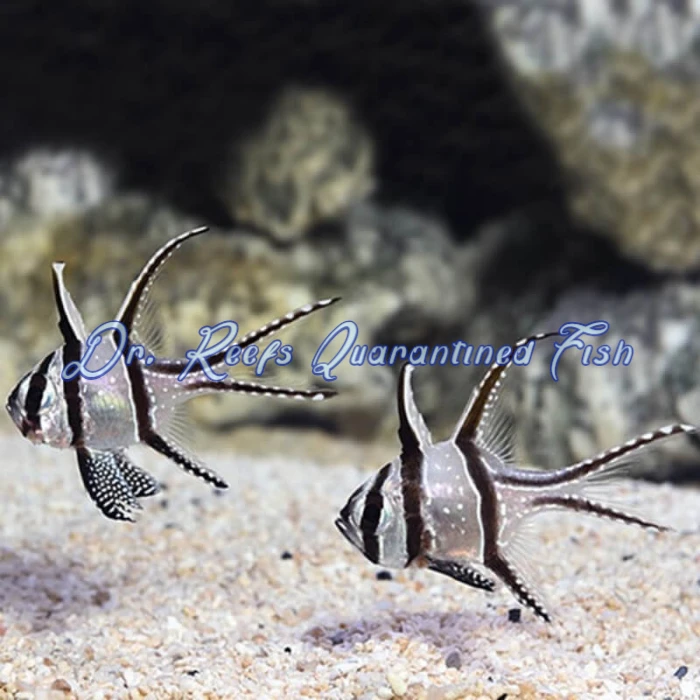
The Banggai Cardinalfish, known scientifically as Pterapogon kauderni, is a small marine fish native to the Banggai Islands of Indonesia. It has a slim silver body marked with bold black vertical stripes and scattered white spots across the fins and tail. It grows to about three inches in length and moves through the water with a calm, unhurried grace that gives it a presence far larger than its size suggests.
What makes this fish truly remarkable is its reproductive behavior. The Banggai Cardinalfish is a paternal mouthbrooder. After the female deposits eggs and the male fertilizes them, the male takes the entire egg mass into his mouth and carries it there until the young are fully developed. He stops eating completely during this period, which lasts around three to four weeks. When the juveniles finally emerge, they are not tiny larvae but fully formed miniature versions of the adults, ready to feed and fend for themselves almost immediately. Witnessing this process in a home aquarium is one of the most extraordinary things the reef hobby has to offer.
Tank Requirements
The Banggai Cardinalfish is a calm, slow-moving fish that is comfortable in tanks of 30 gallons or more. It is not an active open-water swimmer. Instead, it tends to hover in place near a coral, anemone, or long-spined urchin that it treats as a home base and refuge. In the wild, Banggai Cardinalfish shelter among the spines of sea urchins for protection, and providing a similar vertical structure in a home aquarium brings out their most natural and relaxed behavior.
Long-spined urchins, branching corals, and tall rock formations all work well as shelter points. The more comfortable and secure the fish feels, the more active and visible it will be throughout the day.
Maintain water temperature between 72 and 78 degrees Fahrenheit, salinity at 1.025, and pH between 8.1 and 8.4. Consistent water quality through regular partial water changes is especially important for this species. The Banggai Cardinalfish is not particularly tough when it comes to water chemistry swings, so stability is key.
Flow should be moderate and indirect. Strong direct current causes stress and disrupts the hovering behavior that is natural to this fish.
Feeding Your Banggai Cardinalfish
The Banggai Cardinalfish is a carnivore that feeds on small invertebrates and zooplankton in the wild. In an aquarium, it readily accepts frozen mysis shrimp, which should form the core of the diet. Brine shrimp, finely chopped marine seafood, and quality carnivore pellets are all good supplementary options.
The key feeding challenge with this species is its calm, unhurried nature. In a community tank with faster, more aggressive feeders, the Banggai Cardinalfish can easily be outcompeted without the keeper realizing it. Target feeding using a pipette or turkey baster ensures each fish receives its share. Feed once or twice daily in small amounts and confirm visually that each fish is eating at every feeding.
Breeding Tips
The Banggai Cardinalfish is one of the most accessible marine fish to breed in a home aquarium, and the experience is deeply rewarding.
Start by keeping a small group of three to five individuals together. The fish will pair off naturally within the group. You will notice pairs forming as two fish begin spending most of their time together and showing mild aggression toward the other group members to establish their space.
Once spawning occurs, the male will carry the eggs visibly in his mouth, and his throat area will appear noticeably swollen. Stop target feeding him aggressively during this period and minimize disturbances to the tank. Avoid rearranging rocks, adding new fish, or doing anything that raises stress levels while the male is brooding.
After three to four weeks, the juveniles will emerge fully formed. They are large enough to accept baby brine shrimp immediately and grow quickly with consistent feeding. Many reefers who breed Banggai Cardinalfish describe it as one of the most satisfying achievements in the hobby. Captive breeding also matters for conservation because the wild Banggai Islands population has faced significant pressure from overcollection in recent years.
Tank Compatibility
The Banggai Cardinalfish is a peaceful community fish that coexists well with most reef tank inhabitants. It poses no threat to corals, clams, or sessile invertebrates. Its calm temperament makes it an excellent addition to any community reef built around non-aggressive species.
Within the species itself, some territorial behavior can occur in smaller tanks. Keeping a proper group of three or more rather than an isolated pair distributes any aggression and keeps stress low across the group. In a well-structured tank with sufficient space, groups of five or more live together without serious conflict.
Avoid housing Banggai Cardinalfish with highly aggressive or hyperactive tankmates that will stress them or outcompete them at feeding time.
Why Buy Your Banggai Cardinalfish from Dr. Reef?
Dr. Reef quarantines every Banggai Cardinalfish before listing it for sale. Each fish is observed daily, fed consistently, and confirmed healthy before it ships. You receive a fish that has already cleared the most stressful part of the adjustment process and is ready to settle naturally into your reef. That is the standard Dr. Reef holds for every single fish, and it shows in the results customers experience again and again.