
Blenny for Sale: Best Species, Care Guide, and Reef Compatibility

Blenny for Sale: Best Species, Care Guide, and Reef Compatibility
If personality were measured in inches, the Blenny would win every time. These small, expressive, wildly entertaining fish are some of the best additions you can make to a reef tank. They are curious, comical, and full of character. Dr. Reef’s Quarantined Fish carries healthy, quarantined Blennies across several of the hobby’s most popular species.
What Is a Blenny?
Blennies are a large and diverse group of small marine fish belonging to the family Blenniidae. They are found across tropical and subtropical oceans worldwide. What unites them is their body shape: long and slender with large, expressive eyes set high on the head, no scales, and a tendency to perch on and between rocks using their pectoral and pelvic fins. Most Blennies grow between two and five inches, depending on the species, making them ideal for a wide range of tank sizes.
Blennies are bottom-dwellers and rock-dwellers by nature. They are not strong open-water swimmers. Instead, they hop, crawl, and dart between surfaces in a way that is absolutely hilarious to watch. They are curious about everything in their environment and often develop recognizable individual personalities that make them genuine favorites among reef keepers.
Best Blenny Species for Your Reef Tank
Several Blenny species stand out as particularly excellent choices for home aquariums.
The Lawnmower Blenny, also known as the Sailfin Blenny or Algae Blenny, is one of the most useful fish you can add to a reef tank. It grazes on filamentous hair algae and film algae constantly throughout the day, helping keep the tank naturally clean. It grows to about four inches and is completely reef safe.
The Tailspot Blenny is a smaller species, reaching about two and a half inches, with a distinctive dark spot at the base of its tail. It is one of the most peaceful and reef-friendly Blennies available, spending its day perched on rocks and grazing on microalgae. Its small size makes it suitable for nano reef tanks as well as larger systems.
The Midas Blenny is one of the most visually stunning Blenny species in the hobby. It has a brilliant golden yellow body that shimmers under reef lighting. Unlike most Blennies, the Midas Blenny is a more active swimmer and spends more time in open water, darting and hovering near the rockwork with a confidence and grace that sets it apart. It grows to about five inches and is a genuine showpiece fish.
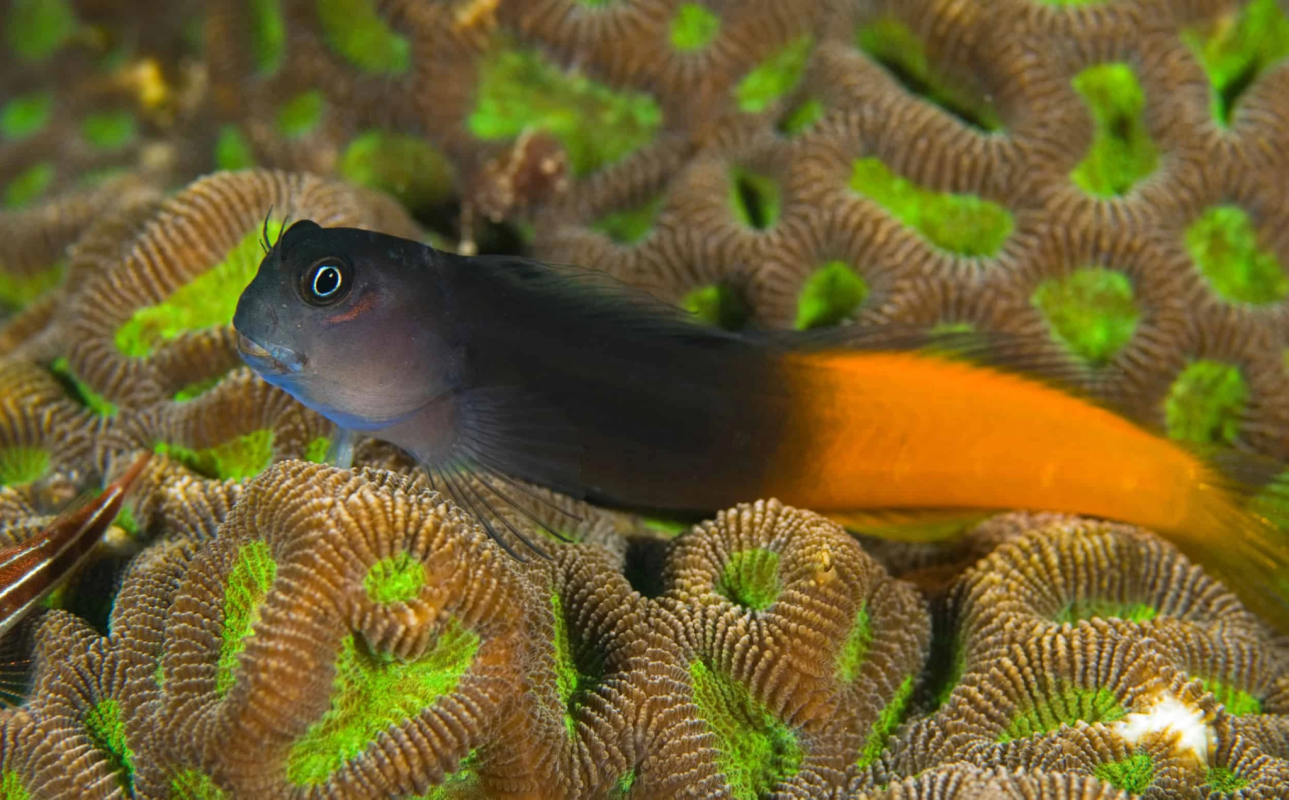
The Bicolor Blenny is a popular and widely available species with a striking two-tone body, blue-gray toward the head and orange-yellow toward the tail. It is hardy, reef safe, and full of personality. It is one of the best starter Blennies for newer reef keepers.
Tank Requirements
Most Blenny species do well in tanks of 30 gallons or more, though smaller species like the Tailspot Blenny can thrive in tanks as small as 10 to 15 gallons. The most important tank feature for any Blenny is rockwork. Blennies need caves, crevices, and small holes to retreat into. They feel stressed and exposed without hiding spots and will spend most of their time in the open, looking uncomfortable rather than behaving naturally.
Provide plenty of live rock with natural caves and tunnels. Many Blennies will claim one specific hole as their home base and return to it constantly throughout the day. Watching a Blenny peek out from its favorite cave is one of the genuine joys of keeping this fish.
Water parameters should be maintained at standard reef levels. Temperatures between 72 and 78 degrees Fahrenheit, salinity at 1.025, and stable pH between 8.1 and 8.4 keep Blennies in great condition. Moderate flow and good filtration round out the setup.
Feeding Your Blenny
Feeding requirements vary slightly between species, but most Blennies in the hobby are herbivores or omnivores. Algae-grazing species like the Lawnmower Blenny and Tailspot Blenny will spend much of the day naturally grazing on microalgae and biofilm growing on rocks and glass. Supplement this natural grazing with algae wafers, spirulina flakes, and blanched vegetables like zucchini and spinach.
More omnivorous species like the Midas Blenny and Bicolor Blenny accept a wider range of foods, including mysis shrimp, brine shrimp, and quality marine flake or pellet food. Feed small amounts once or twice daily and make sure the Blenny is getting enough food to eat, especially in tanks with more aggressive feeders that might outcompete it at meal time.
Reef Compatibility
Blennies are some of the most reef-safe fish available. The vast majority of species pose no threat to corals, clams, or most invertebrates. They are peaceful community fish that coexist well with most reef tank inhabitants.
The one compatibility note worth mentioning is that some Blennies, particularly the Bicolor Blenny, have been known to nip at large polyp stony corals like Hammer and Torch corals in tanks where they are not getting enough food. Keeping them well fed virtually eliminates this behavior. A properly fed Blenny is a well-behaved Blenny.
Avoid keeping two male Blennies of the same species together in a smaller tank, as they can become territorial. In larger tanks with plenty of rock structure, even this issue is minimal.
Why Buy Your Blenny from Dr. Reef?
Dr. Reef’s quarantines and observes every Blenny before it ships. Each fish is confirmed to be eating, healthy, and settled before it leaves the facility. You receive a fish that is past the most stressful part of the transition and is ready to explore, perch, and entertain from the moment it enters your tank.
Blennies from Dr. Reef arrive in exceptional condition because exceptional condition is the only standard Dr. Reef accepts.