
Longnose Hawkfish for Sale: Care Requirements, Diet, and Reef Compatibility

Longnose Hawkfish for Sale: Care Requirements, Diet, and Reef Compatibility
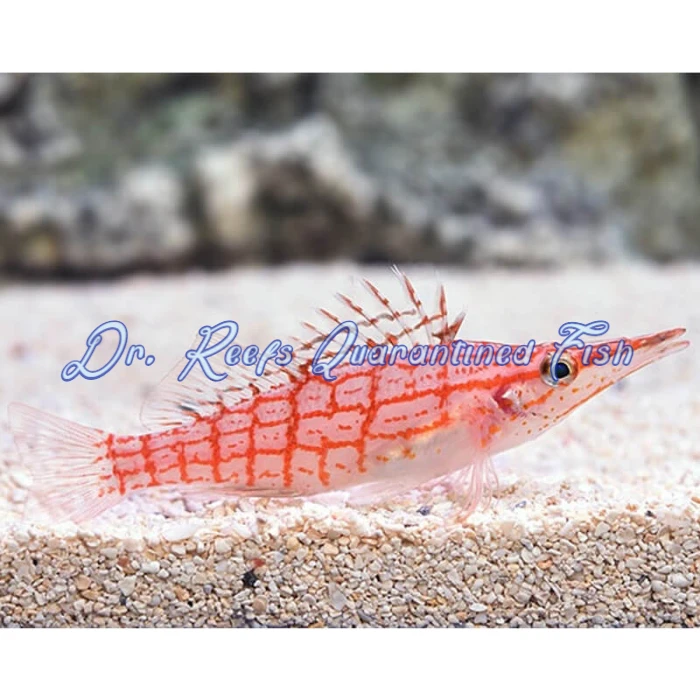
The Longnose Hawkfish is one of those fish that rewards a second look. At first glance, it is simply beautiful, with a bold red and white checkered pattern and a dramatically elongated snout that sets it apart from every other fish in the tank. Look closer, and you start to notice the behavior: the alert posture, the watchful eyes, the lightning-fast darts after prey, and the way it perches with total confidence on the highest point it can find. This is a fish with real character and real presence. Dr. Reef has healthy, quarantined Longnose Hawkfish ready for your aquarium. Here is everything you need to know.
What Is a Longnose Hawkfish?
The Longnose Hawkfish, known scientifically as Oxycirrhites typus, is a marine fish found across the Indo-Pacific and Eastern Pacific oceans. It is the only member of its genus and one of the most recognizable fish in the hobby. The elongated snout that gives it its name evolved specifically for probing deep into coral branches and crevices to extract hidden prey. The body is white with a striking red grid pattern of intersecting horizontal and vertical lines that makes it look almost hand-painted.
It grows to about five inches in length and, like all Hawkfish, completely lacks a swim bladder. Rather than hovering in open water, it uses stiffened pectoral fin rays to grip surfaces and perch in place. In the wild, it is most commonly found perched on large sea fans and black corals in deeper reef zones, using these elevated structures as hunting platforms. In a home aquarium, it brings this same watchful, perching behavior to your rockwork and coral structures.
Tank Requirements
The Longnose Hawkfish is well-suited to tanks of 30 gallons or more. Because of its perching lifestyle, it does not require large amounts of open swimming space, but it does need a tank with interesting, varied structure at multiple heights. Rockwork with elevated peaks, branching corals, and open perching spots throughout the tank gives this fish the environment it needs to behave naturally and stay active.
A fish with plenty of good vantage points will be visible, engaged, and entertaining to watch throughout the day. A fish with nowhere satisfying to perch will retreat and become far less visible and far more stressed.
Maintain water temperature between 72 and 78 degrees Fahrenheit, salinity at 1.025, and pH between 8.1 and 8.4. The Longnose Hawkfish is a reasonably hardy species that handles a range of conditions well, making it a manageable choice for intermediate reef keepers.
A secure lid is important. Like all Hawkfish, the Longnose is a capable jumper and will find any uncovered gap given the opportunity.
Diet and Feeding
The Longnose Hawkfish is a carnivore that feeds on small crustaceans, zooplankton, and tiny fish in the wild. Its elongated snout gives it a precision advantage when targeting prey hidden inside tight coral structures, and this specialized feeding style carries over into aquarium life in an interesting way.
In captivity, the Longnose Hawkfish accepts frozen mysis shrimp and brine shrimp readily. Finely chopped marine seafood, small whole shrimp, and quality carnivore pellets all make good dietary options. Most individuals adapt quickly to prepared foods, especially when coming from a source like Dr. Reef’s, where a consistent feeding routine has already been established during quarantine.
Feed once or twice daily in small amounts. Watching a Longnose Hawkfish launch from its perch to intercept food mid-water is one of the genuine highlights of keeping this species. It is fast, precise, and surprisingly athletic for a fish that spends most of its time sitting still.
Reef Compatibility
The Longnose Hawkfish is generally one of the more reef-compatible Hawkfish species when it comes to corals and sessile invertebrates, but there are real compatibility concerns with mobile invertebrates that every buyer should understand clearly before purchasing.
Small shrimp are at serious risk in any tank housing a Longnose Hawkfish. Cleaner Shrimp, Peppermint Shrimp, Fire Shrimp, and similar ornamental species are natural prey and will not last long, regardless of how well fed the Hawkfish is. If your reef depends on a shrimp-based cleanup crew, this is not the right fish for your system.
Small fish species, including tiny gobies, dartfish, and similarly sized nano fish, can also be at risk, particularly in smaller tanks where escape is not possible. Choose tankmates of appropriate size.
With correctly sized community fish, corals, and a shrimp-free invertebrate crew, the Longnose Hawkfish is a peaceful and visually dramatic addition that brings real impact to any reef display.
Why Buy Your Longnose Hawkfish from Dr. Reef?
Dr. Reef quarantines and observes every Longnose Hawkfish before it is made available for sale. Each fish has been fed consistently and confirmed in excellent health before shipping. Your fish arrives alert, active, and ready to find its favorite perch in your tank from the very first day. That preparation makes a genuine difference in how smoothly the transition goes and how quickly the fish settles into its new home.