
Boxfish for Sale: Care Requirements, Diet, and Aquarium Compatibility

Boxfish for Sale: Care Requirements, Diet, and Aquarium Compatibility
The Boxfish is one of the most unusual, most charming, and most visually distinctive animals in the entire saltwater hobby. Boxy, slow-moving, covered in geometric patterns, and moving through the water with a unique jet-propelled hover that looks more like a flying saucer than a fish, the Boxfish is genuinely unlike anything else you can keep in a marine aquarium. At Dr. Reef’s Quarantined Fish, every Boxfish is fully quarantined, parasite-treated, and eating before it ships to you. Visit Dr. Reef’s website for current pricing and availability.
What Is a Boxfish?
Boxfish belong to the family Ostraciidae, a group of marine fish characterized by their rigid, bony external shell called a carapace that encases the entire body except for the fins, mouth, and tail. This bony box structure gives the fish its common name and its unmistakable cubic or rectangular body shape that looks almost too geometric to be biological.
The most commonly kept Boxfish species in the marine hobby include the Yellow Boxfish, Spotted Boxfish, and Cowfish, all members of the Ostraciidae family with similar care requirements and the same fascinating body structure.
Yellow Boxfish (Ostracion cubicus)
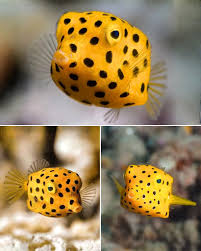
Juvenile Yellow Boxfish are among the most adorable and widely photographed fish in the ocean. Bright yellow with a pattern of dark blue or black polka dots covering the entire boxy body, tiny fins propelling them through the water in a characteristic hover, and large, expressive eyes that give them an almost cartoonish appeal. Adult Yellow Boxfish develop into a more complex coloration of yellow, blue, and white as they mature and can reach 18 inches in the wild, though aquarium specimens typically stay smaller.
Spotted Boxfish (Ostracion meleagris)
Males display a stunning combination of blue-black body covered in white spots on the upper surface, with orange flanks marked with white spots and complex facial patterning. Females are more uniformly brown and white spotted. One of the most colorful Boxfish species available in the hobby.
Longhorn Cowfish (Lactoria cornuta)
Distinguished by a pair of prominent horn-like projections on the forehead and smaller projections near the tail, the Longhorn Cowfish is a beloved and frequently kept member of the Boxfish family. It displays yellow and blue-green patterning and has a particularly endearing personality. Reaches 18 to 20 inches in the wild, with aquarium specimens typically reaching 10 to 14 inches.
The Ostracitoxin Warning
Before purchasing any Boxfish, every potential owner must understand one critical and unique characteristic of this family. When severely stressed, threatened, or dying, Boxfish can release a powerful toxin called ostracitoxin, also known as pahutoxin, from their skin into the surrounding water. This toxin is capable of killing all fish in the tank, including the Boxfish itself, in a very short period.
This defense mechanism is the primary reason Boxfish have a challenging reputation in the hobby. A Boxfish that is properly acclimated, kept in an appropriate environment, fed correctly, and protected from chronic stress is highly unlikely to release toxins. The toxin release almost always occurs in response to extreme stress, severe handling, or the dying process itself.
At Dr. Reef’s Quarantined Fish, every Boxfish goes through a comprehensive quarantine and conditioning process that dramatically reduces stress-related risk. A properly prepared, healthy, and settled Boxfish from Dr. Reef is far less likely to toxin-release than a wild-caught animal shipped without proper preparation.
Care Requirements
Tank Size
A juvenile Yellow Boxfish or Cowfish can start in a 75-gallon tank. Adults require 125 to 180 gallons or more, depending on the species. Boxfish need calm, open swimming space and do not do well in high-flow, chaotic environments that stress them and increase toxin-release risk.
Water Parameters
- Temperature: 72 to 78 degrees Fahrenheit
- Salinity: 1.020 to 1.025 specific gravity
- pH: 8.1 to 8.4
- Ammonia and Nitrite: 0 ppm
- Nitrate: Under 20 ppm
Flow and Stress Reduction
Low to moderate, gentle flow is essential. Boxfish are poor swimmers by the standards of most marine fish and are easily exhausted and stressed by strong currents. Design your flow pattern to create calm zones throughout the tank where the Boxfish can rest and move without constantly fighting the current.
Minimize disturbances near the tank, including loud noises, vibrations, and sudden movements. A calm environment is the single most important factor in preventing the chronic stress that leads to toxin release events.
Diet
Boxfish are omnivores that graze on a variety of foods in the wild, including algae, small invertebrates, sponges, and organic matter from substrate.
- Frozen mysis shrimp
- Frozen brine shrimp
- High-quality marine pellets
- Nori and seaweed sheets for plant matter
- Frozen clam or mussel meat
- Finely crushed marine flake food
Feed two to three times daily in small, consistent amounts. Boxfish are slow, deliberate feeders that need calm feeding conditions without fast, aggressive tank mates stealing food before they can eat. Target feeding near the Boxfish using a feeding wand or pipette ensures it receives adequate nutrition.
Aquarium Compatibility
Boxfish are peaceful animals that do best with similarly calm, non-aggressive tank mates. Good companions include peaceful Angelfish, Tangs in larger systems, Gobies, Firefish, Cardinalfish, and Blennies.
Avoid aggressive, fast-moving, or nippy fish that may stress the Boxfish through harassment. Triggerfish, Pufferfish, and large aggressive Wrasses are particularly problematic companions that increase chronic stress and toxin-release risk.
Boxfish are not reef-safe in tanks with live rock containing sponges or small invertebrates, as they will graze on them continuously. They are generally safe with corals but are best kept in FOWLR systems, given the catastrophic potential of a toxin release event in a coral-filled reef tank.
Visit Dr. Reef’s Quarantined Fish website for current pricing, species availability, and stock levels.