
Horn Shark for Sale: Tank Size, Care Requirements, and Ownership Guide

Horn Shark for Sale: Tank Size, Care Requirements, and Ownership Guide
Owning a Horn Shark is one of the most unique and rewarding experiences the saltwater hobby has to offer. Ancient in appearance, fascinating in behavior, and surprisingly manageable compared to most shark species, the Horn Shark brings a level of prehistoric wonder to a home aquarium that no other fish can match. At Dr. Reef’s Quarantined Fish, every Horn Shark is fully quarantined, conditioned, and eating before it ships to you. Visit Dr. Reef’s website for current pricing and availability.
What Is a Horn Shark?
The Horn Shark, known scientifically as Heterodontus francisci, is a small, bottom-dwelling shark native to the cool Pacific coastal waters of California and the Baja Peninsula in Mexico. It belongs to the family Heterodontidae, one of the oldest shark families on Earth, with a fossil record stretching back over 200 million years. When you look at a Horn Shark, you are looking at an animal whose basic design has barely changed since the age of dinosaurs.
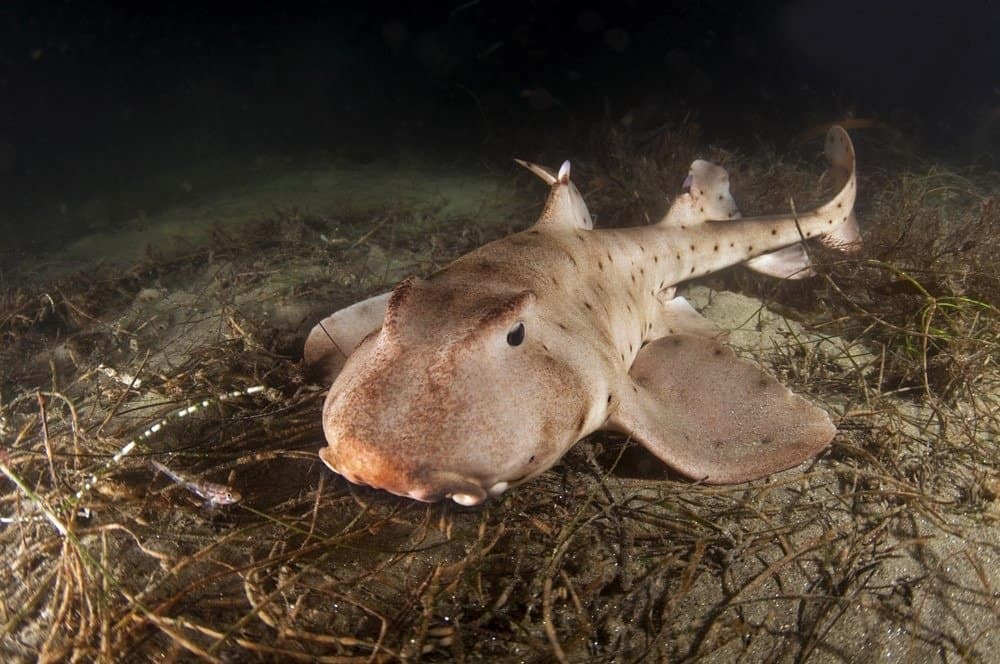
The name comes from the prominent ridges above the eyes that give the shark a horned appearance, and from the sharp dorsal fin spines that serve as a defense mechanism against predators. The body is stout and muscular with a blunt, pig-like snout, large pectoral fins used for walking along the bottom, and a beautiful pattern of dark brown spots on a tan or gray base that provides excellent camouflage against rocky substrate.
Most Horn Sharks reach 24 to 38 inches at adult size in captivity, and their thick, sturdy build gives them a presence that feels significantly larger than their length suggests. They are slow, deliberate animals with a calm demeanor and a surprisingly engaging personality that develops over years of captive keeping.
Care Requirements
Water Parameters
The most critical and most commonly overlooked aspect of Horn Shark care is temperature. Horn Sharks are cold-water animals that require significantly cooler water than typical tropical saltwater fish.
- Temperature: 60 to 68 degrees Fahrenheit. A quality aquarium chiller is absolutely required.
- Salinity: 1.022 to 1.025 specific gravity
- pH: 8.1 to 8.4
- Ammonia and Nitrite: 0 ppm. Elasmobranchs are extremely sensitive to ammonia.
- Nitrate: Under 20 ppm
- Dissolved Oxygen: High levels are essential. Strong surface agitation is required.
Substrate
Fine to medium sand substrate mixed with areas of smooth gravel or rounded rock replicates the natural rocky reef habitat of this species. Horn Sharks spend significant time resting and foraging along the bottom, and a varied natural substrate encourages their most interesting natural behaviors. Avoid sharp rocks or jagged substrate that can abrade the shark’s underside.
Aquascape
Rocky structures, caves, and overhangs are essential. Horn Sharks are crevice-resting animals that naturally wedge themselves into tight rocky spaces during daylight hours. Providing multiple cave and crevice options produces a confident, visible shark that uses its environment actively rather than pacing in an empty tank.
Filtration
Horn Sharks are heavy waste producers that require powerful, oversized filtration. A large sump with substantial biological media, strong mechanical filtration, and a quality protein skimmer is necessary. Plan filtration for a system at least twice the actual tank volume. Weekly water changes of 15 to 20 percent maintain the water quality this species requires long-term.
Tank Size Requirements
A juvenile Horn Shark can start in a 100-gallon system, but a full-grown adult requires a minimum of 180 to 200 gallons with a tank length of at least 6 feet. The tank footprint matters more than volume. Horn Sharks are bottom dwellers that need adequate floor space to move naturally. A long, wide tank with maximum floor area is far superior to a tall, narrow system of equivalent volume.
Plan your upgrade path before purchasing a juvenile so you are never in the position of having an adult shark in an undersized system.
Feeding
Horn Sharks have powerful, molar-like crushing teeth designed for eating hard-shelled prey. Feed frozen shrimp with shell on, frozen squid, frozen clam meat, whole frozen silversides, and fresh fish fillet pieces two to three times per week. Use long feeding tongs to present food near the snout during evening feeding periods when the shark is most active. Never hand-feed.
Every Horn Shark from Dr. Reef’s Quarantined Fish is already accepting frozen prey before it ships, eliminating the stressful food refusal period that affects unconditioned wild-caught animals.
Ownership Guide
The Horn Shark is best suited for intermediate to advanced hobbyists who can commit to a chilled, large-volume saltwater system for the shark’s full lifespan of 12 to 25 years. A secure tank cover, equipment guards on all intakes, and a chiller capable of maintaining temperatures in the low to mid 60s Fahrenheit are non-negotiable requirements.
Horn Sharks are not reef-safe and belong in dedicated FOWLR or predator display setups. They are not compatible with fish small enough to eat or any ornamental invertebrates.
Visit Dr. Reef’s Quarantined Fish website for current pricing, available sizes, and stock status.