
Blue Tang Juvenile vs Adult

Blue Tang Juvenile vs Adult: Growth Stages Explained
The Blue Tang (Paracanthurus hepatus) is one of the most recognized fish in the saltwater hobby, known by many names including Regal Tang, Hippo Tang, Palette Surgeonfish and Pacific Blue Tang. Made globally famous by a certain forgetful animated fish, it is also one of the most commonly misunderstood species when it comes to its growth stages. Many hobbyists purchase juveniles without realizing just how dramatically this fish changes in appearance and behavior as it matures. Here is a full breakdown of what to expect at every life stage.
The Larval Stage
Like most reef fish, the Blue Tang begins life as a pelagic larva known as an Acronurus, drifting in the open ocean. Larvae are translucent with silvery bodies and distinctively prominent dorsal and anal spines. This free-floating stage can last several weeks as currents carry the larvae across the reef ecosystem. Acronurus larvae eventually settle inshore, undergoing metamorphosis over the course of roughly a week. During this transition the translucent silver body gives way to the juvenile coloration that reef keepers often encounter at their local fish store.
The Juvenile Stage
Newly settled juvenile Blue Tangs are strikingly different from what most people expect of a “blue” tang. Juveniles display a vivid yellow body with blue accents around the eyes and a yellow tail. The signature black palette marking that defines the adult is present in outline but not yet fully connected. This bright yellow coloration is thought to serve as a social signal on the reef, communicating to adult fish that the juvenile poses no territorial threat and may also indicate the fish’s role as a potential cleaner. In the wild, juveniles shelter almost constantly within branching corals such as Pocillopora and rubble zones, darting out briefly to feed before retreating to safety.
In the aquarium, juvenile Blue Tangs retain this shy, rockwork-dependent behavior. It is entirely normal for a newly introduced juvenile to hide for several days or even a week before gaining enough confidence to venture out regularly. Providing plenty of live rock caves and crevices is essential for juvenile comfort and settling. Juveniles are also notably more susceptible to marine ich (Cryptocaryon irritans) than adults, making quarantine before display tank introduction a non-negotiable step. Blue Tangs are widely considered one of the most ich-prone fish in the hobby, and this vulnerability is greatest when the fish is young and freshly transported.
Juveniles typically enter the hobby at around 1 to 2 inches in length. Approximate adult size in the aquarium is 10 to 12 inches, though wild specimens can reach up to 12 to 13 inches. At roughly five years old and around 6 inches in length, captive specimens begin to approach sexual maturity.
The Intermediate Stage
As the juvenile grows through 2 to 4 inches, it enters an intermediate phase where the yellow body begins to take on blue tones. During this transitional phase the fish displays a patchwork of yellow and blue, sometimes with blue fins and a yellow body or a mixture of both across the flanks. This phase can look almost marbled in appearance and is one of the more visually interesting periods of the fish’s development. Behavior shifts too as the fish becomes more active in open water rather than constantly seeking shelter.
The Adult Stage
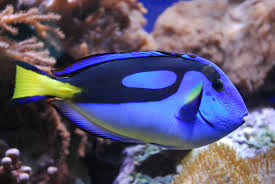
By the time the Blue Tang reaches adult coloration, the transformation is complete. Adults display the iconic royal blue body with the distinctive black palette marking extending from behind the eye across the upper body and connecting near the base of the tail. The tail fin retains its vivid yellow color and the caudal spine, located at the base of the tail on either side, becomes more prominent. Adults in peak coloration are genuinely stunning fish, and under reef lighting the deep blue can take on a vivid iridescent quality.
Adults are noticeably more confident and active than juveniles, spending much of their time cruising the mid and upper water column rather than hiding. In the wild, adult Blue Tangs form loose schools or swim in small social groups. In captivity they can become territorial toward other tang species if not given enough space, and toward other Blue Tangs in particular. Only one should typically be kept per tank unless the system is very large.
At night, adult Blue Tangs lighten their coloration to a pale or slightly violet-washed blue, and during spawning the body can shift to an even paler blue. Some individuals from the west-central Indian Ocean also display yellow or pale yellow on the lower belly as a regional color variant.
Tank Size Planning Across Growth Stages
One of the most common mistakes with this species is purchasing a tiny juvenile for a small tank with the intention of upgrading later. The Blue Tang grows relatively quickly and needs a minimum of 100 gallons as an adult, with 180 gallons or more being recommended by experienced keepers for the fish to truly thrive and swim naturally. A six-foot tank length is considered the gold standard. Planning for the adult size from day one is far better than repeated tank moves, which add stress and ich risk to an already susceptible species.
Diet stays consistent across all stages: primarily algae-based foods such as nori, spirulina-enriched pellets and herbivore frozen preparations, supplemented with meaty foods like frozen mysis for added protein.
At Dr. Reef’s Quarantined Fish, Blue Tangs go through a full quarantine protocol before being offered for sale, giving you the best possible start with one of the most beloved and demanding fish in the hobby.