
Johnson’s Fairy Wrasse

Johnson’s Fairy Wrasse: Care, Diet, and Tank Requirements
Among the many fairy wrasse species available in the marine aquarium hobby, the Johnson’s Fairy Wrasse (Cirrhilabrus johnsoni) occupies a special place. Rarely collected and relatively recently described to science, it combines the manageable care profile of the Cirrhilabrus genus with a coloration that stands apart from most other fairy wrasses. Here is a complete guide to keeping this captivating fish.
Natural Habitat and Origin
The Johnson’s Fairy Wrasse is native to the Western Central Pacific, specifically the deep lagoon and reef environments around the Marshall Islands, particularly the Kwajalein Atoll. In the wild it is found at depths of roughly 60 to 90 feet, inhabiting areas of sparse coral rubble, mixed algae such as Halimeda, soft corals and rocky structures encrusted with coralline algae. This relatively deep natural habitat means the species is accustomed to moderate light intensities and areas with gentle but consistent water movement.
Its limited collection area and specific habitat depth make it a species that appears in the aquarium trade infrequently. When it does become available, it tends to attract the attention of experienced reef keepers and fairy wrasse collectors.
Appearance and Sexual Dimorphism
The Johnson’s Fairy Wrasse is a compact species reaching approximately 3 inches in adult length, though some individuals can reach up to 4.5 inches. It displays one of the more striking color differences between sexes in the Cirrhilabrus genus.
Females display a pink to peach base coloration with subtle yellow lines and softer overall markings. They are attractive in their own right but noticeably more subdued than the males.
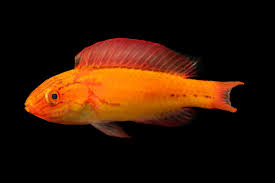
Males are spectacular. The body carries vivid orange to orange-red tones and the fins develop brilliant red coloration highlighted by electric blue markings. The intensity of these colors is not fixed. Like most fairy wrasses, males can dramatically shift and intensify their display coloration during courtship or when asserting social dominance. When a male performs its courtship ritual for females in the tank, the color flash it produces is one of the most compelling behavioral displays available in the reef hobby.
As a protogynous hermaphrodite, all Johnson’s Fairy Wrasses begin life as females. The dominant individual in a group will transition to male over time, and in some cases multiple females in a group may eventually transition even without clear social cues to do so.
Tank Requirements
The Johnson’s Fairy Wrasse is well-suited to a range of reef tank sizes. A minimum of 55 gallons is recommended for a single specimen or a pair, with larger tanks preferred for harem setups or mixed wrasse communities. The aquarium should be well established with plenty of live rock providing caves, overhangs and crevices for shelter and exploration, while still maintaining open swimming areas in the mid and upper water column where this species spends most of its active hours.
Standard reef water parameters apply: temperature 72 to 78°F, pH 8.1 to 8.4, specific gravity 1.020 to 1.025. Moderate water flow suits the species well, reflecting its natural deep lagoon habitat.
A tight-fitting lid is absolutely essential. Like all Cirrhilabrus fairy wrasses, the Johnson’s is an adept jumper and will exit an open or poorly covered tank quickly, especially when startled or when first introduced to a new environment.
When adding to a tank with existing fish, introduce the Johnson’s Fairy Wrasse last or simultaneously with other wrasse species to reduce the likelihood of harassment from established residents. Despite being peaceful with most tankmates, this species can face bullying from fish already in residence when added to an occupied system.
Diet
The Johnson’s Fairy Wrasse is a carnivore that feeds primarily on small planktonic invertebrates in the wild. In the aquarium it accepts a varied diet readily, which is one of the reasons the species settles in well with attentive care. Offer vitamin-enriched frozen mysis shrimp, frozen brine shrimp, high-quality marine pellets and flake foods formulated for carnivores. Nori seaweed can also be offered occasionally for dietary variety, and a tank with established live rock will provide natural grazing opportunities on copepods and amphipods throughout the day.
Feed multiple small portions per day rather than one or two large meals. Johnson’s Fairy Wrasses are active fish with fast metabolisms and benefit from a consistent feeding schedule that mirrors their natural continuous feeding behavior on the reef. Regular feeding with nutrient-rich and color-enhancing foods directly supports the male’s vibrant coloration.
Compatibility
The Johnson’s Fairy Wrasse is peaceful toward virtually all non-similar tankmates. It does well alongside clownfish, gobies, blennies, dartfish, cardinalfish and most tangs. It is fully reef safe and will not harm corals, clams or other sessile invertebrates.
The key compatibility consideration is with other male fairy wrasses. Two males of the same or visually similar species will almost always fight, often seriously. Keep only one male per system. A harem of one male with several females introduced simultaneously is the ideal social structure for this species and produces the most natural and engaging behavioral display. Avoid keeping the Johnson’s Fairy Wrasse with large predatory or aggressive fish that may bully or view it as prey.
For anyone looking to source a healthy and acclimated specimen, Dr. Reef’s Quarantined Fish carries fairy wrasses including rare and less commonly seen species, with every fish quarantined and confirmed eating prepared foods before it reaches your display tank.