
Powder Brown Tang Care Guide

Powder Brown Tang Care Guide: Tank Setup and Health Tips
The Powder Brown Tang doesn’t always get the spotlight that its cousins, the Powder Blue and the Purple Tang, tend to attract, but spend a little time with one in a well-lit reef tank and you’ll quickly understand why so many hobbyists consider it one of the most underrated tangs in the hobby. It’s elegant, active, and genuinely beautiful under aquarium lighting, with a coloration that photographs poorly but absolutely shines in person.
What Is the Powder Brown Tang?
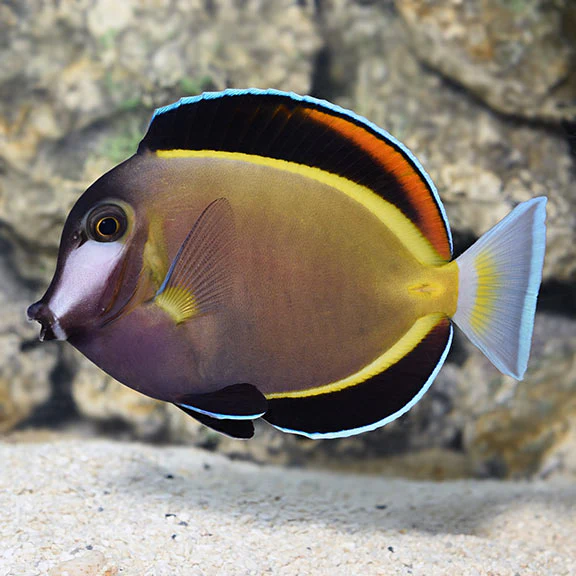
The Powder Brown Tang (Acanthurus japonicus), also known as the Japan Surgeonfish, White-faced Tang, or Powder Brown Surgeonfish, is native to the Indo-Pacific, found from Indonesia and the Philippines across clear lagoons, shallow reef slopes, and near-shore reef environments. Its body is a warm brown-to-blackish-blue with dark dorsal and anal fins edged in blue, an orange stripe along the dorsal fin, a blue tail with a yellow vertical bar, and the most distinctive feature of all: a bold white mark on the cheek, running from the mouth to just below the eye. Under strong LED or actinic lighting, the iridescent blue edging on the fins genuinely glows, and the wishbone-shaped yellow markings along the body become far more striking than any photo suggests.
Adults grow to around 7 to 9 inches and can live 10 or more years in a well-maintained aquarium, a meaningful commitment that deserves thoughtful setup from the start.
Tank Setup
A minimum tank size of 125 gallons is needed for the Powder Brown Tang, and this isn’t a guideline to push against. These are active, fast-swimming fish that cover a lot of ground during the day. A tank shorter than 60 inches in length gives them little room to build the kind of cruising behavior that keeps them healthy and stress-free.
The aquarium should have substantial live rock providing both algae growth for grazing and plenty of caves and crevices the fish can retreat into when they want shelter. An open swimming space is equally important. A balance of rockwork and open water gives this fish the two things it needs most: somewhere to hide and somewhere to move. Strong, consistent water flow and excellent water quality are non-negotiable for this species, as tangs in general are more susceptible to disease when conditions deteriorate.
Water parameters should be kept stable: temperature between 74 and 82°F, salinity of 1.023 to 1.025, and pH between 8.1 and 8.4. High water quality, pristine filtration, a reliable protein skimmer, and regular water changes make a measurable difference in the long-term health of any tang, and the Powder Brown is no exception.
Diet and Feeding
Like all tangs, the Powder Brown is primarily an herbivore and needs a diet rich in marine-based algae and seaweed to stay healthy long-term. Nori sheets clipped to the aquarium glass or a feeding clip should be available throughout the day. This fish grazes constantly, and removing access to plant matter between feedings is a mistake. Spirulina-based pellets, dried seaweed products, and algae blends form the core of a solid diet.
The Powder Brown will also eat frozen mysis shrimp, brine shrimp, and meaty preparations offered to other fish in the tank, but these should complement rather than replace its plant-based diet. Feeding two to three times daily, with constant access to seaweed, is the approach that works best.
Temperament and Tankmates
The Powder Brown Tang generally has a calmer temperament than some of its Acanthurus relatives, but it is still semi-aggressive toward other tangs, particularly those of similar body shape. It is best kept as the only tank in its tank unless the system is very large and territories can be established without constant conflict. If other tangs must be present, adding them simultaneously to a new tank rather than introducing the Powder Brown first reduces aggression significantly.
Toward most non-tang species wrasses, gobies, anthias, blennies, clownfish, and cardinalfish, the Powder Brown Tang is a peaceful and agreeable community member. It is fully reef-safe and will not harm corals, anemones, or ornamental invertebrates.
Health Considerations – Why Quarantine Matters
A fish introduced directly from the ocean to a display tank without any quarantine can devastate an otherwise healthy reef with the disease it carries unknowingly.
This is exactly why sourcing a quarantined Powder Brown Tang from a specialist like Dr. Reef’s Quarantined Fish makes such a material difference. Their Powder Brown Tang is listed at $139.99 to $160.99, and every fish goes through a proper quarantine.
The difference between a quarantined Powder Brown Tang and a non-quarantined one isn’t subtle. A conditioned fish eats immediately, shows no signs of stress-related disease, and settles into the new tank far more quickly than a fish still recovering from the shipping process. For a tang species that is notoriously sensitive during the acclimation phase, that head start is genuinely significant.