
Pacific Cleaner Shrimp for Sale: Benefits, Care Guide, and Reef Compatibility

Pacific Cleaner Shrimp for Sale: Benefits, Care Guide, and Reef Compatibility
Some additions to a reef tank are purely decorative. The Pacific Cleaner Shrimp is something better. It is beautiful, genuinely useful, and one of the most interactive invertebrates you can add to a saltwater aquarium. If you have never watched a Cleaner Shrimp walk directly onto the body of a fish and methodically remove parasites while the fish holds perfectly still, you are in for one of the most fascinating displays the reef hobby has to offer. At Dr. Reef’s Quarantined Fish, every Pacific Cleaner Shrimp is fully quarantined and conditioned before it ships to your door. Visit Dr. Reef’s website for current pricing and availability.
What Is a Pacific Cleaner Shrimp?
The Pacific Cleaner Shrimp, known scientifically as Lysmata amboinensis, is one of the most popular and widely kept marine invertebrates in the saltwater aquarium hobby. It is native to tropical reef environments throughout the Indo-Pacific Ocean and is found on coral reefs from the Red Sea and East Africa all the way to the Pacific Islands and Hawaii.
In the wild, Pacific Cleaner Shrimp set up cleaning stations on coral reefs, specific locations where fish actively seek them out to have parasites, dead tissue, and debris removed from their bodies, gills, and even the inside of their mouths. Fish line up at these cleaning stations and display specific submission postures that signal to the shrimp that they are there to be cleaned rather than to eat the shrimp. The cleaning relationship is one of the most remarkable examples of mutualistic symbiosis in the ocean.
In a home reef tank, Pacific Cleaner Shrimp perform this same service actively and reliably. They set up cleaning stations, attract fish to be cleaned, and actively reduce parasite loads on fish in a way that complements your tank’s overall health management.
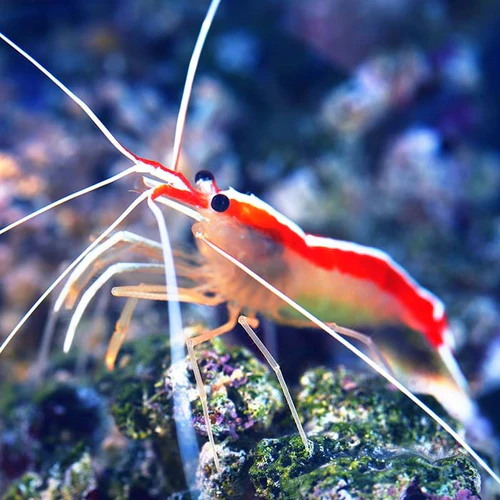
Beyond their cleaning function, Pacific Cleaner Shrimp are simply beautiful animals. A bright red body with a bold white stripe running the length of the back and bright white antennae that wave constantly make them one of the most visually striking invertebrates in the hobby.
Why Buy From Dr. Reef’s Quarantined Fish?
Pacific Cleaner Shrimp are sensitive animals during the shipping process. Stress from uncontrolled temperature swings, ammonia buildup in shipping water, and poor handling practices are the most common reasons shrimp arrive in poor condition from low-quality sources.
At Dr. Reef’s Quarantined Fish, every Pacific Cleaner Shrimp goes through a complete quarantine and conditioning process:
- Full observation period confirming normal movement, feeding behavior, and healthy body condition
- Stable, reef-quality water conditions were maintained throughout the quarantine period
- Animals showing any signs of lethargy, unusual posture, or compromised molting are not cleared for shipping
- Only shrimp showing full antenna extension, active movement, and healthy coloration are approved for sale
The difference between a healthy, active Pacific Cleaner Shrimp that begins setting up a cleaning station within days of arrival and a stressed, declining animal that hides and eventually disappears starts entirely with the sourcing and preparation process. Dr. Reef’s commitment to invertebrate health gives you the best possible animal for your reef.
Visit Dr. Reef’s Quarantined Fish website for current pricing and availability.
Species Overview
Scientific Name: Lysmata amboinensis
Common Names: Pacific Cleaner Shrimp, Scarlet Skunk Cleaner Shrimp, Indo-Pacific White-Banded Cleaner Shrimp
Origin: Indo-Pacific Ocean, Red Sea, East Africa, Hawaii
Adult Size: 2 to 2.5 inches body length, with antennae extending considerably further
Lifespan: 2 to 3 years in captivity with proper care
Temperament: Completely peaceful toward fish and reef inhabitants
Reef Safe: Yes, fully and completely reef-safe
Activity Level: Moderate to high. Active throughout the day and evening, particularly during feeding times and when fish approach for cleaning.
Benefits of Keeping Pacific Cleaner Shrimp
The Pacific Cleaner Shrimp offers a combination of benefits that no other single invertebrate in the hobby can match.
Biological Parasite Control
The most celebrated benefit of the Pacific Cleaner Shrimp is its active removal of external parasites from fish. By methodically cleaning fish that present themselves at the cleaning station, Cleaner Shrimp remove ich cysts, flukes, skin parasites, and other external pathogens before they complete their life cycles. While a Cleaner Shrimp is not a standalone treatment for active disease outbreaks, it provides consistent, ongoing parasite pressure reduction that meaningfully supports fish health over the long term.
Fish Health Monitoring
Fish that present themselves for cleaning are often among the first to show visible health changes. Watching which fish visit the cleaning station and how frequently provides valuable insight into the health dynamics of your reef community. A fish that suddenly begins visiting the cleaning station repeatedly may be showing early signs of a parasite burden that warrants closer observation.
Water Quality Contribution
Like all active invertebrates in a reef tank, Pacific Cleaner Shrimp contribute to the breakdown of organic waste through their feeding activity on organic debris, detritus, and uneaten food particles they encounter during their movements around the tank.
Interactive Display Value
The cleaning station behavior of Pacific Cleaner Shrimp is one of the most fascinating and educational displays available in a home reef aquarium. Watching a large Angelfish or Tang hold perfectly still while a shrimp less than a tenth its size walks across its body and cleans between its scales is genuinely remarkable every time it happens. It never gets old.
Care Guide
Tank Size
Pacific Cleaner Shrimp are comfortable in tanks as small as 10 gallons. They thrive in any size reef or community saltwater system and are one of the most practical invertebrate additions across the full range of tank sizes, from nano reefs to large display systems.
Water Parameters
- Temperature: 72 to 78 degrees Fahrenheit
- Salinity: 1.023 to 1.026 specific gravity
- pH: 8.1 to 8.4
- Ammonia and Nitrite: 0 ppm
- Nitrate: Under 20 ppm
- Calcium: 380 to 450 ppm (important for healthy molting)
- Iodine: Adequate levels through regular water changes or supplementation
Salinity Stability
Pacific Cleaner Shrimp are sensitive to sudden salinity changes. An automatic top-off system that replaces evaporated water continuously is the most effective way to maintain salinity stability in a reef tank housing Cleaner Shrimp.
Acclimation
Drip acclimation over 30 to 45 minutes is strongly recommended for all shrimp species. Rapid changes in water parameters during introduction are a common cause of stress and loss in newly added invertebrates.
Molting
Like all crustaceans, Pacific Cleaner Shrimp grow by periodically shedding their exoskeleton in a process called molting. After molting, the shrimp is temporarily soft-bodied and extremely vulnerable. During this period, it will hide in rockwork and remain inactive for 12 to 24 hours while the new exoskeleton hardens.
Do not remove the shed exoskeleton from the tank immediately. The shrimp will often return to consume it, recovering valuable minerals, including calcium and iodine that support the development of the new shell.
Adequate calcium, alkalinity, and iodine in the tank water support healthy, regular molting cycles. Irregular or incomplete molts are almost always related to water chemistry deficiencies and are correctable by improving and stabilizing reef chemistry parameters.
Feeding
Pacific Cleaner Shrimp are opportunistic omnivores that find a significant portion of their food through their cleaning activities and by scavenging organic matter around the tank. In a well-fed reef community, they generally find enough nutrition on their own.
Supplemental feeding significantly improves their health, coloration, and molting regularity.
What to Feed
- Finely crushed marine flake food
- Frozen mysis shrimp in small amounts
- Frozen cyclops
- Phytoplankton and other fine reef foods are broadcast into the water column
- Reef coral foods that are fine enough in particle size for the shrimp to capture
- Organic debris and uneaten food particles that they encounter naturally during tank exploration
Feeding Method
Broadcast feed near the cleaning station area where the shrimp spends most of its time. Pacific Cleaner Shrimp are active and will find food distributed in the water column near their territory quickly.
Reef Compatibility
The Pacific Cleaner Shrimp is one of the most completely reef-safe invertebrates available in the marine hobby.
They are safe with all coral species, including delicate SPS corals, LPS corals, soft corals, and anemones. They do not nip at coral tissue, disturb coral polyps, or interfere with coral feeding behavior. They can occasionally be observed cleaning the surface of larger coral colonies, which is harmless and potentially beneficial.
They are safe with all other ornamental invertebrates, including other shrimp species, snails, hermit crabs, urchins, starfish, and clams.
They are safe with all peaceful to moderately aggressive fish species that do not include shrimp as a regular part of their diet.
Fish to Avoid Keeping With Pacific Cleaner Shrimp
- Triggers of any species
- Pufferfish
- Large aggressive Wrasses, including many Coris species
- Groupers
- Lionfish
- Large predatory fish of any species that actively hunt crustaceans
In tanks housing these fish, Pacific Cleaner Shrimp will eventually be eaten regardless of the cleaning relationship. Some large predatory fish do learn to accept Cleaner Shrimp as cleaning partners rather than prey, but this is unpredictable and cannot be relied upon.
Setting Up a Cleaning Station
Pacific Cleaner Shrimp naturally establish a cleaning station in a specific location in the tank, usually on a prominent piece of rockwork at mid-height where fish can easily approach. You can encourage cleaning station establishment by placing the shrimp near a central, well-lit rock structure with good visibility from multiple directions.
Once the cleaning station is established, you will notice fish actively approaching the location, extending their fins, opening their gills, and holding still while the shrimp works. Some fish become regular visitors to the cleaning station multiple times per day. Others visit occasionally. The frequency often increases when the fish is carrying a higher-than-normal parasite burden.
Multiple Cleaner Shrimp
Pacific Cleaner Shrimp are simultaneous hermaphrodites, meaning every individual carries both male and female reproductive organs. Any two Pacific Cleaner Shrimp can form a breeding pair. Keeping two or more Pacific Cleaner Shrimp together in a large enough tank is perfectly practical and can result in the production of larvae, though raising larvae to settlement is a specialized undertaking that requires dedicated rearing equipment.
Multiple Cleaner Shrimp in the same tank typically establish cleaning stations in different areas, effectively expanding the cleaning service coverage across more of the tank.
Frequently Asked Questions
Will a Pacific Cleaner Shrimp cure ich in my tank? No. A Pacific Cleaner Shrimp meaningfully reduces external parasite pressure on fish over time, but is not a substitute for proper quarantine and disease treatment during active outbreaks. Think of it as ongoing maintenance rather than emergency treatment.
How do I know if my Cleaner Shrimp is healthy?
A healthy Pacific Cleaner Shrimp is active during the day, displays full antenna extension and normal waving behavior, moves smoothly across rockwork and substrate, visits fish that approach its territory, and eats readily when food is offered near its station.
Can I keep a Pacific Cleaner Shrimp with a Mantis Shrimp?
No. A Mantis Shrimp will kill and eat a Pacific Cleaner Shrimp immediately. They must never be housed together.
How many Pacific Cleaner Shrimp can I keep per tank?
In a 30-gallon tank, one to two is appropriate. In larger systems, the number can scale up. Multiple Cleaner Shrimp in a large reef system enhance the biological cleaning benefit and create multiple active cleaning stations that serve more fish more frequently.
Where can I find current pricing for Pacific Cleaner Shrimp at Dr. Reef?
Visit Dr. Reef’s Quarantined Fish website directly for current pricing and stock availability.
Does Dr. Reef offer a live arrival guarantee on invertebrates?
Yes. Dr. Reef’s Quarantined Fish stands behind every animal they ship, including all invertebrates. Visit the website for the most current guarantee and shipping policy details.
Final Thoughts
The Pacific Cleaner Shrimp is one of the smartest, most practical, and most rewarding invertebrate additions available for any saltwater aquarium. It is beautiful, interactive, genuinely beneficial to fish health, and completely safe with every coral and invertebrate in your reef. At Dr. Reef’s Quarantined Fish, every Pacific Cleaner Shrimp arrives properly quarantined and conditioned, ready to set up its cleaning station and start contributing to the health and beauty of your reef from day one.
Visit Dr. Reef’s Quarantined Fish website today for current pricing and availability.