
Midnight Dogface Puffer

Can a Midnight Dogface Puffer Be Kept Safely in a Reef Tank Without Harming Invertebrates?
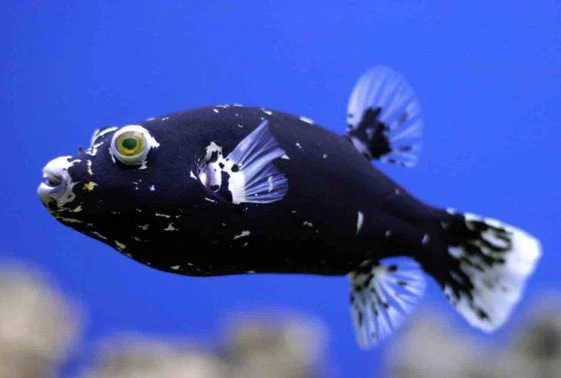
The Midnight Dogface Puffer (Arothron nigropunctatus) is one of the most charismatic, personable, and visually striking fish available to marine aquarists. Its deep, velvety blue-black coloration, intelligent eyes, and almost puppy-like curiosity make it one of those fish that hobbyists fall in love with the moment they encounter one. The question that follows almost immediately, however, is one of the most commonly asked in the reef hobby: can a Midnight Dogface Puffer be trusted in a reef tank alongside corals and invertebrates without causing serious damage? The honest answer is nuanced, and understanding it fully before making a purchase decision is essential to the long-term success of both the fish and the system it will inhabit.
Understanding the Midnight Dogface Puffer’s Natural Instincts
To answer the reef compatibility question honestly, you first need to understand what this fish is built to do. Dogface puffers in the wild are opportunistic predators that feed on hard-shelled invertebrates, including crustaceans, mollusks, tube worms, and sea urchins. Their fused beak-like teeth are specifically designed to crush hard shells and exoskeletons. This is not incidental behavior that can be trained away. It is the biological identity of the species, refined over millions of years of evolution. Any honest assessment of reef compatibility has to begin with that biological reality rather than the hopeful exceptions that occasionally circulate on reef forums.
This means that certain categories of invertebrates are simply not compatible with a Midnight Dogface Puffer under any realistic circumstances. Shrimp, crabs, snails, urchins, starfish, and most other mobile invertebrates will be viewed as food rather than tank mates. Clams and other bivalves are similarly at risk. The puffer’s beak is powerful enough to crack through the shells of most of these animals with ease, and its curiosity means it will investigate and sample anything new in the tank regardless of whether it constitutes a meal.
What About Corals? The More Complex Part of the Answer
The relationship between Midnight Dogface Puffers and corals is where the nuance genuinely enters the picture. Corals are not a natural prey item for Arothron puffers, and many hobbyists do successfully keep them alongside stony and soft corals without incident. However, the operative word is many, not all, and the difference between an individual puffer that ignores corals and one that nips at them relentlessly is almost entirely unpredictable. Puffer behavior toward corals is highly individual. Some specimens will coexist with a fully stocked reef for years without touching a single coral. Others will develop a nipping habit that can destroy an entire coral collection in a matter of weeks.
The nipping behavior, when it occurs, appears to be driven by curiosity and boredom as much as predatory instinct. Puffers are highly intelligent fish that require mental stimulation, and a fish that is not sufficiently engaged by its environment or its feeding routine is a fish that will begin investigating everything in the tank with its beak. Large, fleshy soft corals such as Toadstool Leathers, Sinularia, and Zoanthids are the most frequent targets when nipping does occur. Small polyp stony corals and large polyp stony corals with extended tissue are also vulnerable. Encrusting corals on flat rock surfaces are generally at lower risk, though no coral should be considered fully protected.
The honest summary for corals is this: it is a gamble, and the stakes are high. Some aquarists win that gamble for years. Others lose it within the first month. There is currently no reliable method for predicting which category a given individual puffer will fall into before it is in the tank.
The Systems That Give the Best Odds of Success
For aquarists who are determined to attempt keeping a Midnight Dogface Puffer in a reef context, certain system configurations improve the odds meaningfully. A large tank, 200 gallons or more, reduces the concentration of the puffer’s attention on any given area of the reef and gives corals more physical distance from a curious puffer investigating the rockwork. Larger tanks also dilute aggression and curiosity in ways that simply are not possible in smaller systems.
Feeding the puffer generously and consistently is one of the most effective management strategies available. A well-fed puffer with a varied and interesting diet is a less curious and less destructive puffer. Offer a wide variety of meaty foods including whole clams on the half shell, raw shrimp, squid, and quality frozen marine foods multiple times daily. The physical act of crushing hard-shelled food items satisfies the beak-use instinct that might otherwise be redirected toward coral tissue or tank equipment.
Structuring the reef to place corals toward the upper areas of the aquascape, away from the substrate and mid-water zones where puffers tend to spend most of their time, also reduces incidental contact. This is an imperfect solution, but combined with generous feeding and a spacious system, it improves the probability of a stable coexistence meaningfully.
The Realistic Verdict: A Fish-Only or FOWLR System Is the Safer Home
For the majority of aquarists, the most honest recommendation is that the Midnight Dogface Puffer belongs in a fish-only or fish-only-with-live-rock system rather than a full reef. In that environment, it is an exceptional fish in every respect. Its personality, its intelligence, its interactive relationship with the aquarist, and its dramatic appearance make it one of the most rewarding fish in the hobby when it is given the space and environment suited to its nature. Attempting to constrain that nature within the delicate ecosystem of a reef stocked with expensive corals and invertebrates introduces a level of ongoing risk that most serious reef keepers ultimately find untenable.
That said, if you are an experienced aquarist with a very large system, the willingness to accept real risk to your coral collection, and the commitment to the feeding and management strategies that improve the odds of success, a Midnight Dogface Puffer in a reef context is not an impossible proposition. It is simply an honest one, approached with clear eyes rather than optimism.
Getting the Right Fish for the Right System
Whether you are building a dedicated fish-only system to showcase a Midnight Dogface Puffer properly or you are an experienced reef keeper prepared to take the calculated risk, the quality of the individual fish you start with determines everything that follows. At Dr. Reef’s Quarantined Fish, every Midnight Dogface Puffer we offer has completed our full quarantine protocol, is confirmed eating prepared foods aggressively, and arrives in the genuine health that gives it the best possible start in your system.
Browse our current availability and invest in a fish that is ready. The Midnight Dogface Puffer is one of the hobby’s most extraordinary animals. It deserves the right home, and so does your system.