
How to Feed the Peacock Mantis Shrimp

How to Feed the Peacock Mantis Shrimp
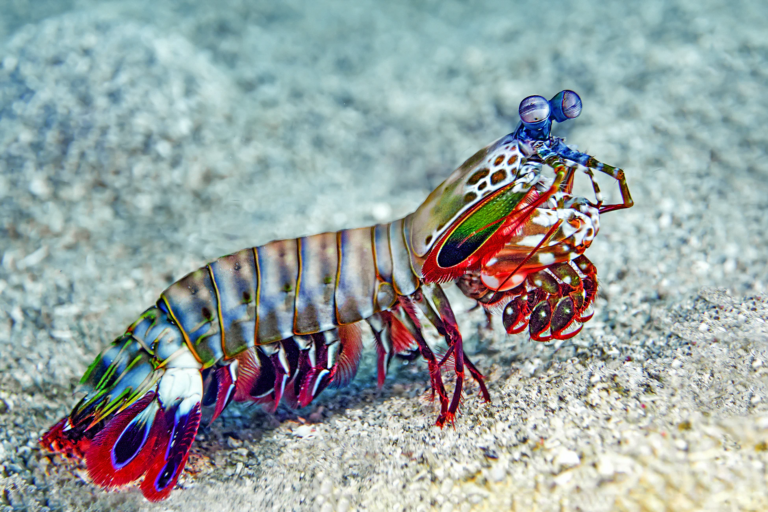
The Peacock Mantis Shrimp is a voracious carnivore. The Dr. Reef’s product page specifies live or frozen crustaceans including shrimp and crabs, live feeder fish, mollusks including clams, mussels, and snails, frozen krill, and raw seafood like shrimp, scallops, and fish.
Providing shell-on prey items is important. The natural smashing behavior keeps the raptorial appendages properly exercised and helps wear them down naturally. An animal that never smashes hard shells may develop overgrown appendages over time.
Feed two to three times per week. Remove uneaten food promptly. The mantis shrimp may cache food in its burrow, which you may not be able to reach before it begins to decompose. Regular water changes and strong filtration compensate for this natural behavior.
The Peacock Mantis Shrimp’s Extraordinary Eyes
The Peacock Mantis Shrimp possesses the most complex visual system of any known animal on earth. Humans have three types of color receptors. The Peacock Mantis Shrimp has sixteen. It can see ultraviolet light, infrared light, and polarized light that are completely invisible to humans. Its eyes move independently and can process visual information from multiple directions simultaneously.
The Dr. Reef’s product page notes that this species is among the most intelligent invertebrates and is capable of recognizing individual humans and learning to associate specific people with feeding times. Many keepers report their mantis shrimp becoming noticeably more active and responsive when the same person approaches the tank. This level of individual recognition and behavioral response is exceptionally rare in invertebrates.
Safety Warnings for Peacock Mantis Shrimp Keepers
The Dr. Reef’s product page includes explicit safety warnings that every potential buyer must understand before purchasing.
Never place unprotected hands inside the tank. The Peacock Mantis Shrimp can cause serious injury. Use tools and never put fingers near the animal during maintenance.
Protect all equipment inside the tank. Heaters, powerheads, and thermometers are all potential strike targets. Use equipment guards or choose external equipment wherever possible.
Secure the lid with weight or clips. A mantis shrimp that escapes its tank will not survive long and creating an escape path is not difficult for a determined animal.
Keep the tank away from high traffic areas where knocks or vibrations could trigger defensive striking behavior toward the glass.
Who Should Own a Peacock Mantis Shrimp?
The Dr. Reef’s product page rates this species as expert care level and that designation is accurate. This is not a fish to add to an established reef. It is not a community tank inhabitant. It is a dedicated specimen display for an experienced keeper who has set up a purpose built system specifically for this animal and who genuinely enjoys observing intelligent, powerful predatory behavior up close.
For the right keeper with the right setup, the Peacock Mantis Shrimp is one of the most captivating and scientifically remarkable animals available in the entire marine hobby. For anyone without a proper acrylic or thick glass species-only system already in place, this is not the right time to buy.
Frequently Asked Questions About the Peacock Mantis Shrimp
Q: Can a mantis shrimp break aquarium glass?
A: Yes. The Dr. Reef’s product page warns explicitly that strikes can crack standard aquarium glass. Acrylic or reinforced glass with minimum half inch thickness is strongly recommended.
Q: Is the Peacock Mantis Shrimp reef safe?
A: No. Confirmed not reef safe on the Dr. Reef’s product page. It will destroy corals, invertebrates, and fish.
Q: What is the minimum tank size for a Peacock Mantis Shrimp?
A: 30 gallons confirmed minimum. 50 gallons or more is preferred for full grown adults.
Q: What are the confirmed water parameters?
A: Temperature 72 to 78 degrees Fahrenheit, salinity 1.023 to 1.025, pH 8.1 to 8.4.
Q: Can I keep two Peacock Mantis Shrimp together?
A: No. Must be kept as a single specimen only except for breeding purposes. They are extremely aggressive toward any other tank inhabitant.
Q: How big does the Peacock Mantis Shrimp get?
A: Up to 7 inches confirmed on the Dr. Reef’s product page.
Q: How long does the Peacock Mantis Shrimp live?
A: 3 to 6 years with proper care. Some reports indicate up to 20 years with exceptional long term care.
Q: Why buy from Dr. Reef’s Quarantined Fish?
A: Every specimen ships professionally quarantined, feeding on prepared foods, and observed for health and behavior before delivery. At $149.99, you are receiving an animal ready for its new dedicated display system.
Expert Tips for Healthy Fish
The Peacock Mantis Shrimp is a genuinely extraordinary animal that rewards expert keepers with a species only display unlike anything else in the marine hobby. It is intelligent, visually breathtaking, and endlessly fascinating to observe. It is also completely incompatible with any other living thing in its tank, capable of cracking glass, and potentially dangerous to handle.
Go in prepared with the right tank, the right equipment, and realistic expectations and the Peacock Mantis Shrimp from Dr. Reef’s Quarantined Fish at $149.99 is one of the most remarkable invertebrate purchases available anywhere in the hobby.