
Hawaiian Yellow Tang for Sale: Care Requirements, Tank Size, and Availability Guide

Hawaiian Yellow Tang for Sale: Care Requirements, Tank Size, and Availability Guide
Some fish are pretty. Some fish are popular. And then there is the Hawaiian Yellow Tang. A fish so pure in its beauty, so deeply woven into the culture of reef keeping, and so genuinely rare right now that owning one feels like holding a piece of living history in your aquarium.
At Dr. Reef’s Quarantined Fish, the Hawaiian Yellow Tang is available right now for $499.99. It is professionally quarantined, health-verified, and ready to ship overnight directly to your door. If you have been waiting for the right moment to add this legendary fish to your reef, this guide gives you everything you need to know before you make your move.
What Makes the Hawaiian Yellow Tang So Special
Pure Color. Zero Compromise.
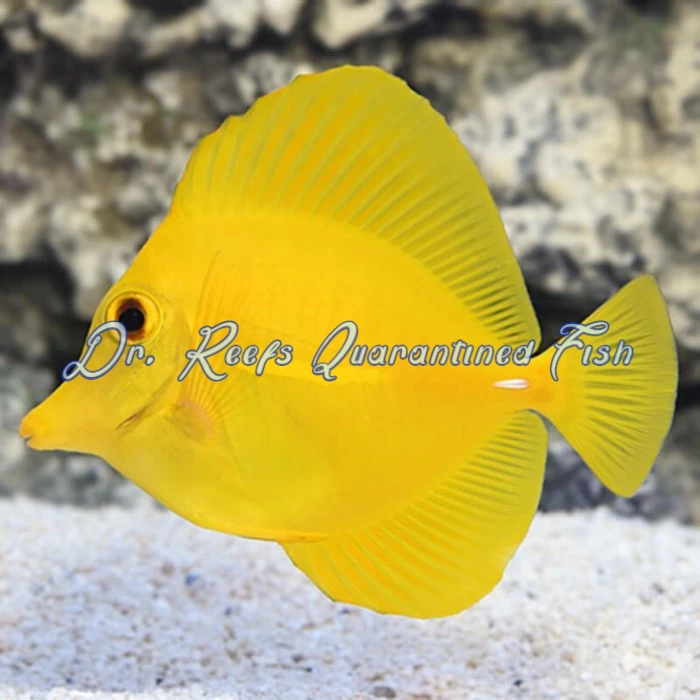
Zebrasoma flavescens, the Hawaiian Yellow Tang, does not need patterns or markings to stand out. Its entire body is one unbroken shade of brilliant yellow, from the tip of its nose to the edge of its tail. It does not look like something from a pet store. It looks like something from the surface of the sun.
At night, the fish reveals a quiet secret. A faint horizontal stripe appears across its midsection while it sleeps. Come morning, when the lights slowly rise, the stripe disappears and the full yellow returns. That daily transformation alone makes this fish endlessly fascinating to watch.
A Fish With a Hawaiian Soul
While small populations exist across the broader Pacific, Hawaii is where this fish truly belongs. For decades, Hawaiian reefs supplied the global aquarium trade with more Yellow Tangs than any other source on earth. Then in 2021, Hawaii banned commercial aquarium fish collection in state waters. The supply of Hawaiian Yellow Tangs collapsed almost overnight. Prices that once hovered around $30 to $50 climbed sharply and have stayed elevated ever since.
The $499.99 price at Dr. Reef’s reflects real market conditions. This is a genuinely rare fish right now. Buying one from a trusted, quarantined source at this moment in the hobby is a decision that reef keepers five years from now will understand completely.
Hawaiian Yellow Tang Care Requirements
Water Parameters That Cannot Be Compromised
Clean, stable water is the foundation of everything with this fish. Maintain salinity between 1.023 and 1.026. Keep temperature between 72 and 78 degrees Fahrenheit. Hold pH between 8.1 and 8.4. Ammonia and nitrite must always read zero. Nitrates should stay below 10 parts per million and phosphates as close to zero as your system can achieve.
Weekly water changes of 10 to 15 percent, a quality protein skimmer, and strong biological filtration are not optional extras for a fish at this price. They are the minimum standard of care this animal deserves.
Flow and Oxygenation
Hawaiian Yellow Tangs originate from high-energy reef zones where water movement is constant. They need strong, well-oxygenated water with circulation reaching every part of the tank. A wavemaker or multiple powerheads creating varied, natural flow patterns keeps this fish comfortable and active. Sluggish, poorly oxygenated water is one of the fastest paths to a stressed and sick Yellow Tang.
No extreme lighting demands here. Standard reef lighting works fine for the fish itself. However, running a blue-dominant LED spectrum during the main display period of the day brings out a visual intensity in the Yellow Tang’s color that white-heavy lighting simply cannot produce. If you want to see this fish at its most breathtaking, let your blue channels do the work.
Tank Size: The Decision That Determines Everything
100 Gallons Is the Real Minimum
The Hawaiian Yellow Tang is a constant swimmer. In the wild it patrols open reef sections without stopping. In a home aquarium, 100 gallons is the honest minimum for a single adult. Many experienced reef keepers push that recommendation to 120 gallons for the best long-term health and natural behavior.
Keeping this fish in an undersized tank is not just uncomfortable for the animal. It is directly harmful. Restricted swimming space creates chronic stress. Chronic stress suppresses immunity. And a tang with suppressed immunity is a tang that is fighting a losing battle against ich and other pathogens. Tank size is not an aesthetic decision with this fish. It is a healthy decision.
Aquascape With Swimming Space in Mind
Leave the front two-thirds of the tank as open water. Build your rock work at the back and sides to create shelter, grazing surfaces, and natural interest without cutting into the swimming lanes your tang needs. A Yellow Tang that has space to move is visible, active, and genuinely stunning to watch throughout the day.
Multiple Yellow Tangs
In tanks of 150 gallons or larger, groups of three or more Yellow Tangs often coexist more peacefully than a pair because aggression distributes naturally across the group. Always introduce multiple tangs simultaneously. Adding a second tang to an already established individual’s territory without careful planning almost always ends badly.
Feeding Your Hawaiian Yellow Tang
This fish is a grazer by nature and a herbivore by design. Its digestive system runs on plant material and needs a steady daily supply of it. Dried seaweed, commonly called nori, clipped to a veggie clip or rubber-banded to live rock, should be available in the tank every day without exception. A Yellow Tang grazes on nori the same way it would graze on algae across a Hawaiian reef, continuously and purposefully throughout the day.
Running out of nori for several days is not a minor inconvenience. It is a dietary gap that compounds into immune and color problems faster than most hobbyists expect. Keep it stocked. Refresh it daily.
Building a Complete Diet
Beyond nori, offer spirulina-enriched brine shrimp, frozen mysis shrimp, and high-quality marine pellets with strong algae content. Foods containing astaxanthin and vitamin C deepen and sustain the brilliant yellow coloration over time. Feed small portions two to three times daily rather than one large feeding. This mirrors the natural constant grazing behavior of the fish and supports both digestion and water quality in the tank.
Natural Grazing on Live Rock
A mature reef tank with healthy natural algae growth across live rock gives your Yellow Tang an additional grazing surface that runs all day without any effort from you. Film algae, coralline growth, and occasional hair algae patches all contribute to the fish’s nutritional baseline. This is one of the strongest reasons to place this fish in a mature, biologically established reef system rather than a new tank still developing its biology.
Questions and Answers
Q: Why does the Hawaiian Yellow Tang cost $499.99?
A: In 2021, Hawaii banned commercial aquarium fish collection in state waters. Hawaii had supplied the vast majority of Yellow Tangs to the global aquarium trade for decades. When that supply ended, prices climbed sharply across the entire market. The $499.99 price at Dr. Reef’s is an accurate reflection of current market conditions plus the significant value of professional quarantine, overnight shipping, and a live arrival guarantee from a trusted source.
Q: Is the Hawaiian Yellow Tang reef safe?
A: Yes, completely. It does not nip at corals, bother anemones, or harass cleanup crew members. It is one of the most reliably reef safe tang species available and coexists peacefully with the vast majority of community reef fish.
Q: Can I keep a Hawaiian Yellow Tang with a Blue Hippo Tang?
A: Yes. This is one of the most popular tang pairings in the hobby. The visual contrast between brilliant yellow and royal blue in the same tank is genuinely jaw-dropping. Introduce them simultaneously in a system of 150 gallons or larger for the smoothest result.
Q: Do Yellow Tangs get ich easily?
A: Like all tangs, Yellow Tangs carry higher ich susceptibility than many other reef fish. However, a quarantined fish from Dr. Reef’s kept in an appropriately sized tank with excellent water quality and a complete diet rarely develops the disease. Stress triggers ich. Remove the stress and you remove most of the risk.
Q: How long does this fish live in captivity?
A: In a properly maintained system, Hawaiian Yellow Tangs regularly live 10 to 20 years. Some hobbyists have kept the same individual for over 25 years. At $499.99, this fish is a genuine long-term investment in decades of daily enjoyment.
Why Dr. Reef’s Is the Right Source
Quarantined Before It Ships
Every Hawaiian Yellow Tang at Dr. Reef’s has been professionally quarantined, personally observed, and confirmed healthy before it ships. For a fish at this price point, that is not a bonus feature. A sick or stressed $499.99 fish is a devastating loss. A healthy, quarantined one from Dr. Reef’s is a long-term treasure.
Overnight Shipping That Protects Your Fish
Dr. Reef ships overnight via UPS on Tuesdays, Wednesdays, and Thursdays, with deliveries arriving Wednesdays, Thursdays, and Fridays. Overnight delivery keeps transit stress to an absolute minimum. Every order is backed by a three-day live arrival guarantee. Payments are accepted via PayPal, Stripe, and Venmo. Free shipping kicks in on orders over $500.
A Team That Loves This Hobby
Dr. Reef’s is a proud sponsor of Reef2Reef and Reef Central. Their reputation was built one healthy fish at a time. When you buy from them, you are buying from reef keepers who genuinely care about the outcome for every animal they ship and every hobbyist they serve.
Final Thoughts
The Hawaiian Yellow Tang is rarer today than it has ever been in the history of the reef hobby. It is also more beautiful, more meaningful, and more rewarding to own than ever before. At $499.99 from Dr. Reef’s Quarantined Fish, you are getting a professionally quarantined specimen of a genuinely iconic fish at the most significant moment in its history in this hobby.