
Bicolor Blenny

Bicolor Blenny Care Guide: Behavior, Feeding, and Tank Mates
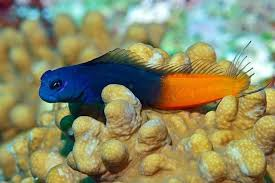
With its distinctive two-toned body, endearing personality, and useful algae-grazing habits, the Bicolor Blenny (Ecsenius bicolor) is one of the most popular small fish in the saltwater hobby. The front half of the body ranges from brown to blue-gray, the rear half transitions to a vivid orange-yellow, and the result is a fish that looks like two completely different colors were stitched together. Beyond the looks, these blennies bring genuine character to any reef system.
Natural Habitat
The Bicolor Blenny is native to the Indo-Pacific, found across the coral reefs, rocky areas and lagoons of the Maldives, Indonesia, Fiji, Sri Lanka and the Philippines. In the wild they inhabit shallow reef areas at depths of 3 to 82 feet, spending their days perching on rock surfaces and grazing continuously on the microalgae growing there. This foraging behavior, combined with their comb-like teeth designed for scraping algae, makes them useful natural cleaners in the aquarium.
Behavior
The Bicolor Blenny is not an active open-water swimmer. Instead it hops from rock to rock, perching briefly to graze before moving on, giving it an almost lizard-like quality that hobbyists find entertaining. It spends most of its time in the lower portion of the tank near the substrate and rockwork, and will choose a favorite cave or crevice as its home territory. Its large mobile eyes observe everything in and around the tank with obvious curiosity.
Despite this docile appearance, the Bicolor Blenny will defend its territory with surprising assertiveness toward fish it perceives as competitors or look-alikes. It can be aggressive toward other blennies, small gobies, dartfish and similarly shaped fish, particularly in smaller tanks where there is limited space. It can also become a jumper when startled or disturbed, making a tight-fitting lid essential.
Tank Setup
A minimum tank size of 30 gallons is recommended, and larger is always better for this species. The tank must be mature and have established live rock with a healthy growth of microalgae. Introducing a Bicolor Blenny to a newly set up or sterile system with no algae growth is a common mistake. Without natural grazing material on the rocks, the fish can decline quickly. Plenty of live rock with holes, caves and crevices gives the Bicolor the territory and shelter it needs to feel secure and settled.
Water parameters should remain stable at 72 to 78°F, pH 8.1 to 8.4, and specific gravity 1.020 to 1.025.
Feeding
The Bicolor Blenny is primarily herbivorous with an algae-based diet forming the core of its nutritional intake. In the aquarium, supplement natural grazing with spirulina-based flake or pellet foods, frozen herbivore blends, marine algae sheets and seaweed. Feed two to three times daily in small amounts. Occasional meaty foods such as mysis or brine shrimp can be offered but should not dominate the diet.
A well-fed Bicolor Blenny is a peaceful tank resident. An underfed one is a different animal entirely. Hungry individuals will begin nipping at fleshy large polyp stony corals, clam mantles and other soft invertebrates that would otherwise be ignored. Ensuring a consistent algae-rich diet prevents this behavior entirely in most cases. If your tank does not produce enough natural algae, consider maintaining a refugium with macroalgae growth as an additional food source.
Tank Mates
Bicolor Blennies coexist well with clownfish, tangs, cardinalfish, firefish, peaceful wrasses, and most angelfish species that occupy different tank zones. They will leave ornamental shrimp and crabs alone due to their herbivorous nature. Avoid housing them with other blennies, small gobies that look similar, dartfish, or seahorses, which cannot compete for the same food resources. Also avoid large aggressive fish that would bully or stress them.
When sourcing a Bicolor Blenny, look for an active specimen with full body weight and a good appetite. At Dr. Reef’s Quarantined Fish every fish is quarantined and confirmed eating before sale, reducing the risk of receiving a stressed or food-refusing specimen.