
Banggai Cardinalfish for Sale

Banggai Cardinalfish for Sale – A Captive-Bred Classic and Hardy Species for Marine Aquariums
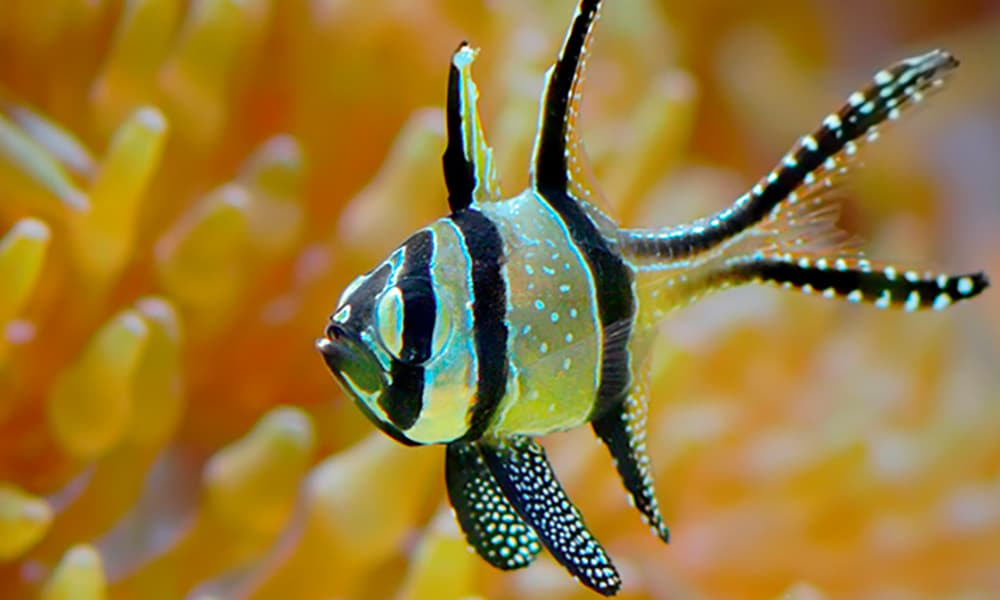
Few fish in the saltwater hobby have earned the kind of broad, lasting affection that the Banggai Cardinalfish (Pterapogon kauderni) enjoys. With its striking black-and-silver patterning, elongated fins, and calm, deliberate movement, it is one of the most visually elegant small fish available to marine aquarists at any experience level. More importantly, the Banggai is one of the hobby’s great success stories in captive breeding, a species that reproduces readily in home aquariums and whose captive-bred specimens are widely available, hardier than their wild-caught counterparts, and a genuinely ethical choice for the reef keeper who cares about where their fish come from.
At Dr. Reef’s Quarantined Fish, every Banggai Cardinalfish we offer has completed our full quarantine protocol and is confirmed eating prepared foods before being made available. Captive-bred or not, every fish benefits from a proper quarantine, and the specimens we ship arrive stable, healthy, and ready to settle confidently into their new home.
The Visual Appeal of the Banggai Cardinalfish
The Banggai Cardinalfish is immediately distinctive. A silver-white body is divided by bold black vertical bars, the fins are elongated and edged with white-spotted black margins, and the overall impression is one of precise, almost geometric elegance that is unlike anything else in the hobby at this price point. It is a fish that looks simultaneously delicate and striking, and it moves through the water with the kind of slow, composed grace that makes it genuinely calming to watch.
At a maximum adult size of around 3 inches, the Banggai is appropriately scaled for a wide range of system sizes. It tends to hover in the mid to lower water column, often in proximity to long-spined urchins, branching corals, or other structures it uses as a point of orientation. In a well-aquascaped reef, a small group moving slowly through the display creates an effect of understated sophistication that many more expensive and harder-to-keep fish fail to match.
Why Captive-Bred Matters for This Species
The Banggai Cardinalfish has a naturally restricted range in the wild, endemic to the Banggai Archipelago of Indonesia, and its popularity in the marine hobby placed significant collection pressure on wild populations in the years before captive breeding programs became widespread. Today, captive-bred Banggai Cardinalfish are readily available from reputable suppliers, and choosing captive-bred specimens over wild-caught is one of the clearest and most impactful ethical decisions a marine aquarist can make for this particular species.
Beyond the conservation argument, captive-bred Banggai simply perform better in home aquariums. They are acclimated to aquarium foods from the earliest stages of life, free of the parasitic loads that wild-caught fish frequently carry from collection and transport, and significantly more tolerant of the water chemistry variations that inevitably occur in closed aquarium systems. For the aquarist, choosing captive-bred is not a compromise. It is an upgrade in every measurable way.
Tank Requirements and Care
The Banggai Cardinalfish is one of the more flexible species in the hobby in terms of tank size requirements. A single specimen or a mated pair can thrive in an aquarium as small as 30 gallons, while groups of three to five are well suited to systems of 75 gallons or more. They are not active open-water swimmers and spend most of their time hovering in a relatively defined area of the tank, which reduces the spatial demands that more energetic species place on a system.
Provide aquascape features that give the fish a structural focal point. Long-spined urchins make natural and highly effective companions for Banggai Cardinals, which associate closely with them in the wild and will hover among the spines in captivity as readily as they would on a natural reef. Branching stony corals, tall soft corals, and elevated rockwork structures all serve a similar orienting function and encourage the fish to remain visible and active in the display rather than retreating to the back of the tank.
Water parameters should be maintained within standard reef ranges. Temperature between 72 and 80 degrees Fahrenheit, salinity at 1.025 SG, and stable, well-oxygenated water with moderate flow suit this species well. Banggai Cardinals are not particularly demanding on the environmental side, which is one of the genuine advantages they offer to aquarists at all experience levels.
Feeding the Banggai Cardinalfish
Captive-bred Banggai Cardinalfish are among the easiest fish in the hobby to feed. They accept a wide variety of frozen and prepared foods readily, including frozen mysis shrimp, frozen copepods, and quality small-pellet foods. Their deliberate, methodical feeding style means they prefer food items that are stationary or moving slowly in the current rather than fast-moving items that require a chase. Releasing frozen foods into a gentle current near the fish’s preferred hovering position produces the best feeding responses.
Feed twice daily in small amounts. Banggai Cardinals are not aggressive feeders and can be outcompeted at the food surface by faster or more assertive species, so ensuring food reaches them directly at their level in the water column is important, particularly in community systems with more active tank mates.
Reef Compatibility, Tank Mates, and Keeping Groups
Banggai Cardinalfish are fully reef-safe and will not disturb corals, clams, or invertebrates of any kind. They are peaceful toward most other species and integrate easily into community reef systems alongside clownfish, small wrasses, gobies, Chromis, and other peaceful inhabitants. They are one of the genuinely uncomplicated choices in the hobby from a compatibility standpoint.
Intraspecific aggression, meaning aggression between Banggai Cardinals themselves, can occur in smaller groups and smaller tanks. Males are territorial toward each other, and in a group of juveniles the dominant individuals will assert themselves as the group matures. The most stable social arrangements are a confirmed mated pair, which will coexist peacefully and eventually breed, or a larger group of five or more in a spacious system where no single individual can dominate the entire territory. Groups of three or four in a small tank frequently result in one fish being persistently harassed.
Avoid housing Banggai Cardinals with aggressive or fast-moving species that will outcompete them for food or stress them with persistent chasing. In a calm, well-balanced community, they are reliable, long-lived, and consistently beautiful additions to any marine display.
A Timeless Fish That Always Earns Its Place
The Banggai Cardinalfish has been a staple of the marine hobby for decades, and its continued popularity is entirely deserved. It is elegant, hardy, ethically available as a captive-bred species, easy to feed, reef-safe, and endlessly watchable. Whether you are stocking your first marine aquarium or adding a refined finishing touch to an established reef, the Banggai Cardinalfish delivers more than its price point suggests and asks for very little in return.
Browse our current Banggai Cardinalfish availability at Dr. Reef’s Quarantined Fish and add a captive-bred classic to a system that is ready to showcase it properly.