
French Angelfish for Sale: The Long-Lived Giant That Commands Attention

French Angelfish for Sale: The Long-Lived Giant That Commands Attention
Some fish are beautiful. Some fish are impressive. The French Angelfish manages to be both at the same time, and it does it in a way that very few marine species can match. This is a fish that people stop to look at when they visit a tank that has one. It is confident, it is intelligent by fish standards, and in the right setup, it can live for 15 to 20 years. That is not a short-term commitment. It is a relationship.
Two Different Fish in One Lifespan
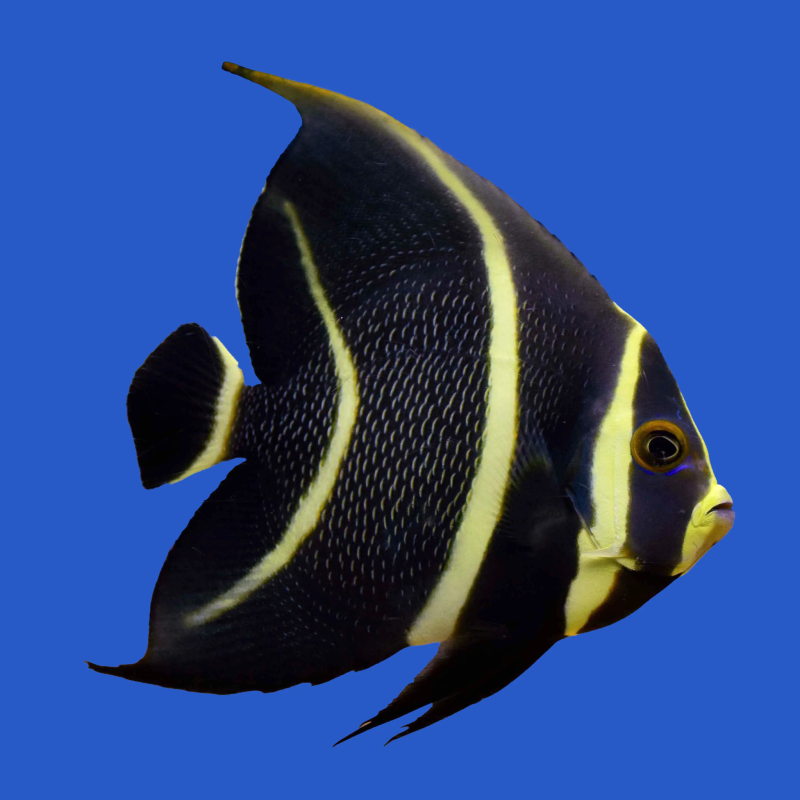
One of the most interesting things about the French Angelfish (Pomacanthus paru) is that juveniles and adults look nothing alike. The juvenile is jet black with bold, vivid yellow vertical bands. It is one of the most striking patterns in the whole angelfish family, and a lot of hobbyists specifically seek out juveniles just to watch the transformation happen over time.
As the fish matures, those bright yellow bands fade and the body transitions to a dark, rich black with golden-yellow scale margins across almost the entire body. The effect in adults resembles a kind of shimmering chainmail under reef lighting. Yellow accents mark the pectoral fin, and the gill cover carries a bright yellow rim. The face shifts to a pale dusky-blue with yellow-rimmed eyes.
Both life stages are available through Dr. Reef’s Quarantined Fish. Juveniles can be started in 75 to 100-gallon systems, but the plan for a much larger tank needs to be firmly in place from the start. Dr. Reef’s product listing is clear about this: adults require 250 to 300 or more gallons minimum, and failing to upgrade as the fish grows leads to real problems, including stunted growth, behavioral issues, and shortened lifespan.
What You Need to House This Fish
The French Angelfish is a large, powerful swimmer. It patrols its territory constantly, investigates everything in the tank, and needs genuine space to do that comfortably. The aquascape should include multiple large caves, overhangs, and swim-through areas, along with open swimming space. All live rock needs to be extremely stable since this fish is strong enough to dislodge pieces that are not properly secured.
For water quality, strong filtration is essential. The French Angelfish is a big fish with a big appetite, which means significant waste production. A high-capacity filtration system, oversized protein skimmer, and water flow at 10 to 15 times the tank volume per hour are the baseline. Pristine, stable water chemistry is not optional with this species.
Water parameters:
- Temperature: 72 to 78 degrees Fahrenheit
- Salinity: 1.020 to 1.025
- pH: 8.1 to 8.4
- dKH: 8 to 12
Feeding
The French Angelfish is an omnivore with a strong preference for sponge-based foods, which reflects what it eats naturally on Caribbean and Atlantic reefs. A quality angelfish formula with sponge material should be a regular part of the diet, not an occasional supplement. Long-term health, including prevention of HLLE (head and lateral line erosion), depends on consistent access to sponge-enriched food.
Beyond that, feed a varied mix of frozen mysis shrimp and chopped seafood, marine algae sheets, spirulina pellets and herbivore blends. Three feedings per day, in portions it can finish quickly, keeping the tank cleaner and the fish in better condition.
Temperament and Tank Mates
The French Angelfish is not a community fish in the usual sense. It is semi-aggressive and becomes more assertive as it matures, particularly toward other large angelfish. One French Angel per tank is the practical approach for most systems. Keeping two would require a system well over 300 gallons with clearly separated territories. Dr. Reef’s compatibility chart is a good starting point when planning which species can share the tank.
It can coexist with other large semi-aggressive species: large tangs, groupers, lionfish, sizable wrasses, and trigger fish chosen carefully. It should not be housed with small, passive fish that it may bully over time, and it should always be the only large angelfish in the tank.
This fish is not reef safe. It will consume corals, sponges, and sessile invertebrates. It belongs in a fish-only with live rock (FOWLR) system, not a mixed reef.
Why Quarantine Matters More With This Fish
A juvenile French Angelfish from Dr. Reef’s goes through a 6 to 8 week quarantine protocol. That extended observation period is meaningful for a long-lived species. It gives the fish time to fully recover from collection and shipping stress, establish a strong feeding routine, and be confirmed healthy before it enters a display system where it may live for the next two decades.
The cost of a quality French Angelfish makes that quarantine period a form of investment protection. Getting a fish that has already been through the hard part of transitioning to captive life is worth a great deal at this price point. Once it arrives, Dr. Reef’s acclimation guide walks you through the best method for introducing it to your display tank. Visit drreefsquarantinedfish.com/shop to check current availability or submit a request for this species.