
Scribbled Angelfish for Sale: What Makes This Rare Australian Fish So Valuable?

Scribbled Angelfish for Sale: What Makes This Rare Australian Fish So Valuable?
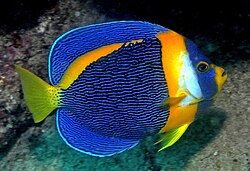
If you ask experienced reef hobbyists to name the most stunning large angelfish available in the aquarium trade, the Scribbled Angelfish (Chaetodontoplus duboulayi) comes up again and again. Endemic to Australia — found primarily along the Great Barrier Reef, the Coral Sea, and down to Lord Howe Island — this fish is rare, spectacular, and highly sought after. When you finally see one in person, it is easy to understand why.
At Dr. Reef’s Quarantined Fish, Scribbled Angelfish are carefully prepared before sale. Check drreefsquarantinedfish.com for current pricing, which has historically ranged from $250 to $800 depending on size.
What Does It Look Like?
The Scribbled Angelfish has a body that looks like someone took an ink brush and covered it in intricate blue-white scribbles over a deep dark bluish-black base. A broad yellow band sits behind the face, and the tail is a vivid yellow that creates a striking contrast against the dark body. The fins have bright blue edging, and the face carries splashes of vivid color that make this fish look hand-painted. Adults can reach 10 to 12 inches, making this a true centerpiece species for a large display tank.
Like all angelfish in the family Pomacanthidae, it is a protogynous hermaphrodite — all individuals are born female, and the largest female in a group will eventually change into a male. It is extremely difficult to breed in captivity.
Why Is It So Rare and Valuable?
The Scribbled Angelfish is native only to Australia and Papua New Guinea, with very rare sightings in southern Taiwan. It is not common even within its natural range. Combined with export regulations and collection limits, this means the supply to the global aquarium market has always been limited — which drives the price up.
It is also an iconic species in the trade. Reef hobbyists who have been in the hobby long enough recognize the Scribbled Angel as one of the true bucket-list fish, the kind you save for and plan around when designing a large system. Browse Dr. Reef’s full selection of large marine angelfish to see what other premium centerpiece species are available, and visit the Dr. Reef blog for ongoing care guides and fish spotlights.
Tank Requirements
Adults require a minimum of 110 to 180 gallons, and larger is always better. The tank should have plenty of live rock with caves and overhangs for the fish to explore and retreat into. This species does best in a Fish-Only-With-Live-Rock (FOWLR) setup rather than a reef tank, because it will nip at soft corals, stony corals, sessile invertebrates, and clam mantles. An underfed adult is especially likely to start sampling things it should not, so keep up consistent feedings of two to three times daily.
Water parameters:
- Temperature: 72°F to 78°F
- pH: 8.1 to 8.4
- Specific Gravity: 1.021 to 1.023
- dKH: 8 to 12
When first introduced, the Scribbled Angel tends to be shy. Do not house it with aggressive fish during this period. Once fully settled, it may become more territorial, so plan tank mates accordingly. Keep only one Scribbled Angelfish per tank unless your system is 500 gallons or larger.
One important handling note: like all Pomacanthidae, this fish has sharp cheek spines along the gill covers. Never use a net to catch it. Instead, coax it into a container. A net can cause serious gill damage.
Diet
Scribbled Angelfish are omnivores. Their natural diet focuses on sponges, sessile invertebrates, and marine algae. In captivity, offer a varied mix of Spirulina, dried nori sheets, frozen mysis shrimp, frozen brine shrimp, marine algae preparations, and high-quality angelfish formula foods that include marine sponge material. Feed two to three times per day to keep the fish healthy and reduce the temptation to nip at corals.
Captive-bred specimens, when available, arrive already trained on pellets and frozen foods is a significant advantage over wild-caught fish that may take weeks to accept aquarium fare.
The Dr. Reef Difference
Scribbled Angelfish that arrive at Dr. Reef’s are visually inspected immediately and placed into quarantine. Dr. Reef’s quarantine protocol — Chloroquine Phosphate or Copper Power treatment, followed by internal parasite treatment and observation — means that your fish has been fully screened by the time it reaches you. For a fish this valuable and this rare, that level of preparation is not just nice to have — it is essential.
Visit drreefsquarantinedfish.com to check current availability and place a request for your Scribbled Angelfish.