
Australian Harlequin Tusk for Sale: Care Requirements, Diet, and Tank Mates

Australian Harlequin Tusk for Sale: Care Requirements, Diet, and Tank Mates
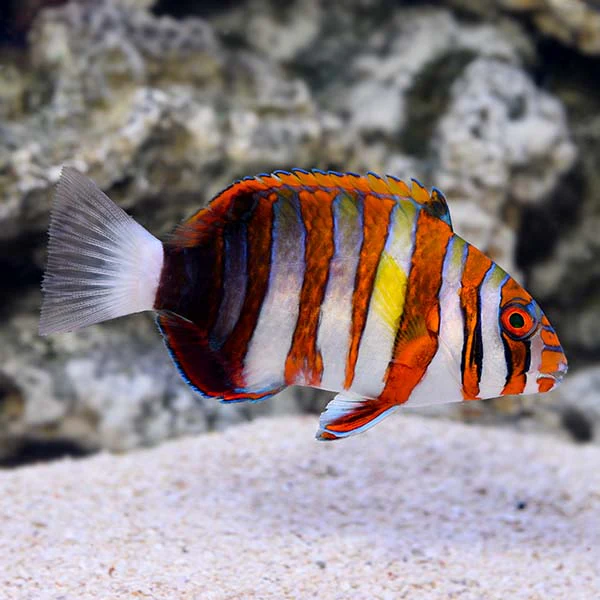
If you have been looking for a saltwater fish that turns every head the moment it swims across the glass, the Australian Harlequin Tusk is exactly what your tank has been waiting for. With blazing orange stripes, crisp white bands, and those one-of-a-kind electric blue teeth, this fish is not just beautiful but a showstopper. And when you get yours from Dr. Reef’s Quarantined Fish, you are getting a specimen that has already been through a professional quarantine process, so you can focus on enjoying it rather than worrying about disease.
Why the Australian Version Is Special
Not all Harlequin Tusks are the same. The Australian variety (Choerodon fasciatus) is noticeably more vibrant than specimens collected from the Philippines or Indonesia. The colors are bolder, the blue teeth are more striking, and the fish tend to be much hardier in a home aquarium. Hobbyists who have kept both versions consistently say the Australian Tusk adjusts to captivity with far fewer problems. That is a big deal when you are investing in a premium fish.
Tank Size and Setup
The Harlequin Tusk grows up to 10 to 12 inches, so it needs room to roam. A minimum tank size of 125 gallons is recommended for a single adult, though a larger setup is always better. You want plenty of live rock arranged to create caves and hiding spots, since this fish loves to explore and retreat when it wants to rest. Keep only one Tusk per tank as they do not get along with their own kind.
Water parameters to aim for:
- Temperature: 77°F to 82°F
- pH: 8.1 to 8.4
- Specific Gravity: 1.020 to 1.025
- dKH: 8 to 12
A strong protein skimmer and regular water changes of 10 to 20 percent weekly will keep the water quality where it needs to be, since this fish is a messy eater.
Diet
The Harlequin Tusk is a carnivore through and through. In the wild, it uses those impressive blue teeth to crunch through crustaceans and hard-shelled invertebrates. In the aquarium, it does great on a varied diet of frozen mysis shrimp, brine shrimp, krill, silversides, clams on the half shell, and squid. Feed one to three times daily. One of the big advantages of buying from Dr. Reef’s Quarantined Fish is that every fish is already trained to eat while in quarantine, so yours arrives ready to accept food without the usual adjustment headaches.
Tank Mates
The Harlequin Tusk is semi-aggressive and does best with fish that can hold their own. Good tank mates include tangs, angelfish, larger triggers like the Niger Triggerfish or Bluejaw Triggerfish, eels, puffers, and similarly sized robust fish. Avoid keeping it with smaller or delicate species like gobies or small wrasses — they may end up as a snack. Also keep in mind that this fish will eat shrimp, crabs, snails, and other small invertebrates, so a reef setup is not ideal unless you are fine losing your cleanup crew.
Why Buy From Dr. Reef?
Most fish sold online or at your local fish store come straight from a wholesaler with little to no health screening. Wild-caught fish naturally carry parasites and other issues picked up in the ocean. Dr. Reef’s quarantine protocol treats every fish with either Chloroquine Phosphate or Copper Power for two full weeks, followed by an observation period with treatments for internal parasites using Prazipro and Metro. By the time your Australian Harlequin Tusk ships to you, it has been through the full process and is eating well twice a day. That is the kind of peace of mind that is hard to put a price on.