
Pearly Jawfish for Sale: Burrowing Behavior, Care Guide, and Tank Setup

Pearly Jawfish for Sale: Burrowing Behavior, Care Guide, and Tank Setup
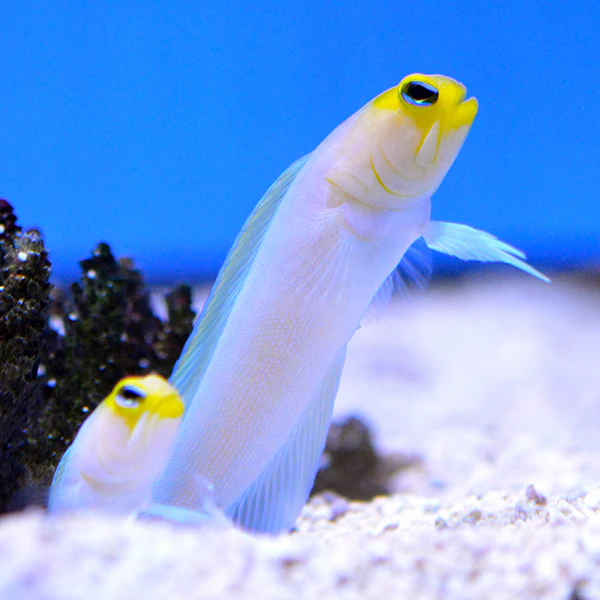
Some fish just have a way of making you smile every time you walk up to the tank. The Pearly Jawfish — also widely known as the Yellowhead Jawfish (Opistognathus aurifrons) — is one of those fish. With its bright yellow head, soft blue-green body, and habit of hovering just above its burrow like a tiny little sentry on guard duty, this Caribbean native brings a kind of personality to a reef tank that bigger and flashier fish simply cannot match.
At Dr. Reef’s Quarantined Fish, the Pearly Jawfish goes through a full quarantine and observation period before shipping, so you receive a fish that is healthy, eating, and ready to start digging its new home in your tank.
What Makes the Pearly Jawfish So Fun to Watch
The Jawfish is famous for its burrowing lifestyle. It digs a hole in the substrate, reinforces it with small pieces of rubble and shells, and spends most of its time peeking out from the entrance. When it senses danger, it rockets backwards into its burrow tail-first with incredible speed. When multiple Jawfish are kept together in a large enough tank, they perform a kind of up-and-down hovering display that experienced hobbyists describe as dancing.
There is also the mouth-brooding behavior to look forward to. In this species, the male carries fertilized eggs in his mouth until they hatch — one of the more unique sights you will ever see in a home aquarium.
Tank Setup Requirements
The most important thing you need for a Jawfish is a deep sand bed. Aim for at least five to seven inches of substrate, using a mix of fine sand and small rubble pieces. The rubble is important — the fish uses it to build and reinforce its burrow entrance. Without enough depth and material, your Jawfish will be stressed and unable to settle in properly.
A 30-gallon tank is the minimum for a single specimen. If you want to keep a small group, go bigger and make sure each fish has enough open sand space to dig its own burrow, with at least three to five inches of spacing between burrows.
One thing many new Jawfish keepers learn the hard way: always use a tight-fitting lid. These fish are incredible jumpers and will launch themselves out of the tank when startled. Do not skip this step.
Water parameters:
- Temperature: 72°F to 78°F
- pH: 8.1 to 8.4
- Specific Gravity: 1.020 to 1.025
- KH: 8 to 12
Diet
In the wild, Pearly Jawfish feed on tiny zooplankton drifting near their burrows. In captivity, they do well on mysis shrimp, brine shrimp, small chunks of clam or mussel, and other meaty foods. Target feeding near the burrow entrance with a turkey baster is a great way to make sure your fish is getting enough, especially when first introduced. Many will also learn to accept quality pellet foods over time.
Tank Mates
Pearly Jawfish are peaceful and do well with other calm, reef-safe species such as clownfish, firefish, blennies, chromis, and small reef-safe wrasses. They will not bother corals or most invertebrates, though very small shrimp may occasionally be at risk. Avoid housing them with aggressive or territorial fish that might stress them out or bully them out of their burrow.
You may also want to consider the Blue Dot Jawfish as a companion species in a larger sandy-bottom setup as it shares similar care requirements and behavior.
The Dr. Reef Advantage
One of the biggest risks with Jawfish is receiving a specimen that is already stressed or sick from poor handling. Dr. Reef’s process starts the moment a fish arrives as it is visually inspected, placed into a quarantine tank, and treated to rule out parasites and disease. By the time it ships to you, it has had time to settle, eat, and build its strength. That is the difference between a fish that thrives and one that disappears into the substrate and never comes back out.