
Porcupine Puffer Fish for Sale: Care Guide, Diet, and Tank Requirements

Porcupine Puffer Fish for Sale: Care Guide, Diet, and Tank Requirements
If you have ever wanted a fish that acts more like a pet than a tank decoration, the Porcupine Puffer Fish is exactly what you are looking for. This fish has a personality so big and so expressive that it changes the entire feel of an aquarium. It is bold, it is entertaining, and it is one of the most interactive marine fish you can own. Dr. Reef has healthy, quarantined Porcupine Puffer Fish ready for your tank right now. Here is your complete care guide.
What Is a Porcupine Puffer Fish?
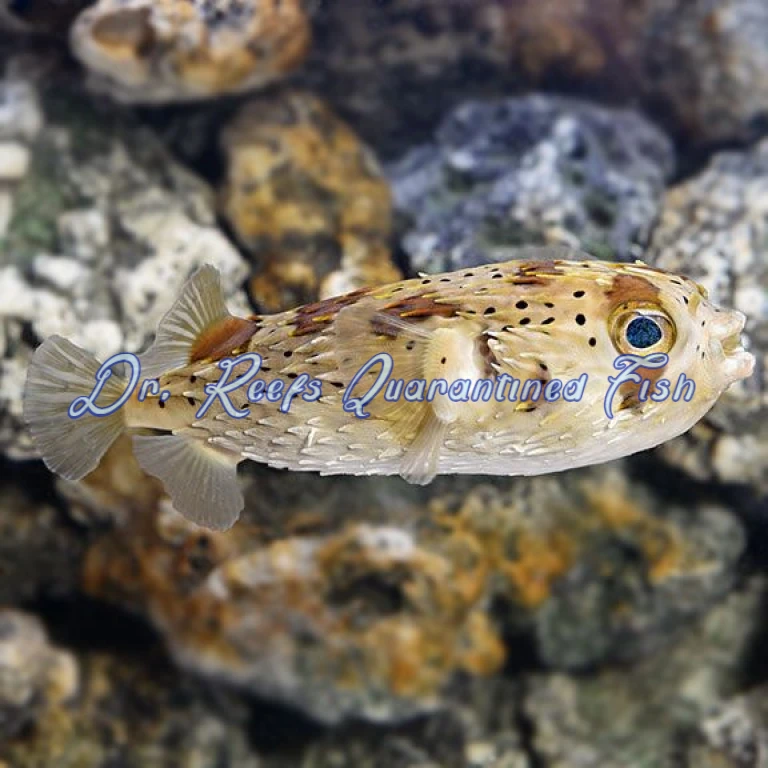
The Porcupine Puffer Fish, known scientifically as Diodon holocanthus, is a medium to large marine fish found across tropical and subtropical oceans worldwide. It gets its name from the sharp spines that cover its entire body. When the fish is relaxed, those spines lie flat against the body. When it feels threatened, it inflates itself by drawing in water, and the spines stand fully erect, turning the fish into a spiky ball that is very difficult for a predator to swallow. It is one of the most effective defense mechanisms in the ocean.
In an aquarium with appropriate tankmates and good care, a Porcupine Puffer Fish seldom needs to inflate. Instead, it spends its days swimming confidently around the tank, exploring every corner, interacting with its keeper, and generally behaving in a way that makes it one of the most entertaining fish in the hobby.
It grows to about 12 inches in a home aquarium, has large expressive eyes that move independently, and develops a face that many keepers genuinely describe as having character. The coloration is a warm tan and brown with darker markings and a pale belly, and the spines give it a texture and visual presence that is unique.
Tank Requirements
The Porcupine Puffer Fish needs a tank of at least 100 gallons to live comfortably as an adult. It is an active swimmer that explores the full volume of the tank throughout the day, and a tank that is too small creates chronic stress and restricts the natural behavior that makes this fish so enjoyable to keep.
The tank should have open swimming areas as well as rockwork and structure for the fish to explore and investigate. The Porcupine Puffer is curious about everything in its environment and will inspect every rock, every piece of equipment, and every new addition to the tank with great interest.
Strong, efficient filtration is essential. Porcupine Puffers produce a significant bioload and are messy eaters that leave food particles in the water after every meal. A powerful sump-based filtration system combined with regular partial water changes and consistent skimming keeps the water quality at the level this fish needs to stay healthy.
Maintain water temperature between 72 and 78 degrees Fahrenheit, salinity at 1.025, and pH between 8.1 and 8.4. Stable, clean water is particularly important because Puffer Fish are more sensitive to poor water quality than many other marine species and can develop skin and fin issues if nitrates are allowed to climb too high.
A secure lid is important. Although Porcupine Puffers are not known as frequent jumpers, any open top on a marine tank is a risk worth eliminating.
Diet and Feeding
The Porcupine Puffer Fish is a carnivore with a powerful beak-like mouth designed for crushing hard-shelled prey. In the wild, it feeds on crustaceans, sea urchins, mollusks, and similar hard-bodied invertebrates. Like all Puffer Fish, its teeth grow continuously and need regular wear from hard foods to stay at a healthy length.
In an aquarium, feed a varied diet that includes hard foods as a regular component. Whole shrimp with shells, clams on the half shell, crab legs, and squid all make excellent meals. Frozen mysis shrimp and marine-based carnivore pellets round out the diet on days when harder foods are not offered. Feed once or twice daily in portions that the fish can consume within a few minutes.
Feeding a Porcupine Puffer is a genuinely interactive experience. This fish learns feeding time quickly, recognizes its keeper at the glass, and approaches food with obvious enthusiasm. Many keepers hand-feed their Porcupine Puffer using tongs, though using tongs rather than fingers is strongly recommended since the beak is powerful and bites, even accidental ones, are painful.
Remove uneaten food promptly after each feeding to protect water quality.
Tank Compatibility
The Porcupine Puffer Fish is best kept in a fish-only tank with live rock. It is not reef safe. Any invertebrates in the tank, including shrimp, crabs, snails, hermit crabs, and clams, will be eaten. This is not trainable behavior. It is the natural diet of this fish, and it will pursue invertebrates regardless of how well fed it is.
The Porcupine Puffer is generally peaceful with larger fish that are too big to be considered food. It coexists well with other large community fish, including Tangs, Lionfish, larger Angelfish, and similarly sized species. Avoid keeping it with very small fish that could be mistaken for prey, and avoid fish known for fin nipping since the Puffer’s flowing fins can invite that kind of attention.
The Porcupine Puffer Fish is not aggressive toward tankmates in a meaningful way. It is focused on food and exploration rather than conflict, which makes it a manageable community fish in the right setup.
Why Buy Your Porcupine Puffer Fish from Dr. Reef?
Dr. Reef quarantines every Porcupine Puffer Fish before listing it for sale. Each fish is observed daily, fed on a consistent schedule, and confirmed in excellent health before it ships. The personality of this fish starts showing early, and by the time your Porcupine Puffer arrives from Dr. Reef’s, it is already eating confidently and ready to make its presence felt in your aquarium from day one.