
Flasher Wrasse

Flasher Wrasse Care Guide: Colors, Behavior, and Tank Setup
If you’ve ever watched a male Flasher Wrasse light up in the middle of a reef tank, fins fully extended, body blazing with color, you already understand why hobbyists get obsessed with this fish. They’re small, peaceful, reef safe, and genuinely one of the most entertaining fish you can keep. This guide covers everything you need to know to set one up and keep it thriving.
The Colors – And Why Males Flash
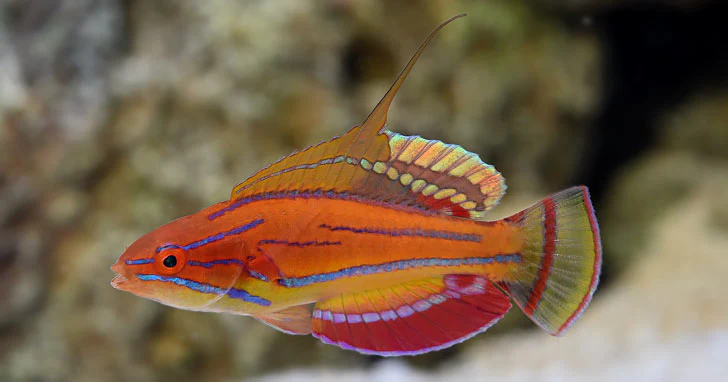
This is the part that hooks most people. The “flashing” behavior that gives this fish its name is a courtship and territorial display where the male rapidly erects his dorsal and anal fins while blood rushes to his scales, producing an almost electric burst of color. Blue lines seem to glow from within. Reds and oranges intensify. He darts back and forth in an animated, almost frantic dance. It’s something you really have to see in person.
Male Flasher Wrasses are significantly more colorful than females. A Carpenter’s Flasher male, for instance, has a vibrant yellow body with horizontal blue lines and a dramatic red dorsal fin with blue and yellow accents completely different from the more subdued orange-and-striped coloring of juveniles. The more females you have in the tank relative to one male, the more frequently he’ll display. This is natural haremic behavior: one male with a group of females is exactly how they live in the wild, and replicating that social structure brings out their best colors and most active behavior.
It’s worth knowing that, like most wrasses, Flasher Wrasses are protogynous hermaphrodites; they’re all born female, and the dominant fish in a group transitions to male. This means if you lose your male, one of the females will eventually change sex to take his place.
Tank Size and Setup
The good news is that Flasher Wrasses are among the smaller wrasse species, with most topping out around 3 inches. A single specimen can technically be housed in a 30-gallon tank, but for a small group, one male and two or more females, a 55-gallon aquarium is the practical minimum, and most experienced keepers recommend going larger if you can.
Horizontal swimming space matters more than tank height. These fish cruise from one end of the tank to the other constantly, so a longer footprint is always better. They’re also found near the bottom of the reef in the wild, so rockwork near the substrate where they can duck for cover will help them feel secure, especially during the first few days after introduction.
Behavior and Tank Mates
Flasher Wrasses are one of the more peaceful wrasse species you can keep. They won’t bother corals or most invertebrates, making them genuinely reef safe. The biggest behavioral consideration is male-to-male aggression; you should keep only one male per tank unless you have a very large system. Multiple males will compete aggressively, and it’s not pretty.
When adding a Flasher Wrasse to a community tank, introduce it before more aggressive residents are established, or use an acclimation box for a few days so everyone can size each other up through the barrier. Never introduce one into a tank where aggressive or fin-nipping fish are already settled and territorial. The male’s long dorsal fin filaments are particularly vulnerable to fin nippers.
They do well alongside clownfish, gobies, cardinalfish, anthias, and other peaceful reef tank inhabitants. Because they’re so peaceful themselves, avoid housing them with larger aggressive fish like triggers or groupers that would stress or bully them.
Feeding
Flasher Wrasses are carnivores that feed on zooplankton in the wild. In captivity, they readily accept frozen mysis shrimp, brine shrimp, and small meaty foods. They’ll also take high-quality pellets and marine flake food without much trouble, which makes them relatively easy feeders compared to some other wrasse species.
Feed small amounts three to four times a day. Frequent, smaller feedings suit their natural grazing behavior better than one or two big meals, and it keeps the water cleaner. Soaking foods in a vitamin supplement occasionally will help maintain their vivid colors over the long term.
Quarantine First – Always
At Dr. Reef’s Quarantined Fish, every fish goes through a proper quarantine process before it’s sold, and Flasher Wrasses are a great example of why that matters. These fish are known to carry Monogenean Flukes, microscopic parasites that attach to the skin and eyes and can cause real damage if left untreated. They can also carry internal parasites and are susceptible to ich. Catching and treating these issues in a quarantine tank before the fish ever enters your display system protects both the new fish and every fish already living in your reef.
If you’re sourcing fish elsewhere, always run a proper quarantine protocol. If you’re ordering from Dr. Reef’s Quarantined Fish, that work is already done for you.
What to Remember
Flasher Wrasses are everything a reef keeper could want in a fish: colorful, active, peaceful, reef safe, and endlessly entertaining. Set them up with the right tank size, give them a secure lid, feed them well, and keep the social structure natural with one male and a small group of females. Do all that, and you’ll have a centerpiece fish that performs for you every single day.