
Mystery Wrasse in a Well-Established Reef System

What Should Hobbyists Know About Keeping a Mystery Wrasse in a Well-Established Reef System?
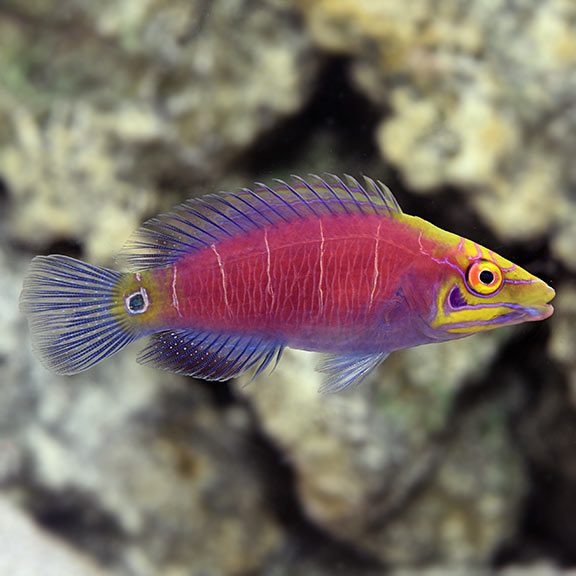
The Mystery Wrasse (Pseudocheilinus ocellatus) is one of the most desirable small wrasse species in the reef hobby. Its bold white stripes, vivid purple coloring, and active personality make it a standout fish in any well-established reef tank. It is reef-safe, relatively hardy, and fascinating to watch as it darts in and out of rock work throughout the day.
Like many sought-after reef fish, the Mystery Wrasse comes with specific requirements that hobbyists need to understand before adding one to their system. This guide covers what you need to know to keep this species successfully.
What Is the Mystery Wrasse?
The Mystery Wrasse is a member of the Pseudocheilinus genus, found across the Indo-Pacific on coral-rich reef environments. It grows to around 4 inches in adulthood, making it a compact and manageable species for mid-sized reef systems.
The coloring is striking. Bold white horizontal stripes run across a rich purple and violet body, with yellow and orange accents around the face. A distinctive eyespot near the tail adds to its visual appeal and gives it an almost hand-painted appearance. Despite its small size, this fish has a confident and assertive personality that makes it one of the more characterful species available to reef hobbyists.
Why a Well-Established Reef System Matters
The Mystery Wrasse is consistently recommended for mature reef systems rather than newly set up tanks, and for good reason.
A well-established reef with mature live rock provides a natural, continuous supply of copepods, amphipods, and microfauna that this wrasse relies on between formal feedings. A new tank simply does not have this biological richness yet, and a Mystery Wrasse placed into an immature system will struggle as a result.
Beyond food availability, a mature tank offers stable water parameters and a settled community that the Mystery Wrasse can integrate into more smoothly. As a general guide, a tank running for at least 12 months with stable parameters and an established microfauna population is an ideal environment for this species.
Temperament and Tank Mate Compatibility
The Mystery Wrasse has a semi-aggressive reputation that hobbyists should understand before adding one to a community reef. It is not overtly aggressive, but it is bold and territorial and will assert itself confidently within its patch of the reef.
It coexists well with clownfish, dartfish, firefish, gobies, and other peaceful reef fish. The key is avoiding fish that are too similar in appearance or behavior, as the Mystery Wrasse may persistently harass them. Keeping two Mystery Wrasses together is generally not recommended unless you have a proven mating pair, as two individuals of the same sex will almost certainly conflict in a smaller system.
The Mystery Wrasse is safe with corals and most large invertebrates. It may occasionally pick at very small ornamental shrimp, so tiny shrimp species should be added with caution. Larger cleaner shrimp and fire shrimp are generally left alone.
Feeding Your Mystery Wrasse
Feeding this species is one of the more straightforward aspects of keeping it, particularly when starting with a properly conditioned specimen.
Frozen mysis shrimp is the staple food and is accepted readily by most well-conditioned individuals. Enriched frozen brine shrimp, small copepods, and finely chopped marine seafood are excellent supplements. The wrasse will also spend part of its day picking through rock work for natural microfauna, which is another reason a mature reef system is so beneficial.
Feed once or twice daily in small amounts. Because this fish can be outcompeted by faster tank mates at feeding time, target feeding with a pipette ensures it gets its share without unnecessary competition.
Housing and Tank Setup
Tank size of at least 50 gallons is recommended, with 75 gallons or more being ideal. This gives the fish enough territory to establish itself comfortably.
Plenty of live rock with caves and crevices is essential. The Mystery Wrasse naturally associates with complex reef structure and spends much of its time weaving through rock work. A well-aquascaped tank with open swimming space and sheltered areas gives the fish exactly what it needs.
Stable water parameters are important. Maintain salinity at 1.025 to 1.026, temperature between 74 and 80 degrees Fahrenheit, and pH between 8.1 and 8.3.
A tightly sealed lid is strongly recommended. The Mystery Wrasse can jump, particularly during the first weeks in a new environment while it is still finding its place in the tank.
Why Buying a Quarantined Specimen Matters
The condition of the fish at purchase directly affects how well it settles into your reef. At Dr. Reef’s Quarantined Fish, every Mystery Wrasse goes through a thorough quarantine process before being made available. Each fish is monitored for disease, treated for any issues found, and transitioned onto prepared frozen foods before sale.
While the Mystery Wrasse is reasonably hardy, it can be susceptible to ich and parasitic infections during the stress of transport. A quarantined fish has already worked through that vulnerable period in a controlled environment, arriving at your tank in a far stronger position.
Introducing an untreated fish directly into a display reef is one of the most common ways disease enters a closed system and puts everything you have built at risk.
Final Thoughts
The Mystery Wrasse is a rewarding fish for the right reef system. Its striking appearance, active personality, and natural reef behaviors make it one of the most enjoyable small wrasse species in the hobby. Source a properly quarantined specimen from Dr. Reef’s Quarantined Fish, give it a mature and stable reef environment, and this fish will become one of the highlights of your aquarium for years to come.