
Yellowtail Tamarin Wrasse

Yellowtail Tamarin Wrasse: Care, Feeding, and Reef Compatibility
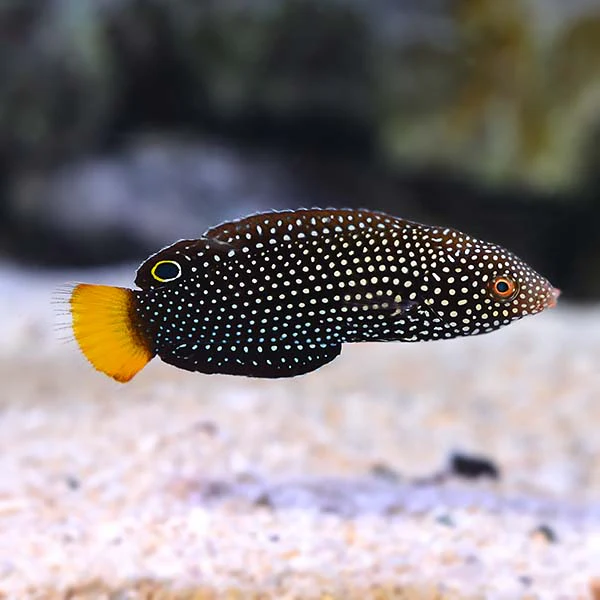
The Yellowtail Tamarin Wrasse is the kind of fish that stops you mid-scroll when you first see it. A dark blue-black body covered in dense white spots, capped off with a brilliant yellow tail, it looks like someone handed nature a fine paintbrush. But as beautiful as this fish is, it also comes with an honest reputation for being one of the more challenging wrasses to keep long-term. The good news is that with the right setup and a little patience, it’s absolutely achievable.
What Is the Yellowtail Tamarin Wrasse?
Scientifically known as Anampses meleagrides, the Yellowtail Tamarin Wrasse goes by several names, including Spotted Wrasse, Yellowtail Wrasse, and Yellow-tail Tamarin, which are the most common. It’s native to a wide stretch of the Indo-Pacific, from the Red Sea and East Africa all the way through the western Pacific to Samoa and Japan, typically found in coral-rich reef zones and sandy lagoon areas where it forages constantly for small invertebrates. Like other Anampses wrasses, it is a sequential hermaphrodite. All individuals begin as females, and dominant fish can transition into males over time. Males tend to display more vivid coloration, while females carry the spotted pattern across the full body with slightly less intensity.
Feeding – The Make-or-Break Factor
Feeding is where the Yellowtail Tamarin Wrasse earns its “expert” label, and being upfront about this is more helpful than glossing over it. When first introduced to a new aquarium, this fish almost always ignores prepared foods initially. Live foods, such as small brine shrimp, live mysis, and copepods, are the key to bridging that gap. A tank with a thriving pod population gives the fish something to hunt naturally while it settles in, which accelerates the transition to frozen and prepared foods.
With patience and persistence, most keepers report that within the first few days to a week, the fish begins accepting frozen mysis and brine shrimp. From there, gradually introducing high-quality marine pellets and other prepared foods builds a sustainable, long-term diet. Feeding small amounts multiple times a day works better than one or two large feedings, as this mirrors how the fish naturally forages throughout the reef.
A well-fed Yellowtail Tamarin is an active, confident fish. A hungry one becomes stressed and withdrawn, which is why a quarantined, food-conditioned specimen is such a significant advantage when starting with this species.
Reef Compatibility
The Yellowtail Tamarin Wrasse is reef safe with corals. It has no interest in nipping at coral tissue, making it compatible with SPS, LPS, and soft corals alike. Where caution is warranted is with smaller invertebrates. This wrasse is a natural hunter of small crustaceans, worms, and micro-invertebrates, which is useful for pest control but means small ornamental shrimp may be at risk, particularly as the fish matures and grows more confident in its hunting.
Most snails and larger crabs are generally left alone. The risk sits primarily with smaller shrimp species and fan worms. As always with wrasses in this category, keeping the fish well-fed significantly reduces the likelihood of it targeting desirable tankmates.
Temperament and Tankmates
The Yellowtail Tamarin is generally peaceful toward fish that don’t share a similar body shape. It coexists well with clownfish, royal grammas, chalk bass, gobies, blennies, anthias, and peaceful angelfish. Avoid housing it with aggressive or dominant wrasses that might harass it, particularly in smaller tanks. Other wrasses of similar shape can trigger territorial behavior.
It does best as the only Anampses wrasse in the tank unless the system is very large and both fish are introduced simultaneously. Adding a second one after the first has established territory almost always leads to conflict.
Why a Quarantined Specimen Makes All the Difference
For a fish as sensitive as the Yellowtail Tamarin Wrasse, the quarantine process is genuinely the difference between a smooth experience and a frustrating one. At Dr. Reef’s Quarantined Fish, every fish goes through a proper observation and conditioning period before sale, is monitored for health, treated preventatively as needed, and trained on prepared foods. This matters enormously for a species that can be reluctant to accept frozen or prepared foods when first acquired wild.
A fish that is already eating mysis and pellets before it arrives in your tank removes one of the biggest hurdles this species presents. It settles in with far less stress, adapts to the new environment more quickly, and shows its true, vibrant self sooner. You can explore the full wrasse collection, including other challenging and rewarding species, at Dr. Reef’s Quarantined Fish.
The Yellowtail Tamarin Wrasse is not for everyone, and that’s fine. But for the hobbyist who’s ready to meet its needs, a mature tank, a deep sand bed, live foods at first, and a little patience, it is one of the most visually arresting and rewarding wrasses in the hobby.