

Blog
What Do Pajama Cardinalfish Eat in the Wild?

What Do Pajama Cardinalfish Eat in the Wild? A Complete Feeding Guide
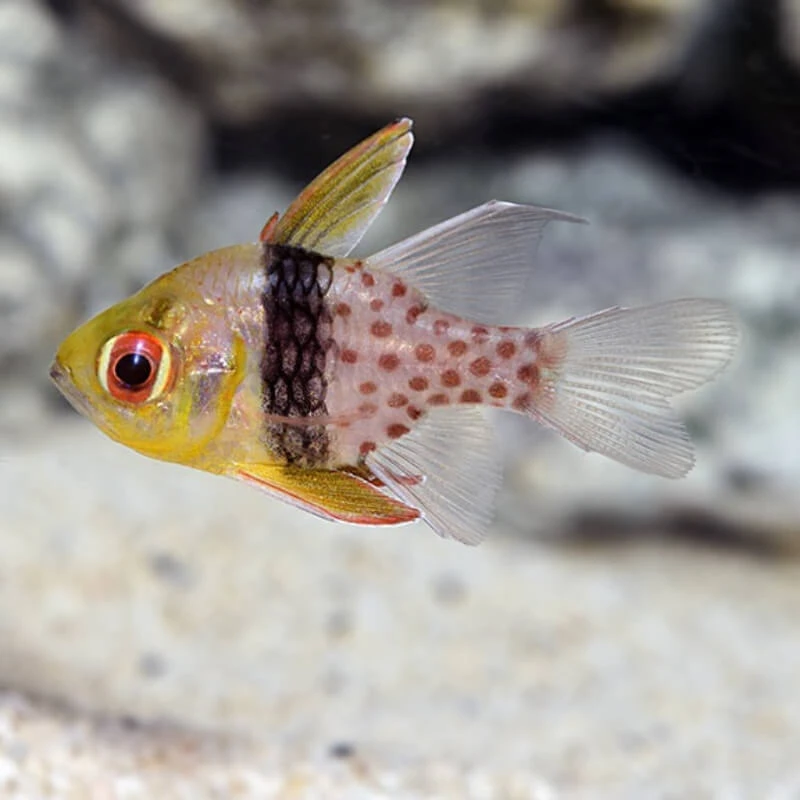
If you are looking for a fish that combines genuine visual drama with a completely peaceful, easy-going personality, the Pajama Cardinalfish (Sphaeramia nematoptera) is one of the hobby’s most joyful discoveries. Its greenish-yellow face, bold black waistband stripe, and vivid red-spotted rear half make it look almost impossibly charming, like something designed by an artist rather than evolved by nature. And the wonderful news for home reef keepers is that feeding this extraordinary little fish is one of the most straightforward aspects of its care. To understand why, it helps to start with what Pajama Cardinalfish eat in the wild.
A Natural Carnivore of the Twilight Reef
In the wild, the Pajama Cardinalfish is a carnivorous micro-predator found throughout the Indo-Pacific, from the Philippines and Indonesia through to Fiji and the Great Barrier Reef. During daylight hours, groups of Pajama Cardinals shelter among the branches of Porites and Acropora corals, tucked into the reef’s shady overhangs and crevices. They are famously docile and social animals, spending the day hovering together in loose, elegant formations that are stunning to observe.
As evening falls and the reef transitions into its nighttime phase, something remarkable happens. These quiet, sheltering fish disperse from their daytime resting spots and become active hunters, moving low over the reef bottom in search of prey. Their natural diet consists primarily of zooplankton, small crustaceans, and tiny invertebrates that become active in the water column during the night hours. They are precision hunters rather than aggressive chasers, hovering patiently and striking with accuracy at small prey that drifts within reach.
This nighttime hunting strategy is reflected in those beautiful large red eyes, which are perfectly adapted for low-light vision and give the Pajama Cardinal its distinctively soulful expression.
What This Means for Feeding in the Aquarium
The great news for aquarium hobbyists is that despite their naturally nocturnal feeding habits, Pajama Cardinalfish adapt remarkably well to daytime feeding in captivity. Given a consistent routine and appropriate food choices, most specimens will transition to feeding actively during the day alongside their tank mates, making them wonderfully practical display animals.
The foundation of a healthy captive diet mirrors their natural prey as closely as possible:
Mysis shrimp is the gold standard food for Pajama Cardinals and the closest available match to the small crustaceans they hunt in the wild. Frozen mysis, offered daily, forms the nutritional backbone of their diet and is eagerly accepted by virtually all healthy specimens.
Brine shrimp, particularly vitamin-enriched varieties, is another firm favorite. Live baby brine shrimp is especially useful for encouraging newly arrived fish to begin feeding confidently, as the movement triggers their natural predatory response powerfully.
Finely chopped meaty foods such as diced shrimp, clam, and fresh or frozen seafood round out the diet beautifully. Variety is the key to long-term health and vibrant coloring in this species.
Pellet and flake foods are also accepted by well-conditioned specimens. While these should never be the sole food source, high-quality marine pellets make a practical and nutritious supplement to a primarily frozen food diet.
Feed small amounts two to three times daily to match the natural grazing style of this species. Because Pajama Cardinals are slow, deliberate swimmers, it is important to ensure they are not being outcompeted at feeding time by faster, more aggressive tank mates. Peaceful companions such as clownfish, small gobies, firefish, and other cardinalfish make ideal community partners that allow the Pajama Cardinal to feed at its own comfortable pace.
The Mouth-Brooding Marvel
No article about the Pajama Cardinalfish would be complete without mentioning one of the most extraordinary behaviors in the reef hobby. Pajama Cardinals are paternal mouth brooders: once a pair has spawned, the male collects the fertilized eggs and holds them inside his mouth, where he incubates them until they hatch. During this period, the devoted father does not eat at all, protecting his brood entirely without feeding. It is one of the most touching examples of parental care in the marine world, and pairs kept in a well-maintained aquarium will breed regularly, making the Pajama Cardinal one of the most accessible marine fish to breed at home.
Why Your Pajama Cardinal’s First Meal Matters More Than You Think
For all their adaptability, Pajama Cardinalfish that arrive stressed, underfed, or unaccustomed to prepared foods face a meaningfully harder transition into a home aquarium. The first two weeks are critical, and a fish that is already eating confidently and in good health before it ships is at a profound advantage over one that has never been properly conditioned.
At Dr. Reef’s Quarantined Fish, every Pajama Cardinalfish goes through a thorough quarantine and feeding observation program before it is made available. We confirm that each fish is actively eating, behaving normally, and free of the common pathogens that can undermine even the most carefully kept reef. That means when your Pajama Cardinal arrives, it is not starting from scratch. It is arriving healthy, hungry, and ready to become one of the most delightful residents your reef has ever had.
Browse the current Pajama Cardinalfish availability at Dr. Reef’s Quarantined Fish and bring home a fish that is already thriving.