
Tessalata Eel

Tessalata Eel for Sale: Giant Moray Eel Care and Tank Requirements
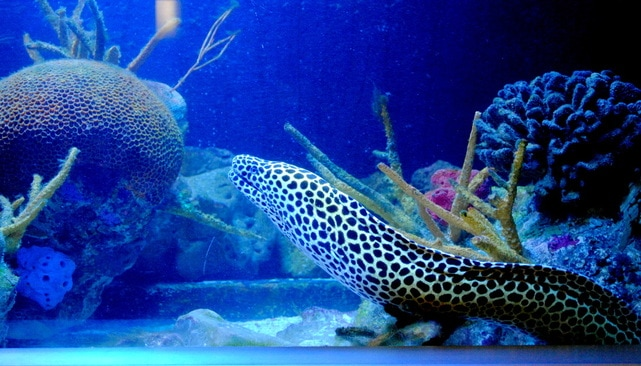
There are few creatures in the marine aquarium hobby that command the kind of raw, immediate presence that a Tessalata Eel brings to a display tank. Dramatic in size, extraordinary in pattern, and deeply fascinating in behavior, the Tessalata Moray (Gymnothorax favagineus) is a species that transforms a large aquarium into something closer to an encounter with the wild ocean. It is not a fish for everyone, and it is not a fish for every tank. But for the prepared, dedicated hobbyist who has built the right system, the Tessalata Eel is one of the most rewarding long-term investments in the marine aquarium world. And sourcing yours from Dr. Reef’s Quarantined Fish is the smartest way to begin that journey.
Introducing the Tessalata Moray Eel
Gymnothorax favagineus goes by several names in the hobby and in scientific literature. It is commonly called the Tessalata Eel, the Honeycomb Moray, or the Laced Moray, each name referencing the extraordinary black and white geometric patterning that covers its body from snout to tail. The pattern is a dense, irregular network of dark spots and reticulations on a pale background, unique to each individual animal, functioning much like a fingerprint.
Found throughout the Indo-Pacific from the Red Sea and East Africa to Hawaii and the Tuamoto Islands, Gymnothorax favagineus inhabits reef environments from shallow rubble zones to depths of around 50 meters. In the wild, it is one of the largest moray species, capable of reaching lengths of 8 feet and weights exceeding 65 pounds. In captivity, growth is typically more moderate, but a well-fed, well-kept Tessalata Eel will still reach impressive proportions over the years.
This is an animal built for endurance. Moray eels are long-lived in the wild and in captivity, with well-maintained specimens surviving well beyond a decade. Acquiring a Tessalata Eel is a long-term commitment, not a short-term display.
Tank Requirements for the Tessalata Eel
No aspect of Tessalata Eel keeping is more important than getting the tank right from the beginning. This species grows large, produces significant biological waste, and requires infrastructure scaled to match.
- Tank Size: A minimum of 200 gallons is the starting point for a juvenile or sub-adult Tessalata Eel. For a full-grown adult, 300 to 500 gallons or more is appropriate. The footprint of the tank matters as much as volume, as eels need horizontal space to move and extend their bodies fully.
- Rockwork and Caves: Tessalata Eels are highly secretive by nature and require substantial shelter in the form of caves, overhangs, and dense rockwork. In the wild, morays spend much of their daytime hours sheltered within reef crevices with only their heads visible. Replicating this in captivity is not merely aesthetic; it is essential for the animal’s sense of security and behavioral wellbeing. Build a deep, layered aquascape with multiple eel-sized caves before introducing the animal.
- Substrate: A fine to medium sand bed or a bare bottom system both work for moray eels. Bare bottom is often preferred in large predator systems because it simplifies cleaning and waste management.
- Filtration: Tessalata Eels are heavy bioload animals. They produce significant amounts of ammonia-rich waste, and their feeding habits further challenge water quality. Your filtration system must be substantially oversized relative to the tank volume. A high-capacity protein skimmer, robust biological filtration media, and aggressive mechanical filtration are all required. Plan for weekly large water changes of 20 to 30 percent as a baseline.
- Lid Security: This cannot be overstated. Moray eels are escape artists of the highest order. They are strong, flexible, and persistently exploratory, particularly at night. Any gap in the lid, any unsecured equipment port, any overflow chamber without a barrier is a potential exit. Tessalata Eels found outside their tank rarely survive. Every possible escape route must be physically blocked before the eel is introduced.
- Water Parameters: Maintain salinity at 1.023 to 1.025, temperature between 74 and 82 degrees Fahrenheit, and pH between 8.1 and 8.4. Moray eels are relatively tolerant of moderate parameter variation compared to reef fish, but ammonia and nitrite must remain at zero. Elevated nitrogen compounds cause immune suppression and chronic respiratory stress in morays over time.
Feeding the Tessalata Eel
The Tessalata Moray is a carnivore that feeds on fish, crustaceans, and cephalopods in the wild. In captivity, the diet should reflect this: whole silversides, market shrimp, squid, large krill, and pieces of marine fish all make appropriate meals.
Feeding frequency depends on the size of the animal. Juveniles benefit from feeding every two to three days. Sub-adults and adults can be fed twice per week. Overfeeding a moray significantly degrades water quality and increases the risk of hepatic lipidosis, a liver condition caused by excessive fat accumulation.
Use feeding tongs rather than your hands. This point is not negotiable. Tessalata Eels have poor eyesight and hunt primarily by scent. During feeding mode, they strike at any food-scented object in their vicinity, including fingers. Their teeth are designed to grip and tear, and bites from a large moray are serious injuries. Always use long feeding tongs and feed deliberately and predictably.
Most Tessalata Eels in captivity learn to recognize feeding routines and will emerge from their caves in anticipation of scheduled feedings. This is a sign of a healthy, settled animal and one of the most engaging behaviors the species displays.
Tankmates for the Tessalata Eel
The Tessalata Moray’s tankmate options are limited by a simple reality: anything small enough to fit in its mouth will eventually end up inside it. Fish, crustaceans, and invertebrates that fall within its prey size range will be consumed, often at night when the eel is most active and other fish are less alert.
Large, robust fish are the most viable companions. Species such as large groupers, lionfish, large pufferfish, large angelfish, and other big-bodied predator fish can coexist with a Tessalata Eel in an appropriately sized system. Avoid small fish entirely, and avoid any crustaceans unless you intend for them to become meals.
Avoid keeping multiple moray eels in the same tank unless the system is very large and both animals have been gradually introduced with careful monitoring. Interspecies aggression can occur, particularly over food and territory.
Why Quarantine Is Essential for Moray Eels
Moray eels present a specific challenge when it comes to disease detection and treatment. Their slick, scaleless bodies are less susceptible to some external parasites than bony fish, but they are by no means immune. More importantly, internal parasites, bacterial infections, and nutritional deficiencies acquired during collection and transport can be extremely difficult to detect until they have progressed significantly.
By the time an unhealthy moray shows outward signs of illness, it is often already in a serious state. Prevention through proper quarantine is therefore far more important than reactive treatment.
Dr. Reef’s Quarantined Fish applies the same rigorous quarantine standards to every Tessalata Eel as to every other species in the store. Each eel is held in dedicated quarantine systems, assessed for physical condition and behavioral health, confirmed to be feeding, and evaluated for any signs of internal or external illness before being made available for purchase.
Buying a quarantined Tessalata Eel from Dr. Reef means acquiring an animal that has been observed, cared for, and cleared by people who understand exactly what a healthy moray looks and behaves like. That expertise and that process protect both the animal and your investment.
The Long View on Tessalata Eel Keeping
Keeping a Tessalata Moray is a commitment measured in years and decades, not months. These are long-lived, slowly maturing animals that reward patience and consistent husbandry with increasing confidence, increasingly predictable behavior, and a growing individual relationship with their keeper.
Many experienced moray keepers describe their eels as genuinely personable animals that recognize them, respond to their presence, and interact in ways that most people do not expect from a fish. That relationship takes time to develop, but for those who invest in building it correctly from the start, the Tessalata Eel is one of the most extraordinary animals the marine aquarium hobby can offer.
Begin with the right animal from the right source. Dr. Reef’s Quarantined Fish is built for exactly this kind of informed, serious hobbyist. When you are ready to bring a Tessalata Eel into your system, Dr. Reef will make sure you are starting with the healthiest possible specimen, backed by the knowledge and support to see it thrive for years to come.