
Squareback Anthias for Sale: How Gender Changes Happen in Your Aquarium

Squareback Anthias for Sale: How Gender Changes Happen in Your Aquarium
There’s something almost magical about keeping Anthias in a reef tank. They hover in the water column, drift through the current in loose groups, and fill the mid-level of your aquarium with constant, gentle movement and color.
Among all the Anthias species available to hobbyists today, the Squareback Anthias stands out as one of the more manageable and visually rewarding choices, and one with a fascinating biological trick built right into its biology.
What Is the Squareback Anthias?
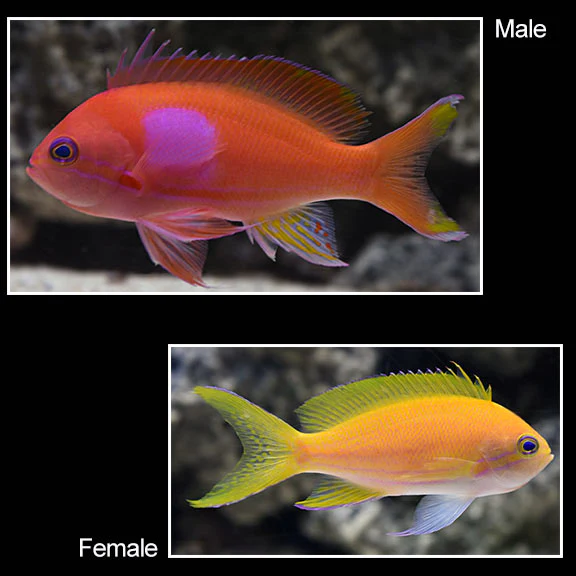
The Squareback Anthias (Pseudanthias pleurotaenia), also known as the Mirror Anthias or Squarespot Anthias, is a mid-sized Anthias species native to the Indo-Pacific. Males are bold and striking; they carry a vivid pink-to-orange body with a large, distinctive square or rectangular patch of deeper color on their sides, which gives the species its common name. Females are more subdued, typically orange-yellow in tone with a rosy tinge, and slightly smaller than the males.
Adults typically reach about 5 to 7 inches, which makes them one of the larger Anthias species in the hobby. That size is actually a point in their favor. Squareback Anthias tend to be hardier and more adaptable than some of the smaller, more delicate Anthias species that can really struggle in captivity.
How Gender Change Actually Works
In the wild, Anthias groups operate as harems: one dominant male oversees a group of females, typically staying close to the reef structure while the females feed in the water column above. If the male disappears or dies, the most dominant female undergoes sex change within days to weeks and assumes the role. The transformation is triggered by social hierarchy, not by genetics or age.
In your aquarium, this same dynamic plays out. If you purchase a group of females and no male is present, one of them will begin transitioning naturally over time. Some hobbyists intentionally purchase all females and let the transformation happen in the tank; it’s genuinely something to watch as the coloration shifts over weeks, with the orange-yellow female slowly developing the deeper square patch and fuller male body shape. Others prefer to introduce an established male alongside females for an immediate display of full adult coloration.
Tank Setup and Requirements
Squareback Anthias are on the larger side for the family, they need more space than smaller Anthias like the Dispar or Lyretail. A 75-gallon tank is workable for a small group of two to three females, but 100 gallons or more is ideal if you want to keep the full recommended group of one male with three or more females. A longer tank footprint is far more valuable than height; these fish swim horizontally across the mid and upper water column constantly.
Feeding Squareback Anthias
Feeding is the part of Anthias care that requires the most commitment, and Squareback Anthias are no exception. In the wild, these fish feed almost constantly throughout the day on zooplankton drifting in the current. In captivity, that feeding rhythm needs to be replicated.
Target two to three feedings per day, minimum. Frozen mysis shrimp is the cornerstone of their diet and should be offered at every feeding. Supplement with brine shrimp, enriched copepods, and small meaty foods to give them variety and ensure adequate nutrition. Many hobbyists use an automatic feeder to deliver smaller, more frequent portions throughout the day. This works well for Anthias and reduces the pressure of manual feeding.
It is critically important that all individuals in the group are getting enough food. Males, especially, can sometimes outcompete females for food during feeding time. Feeding at multiple spots in the tank simultaneously and using high-flow dispersal to spread food across the water column helps ensure everyone eats.
Why Quarantine Matters for Anthias
Anthias are among the fish species most vulnerable to stress-related illness during collection, transport, and acclimation. Stress suppresses their immune response quickly, and a weakened Anthias is easy prey for ich, velvet, and internal parasites, all of which can arrive in the tank invisibly alongside an unquarantined fish.
At https://drreefsquarantinedfish.com/ the Squareback Anthias is quarantined before shipping, which means the most dangerous window, the post-collection stress period, has already passed by the time the fish arrives at your door.
If you’re building out a full Anthias community, Dr. Reef’s carries a broad selection across the Anthias category, including the popular Lyretail Anthias (Female), Dispar Anthias, and Red Bar Anthias, all quarantined, all ready to ship overnight via UPS. You can also browse the full saltwater fish collection to plan the rest of your build around them.
Concluding Remarks
The Squareback Anthias is one of those fish that rewards you for doing it right. Keep them in a proper group, feed them consistently, give them a stable reef environment, and you’ll get to watch one of the ocean’s most fascinating social dynamics unfold right in your living room, including the chance to witness a female change into a fully colored, dominant male. Not many fish in the hobby offer that kind of story.
Start with healthy, quarantined fish, and you’re already ahead of the game.