
Chevron Tang for Sale: Why This Fish Looks Completely Different as an Adult

Chevron Tang for Sale: Why This Fish Looks Completely Different as an Adult
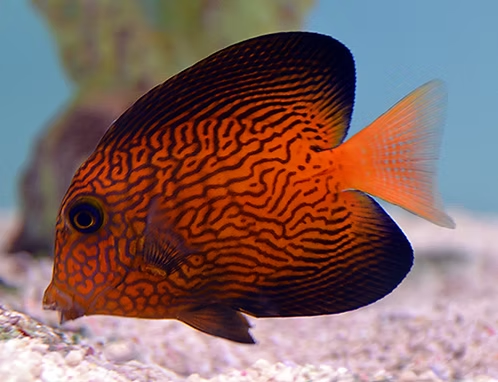
If you have ever seen a juvenile Chevron Tang and an adult Chevron Tang side by side without knowing what you were looking at, you would swear they were two completely different species. The juvenile is one of the most striking fish in the entire hobby. A vivid red-orange body covered in an intricate maze of bright blue and purple lines that form nesting V-shapes, gives the fish its common name. The adult, by comparison, is dark olive to near-black with fine horizontal stripes that are only visible up close. One is a firework. The other is a shadow.
Both are extraordinary. And the fact that you get to watch one turn into the other inside your own tank is exactly what makes the Chevron Tang (Ctenochaetus hawaiiensis) one of the most fascinating fish in the saltwater hobby.
At Dr. Reef’s Quarantined Fish, Chevron Tangs go through the full quarantine process before sale. This is a step that is not optional with this species, as it is known to be highly susceptible to marine ich due to its thinner mucus coating. Getting a healthy, treated fish from the start is the single most important thing you can do when keeping this fish.
The Color Transformation Explained
Juvenile Chevron Tangs have a bright orange-to-red body with blue-purple chevron patterning throughout. The dorsal and anal fins carry the same rich purple tones. This coloration is not random as it serves as camouflage among the colorful coral growth where young Chevrons spend their days feeding. As they grow toward three inches and beyond, the body color begins to deepen. The brilliant orange fades gradually into olive-brown, and then into the dark, rich tones of adulthood. Up close, a fully grown adult Chevron Tang still carries a striking network of fine dark green-blue stripes and lines, but from a distance, it appears a deep, dramatic near-black that commands its own kind of respect.
This shift also reflects a real behavioral change. Young Chevrons live deeper among corals. Adults move into shallower, rockier surge areas where darker tones provide better camouflage. The fish is changing its appearance to match its new lifestyle.
Tank Size and Setup
The Chevron Tang reaches about 11 inches at full adult size. This is a fish that needs room. A minimum of 125 gallons works for a juvenile, but an adult needs 180 gallons or more. The tank should be well-established, ideally running for at least six months to a year before introducing a Chevron Tang, because natural algae growth on rocks and substrate is a key part of this fish’s diet that commercial foods alone cannot fully replicate.
Provide plenty of live rock with crevices and ledges for grazing, along with open swimming space. Unlike some more active surgeonfish, the Chevron is one of the calmer members of its family, but it still needs room to move.
Water parameters:
- Temperature: 77°F to 80.6°F
- pH: 8.1 to 8.4
- Specific Gravity: 1.020 to 1.025
- dKH: 8 to 12
Chevron Tangs are sensitive to ammonia and nitrite spikes. Pristine, stable water quality is non-negotiable for long-term success.
Diet
The Chevron Tang is a bristle-tooth tang, which means it has a very specialized mouth with rows of flexible teeth designed to sift through and scrape detritus, microalgae, and organic material off rocks, sand, and glass. This is not a fish that hunts for a meal and stops; it grazes continuously throughout the day, and it needs consistent access to algae-based foods to stay healthy.
Offer nori sheets daily on a feeding clip. Supplement with Spirulina-based foods, blanched vegetables, frozen herbivore mixes, and algae pellets. The Chevron Tang will also accept mysis shrimp and brine shrimp as occasional protein supplementation. Feed small portions multiple times per day rather than one large feeding, which more closely mirrors natural grazing behavior.
Tank Mates and Temperament
The Chevron Tang is one of the more peaceful tang species. It very rarely bothers non-tang fish and coexists comfortably with wrasses, clownfish, cardinalfish, gobies, blennies, anthias, and most other reef-safe community fish. Its main point of friction is with other Ctenochaetus species and similarly shaped surgeonfish, with which it can show territorial behavior. Introducing multiple tangs at the same time rather than sequentially helps reduce aggression.
The Chevron Tang is fully reef safe and will not harm corals or invertebrates. Many reefers value it specifically for its ability to sift through and clean rockwork in ways that other fish cannot. For a broader look at compatible surgeonfish, the full tangs collection at Dr. Reef offers many quarantined options.
The Ich Problem and Why Quarantine Matters
Ctenochaetus tangs, including the Chevron, lack the thick protective mucus coating found on some other fish families. That makes them highly vulnerable to marine ich (Cryptocaryon irritans) during the stress of collection, shipping, and acclimation. A Chevron Tang that skips quarantine and goes straight into a display tank has a very real chance of breaking out with ich within weeks, potentially spreading it to your entire system.
At Dr. Reef’s Quarantined Fish, every Chevron Tang receives full parasite treatment as part of the quarantine protocol before it ever ships to you. Visit drreefsquarantinedfish.com to check current availability and request your fish.