
Blueface Angelfish

Blueface Angelfish for Sale: Care, Diet, and Aquarium Requirements
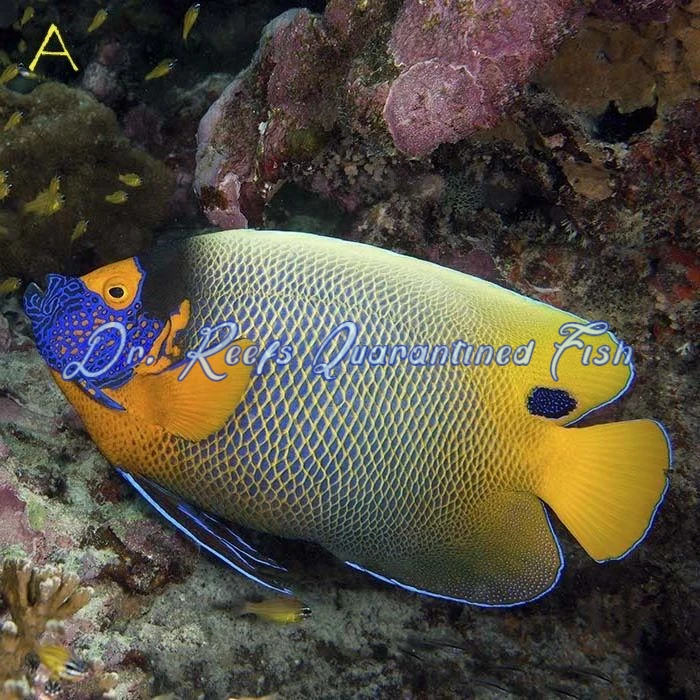
The Blueface Angelfish (Pomacanthus xanthometopon) is one of the most regal and visually complex fish available in the marine hobby. With its mosaic patterning, vivid yellow mask, and striking blue facial markings, this species commands attention in any large reef or fish-only system. At Dr. Reef, Blueface Angelfish are offered only after completing a thorough quarantine protocol, giving you the best possible start with one of the ocean’s most magnificent fish.
Appearance and Natural Habitat
Found throughout the Indo-Pacific region from the Maldives to Vanuatu, the Blueface Angelfish inhabits lagoons and the outer slopes of coral reefs at depths between 5 and 25 meters. Juveniles look entirely different from adults, displaying a dark blue and white striped pattern that gradually transforms as the fish matures. The full adult coloration, featuring that iconic blue and yellow face surrounded by intricate golden body scales, typically develops between the ages of three and five years.
This dramatic color transformation is part of what makes the Blueface Angelfish so fascinating to raise in captivity. Hobbyists who purchase a juvenile enjoy watching the transformation unfold over time.
Tank Size and Environment
The Blueface Angelfish is a large, active fish that requires a substantial aquarium. A minimum of 180 gallons is recommended for a single adult, and larger systems are always better. This fish needs open swimming space as well as rockwork for shelter and grazing. Good filtration is essential, as large angelfish produce significant waste.
Water parameters should be consistently maintained: salinity of 1.020 to 1.025, temperature between 72 and 82 degrees Fahrenheit, and a pH of 8.1 to 8.4. Stability matters more than chasing perfect numbers, as fluctuating conditions stress large angelfish and increase disease susceptibility.
Reef Compatibility Considerations
The Blueface Angelfish is considered reef safe with caution. Like most large angelfish, it may nip at soft corals, large-polyp stony corals, and the mantles of clams. Many hobbyists keep this species successfully in mixed reef systems by providing ample feeding so the fish has no motivation to graze on coral. Others keep it exclusively in fish-only with live rock (FOWLR) systems where coral safety is not a concern.
If you plan to keep a Blueface Angelfish with corals, introducing the fish as a juvenile and keeping it very well fed gives the best odds of peaceful coexistence.
Diet: Feeding a Blueface Angelfish Well
A varied diet is the cornerstone of long-term health in large angelfish. In the wild, the Blueface Angelfish feeds on sponges, tunicates, and algae. In captivity, a diet that mimics this variety keeps the fish thriving and its colors vibrant.
Offer a combination of high-quality frozen foods including mysis shrimp, angel-specific preparations that contain sponge material, and marine algae. Dried seaweed on a clip provides important fiber and grazing enrichment. Feeding two to three times daily in smaller portions is preferable to one large feeding. A fish that is eating enthusiastically and consistently is a fish that will hold its color and resist disease.
Why Quarantine Matters So Much for Large Angelfish
Blueface Angelfish are a significant investment, and they are also more susceptible to parasites like ich and marine velvet than many smaller fish. The stress of collection, transport, and acclimation suppresses immune function, making wild-caught angelfish particularly vulnerable during the period just after import.
At Dr. Reef, every Blueface Angelfish goes through a minimum 30-day quarantine with prophylactic parasite treatment before being offered for sale. The fish arrive at Dr. Reef, settle into dedicated quarantine systems, receive treatment, and are monitored daily. By the time a Blueface Angelfish is listed for sale on the Dr. Reef website, it has cleared treatment, resumed eating normally, and demonstrated consistent healthy behavior.
This process protects your display tank from introduced disease and dramatically improves the survival rate of your new fish. Hobbyists who have purchased quarantined Blueface Angelfish from Dr. Reef regularly report that the fish ate within 24 to 48 hours of arrival and showed no signs of stress, results that are exceptional compared to the industry standard.
Compatibility With Other Fish
Blueface Angelfish are generally peaceful toward fish of different species but can be territorial toward other large angelfish. In most systems, keeping only one large angelfish per tank is the safest approach. They coexist well with tangs, large wrasses, hawkfish, and other robust community fish.
Add a Showpiece to Your System
The Blueface Angelfish is the kind of fish that stops people mid-sentence when they see it for the first time. At Dr. Reef, you can purchase one of these spectacular animals knowing that the hard work of quarantine and health stabilization has already been done for you. Browse the current Blueface Angelfish availability at Dr. Reef and bring home a fish that will anchor your system for years to come.