
Atlantic Blue Tang for Sale: Why This Fish Changes Color as It Grows

Atlantic Blue Tang for Sale: Why This Fish Changes Color as It Grows
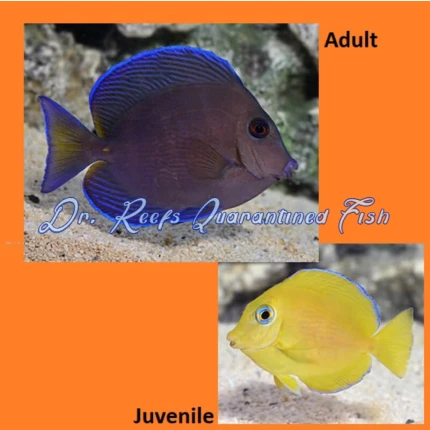
Most fish look the same from juvenile to adult. The Atlantic Blue Tang does something completely different. As a juvenile it is bright yellow. As it matures it turns blue. By adulthood it has transformed into a deep ocean blue with hints of purple.
It is like getting two different fish in one lifetime.
What Is the Atlantic Blue Tang?
The Atlantic Blue Tang (Acanthurus coeruleus) is a surgeonfish from the Caribbean and Western Atlantic. It reaches about 9 to 14 inches at full size. Adults are a rich blue-grey with soft yellow accents around the tail. Juveniles are almost entirely yellow, which is why they are sometimes sold as yellow fish and surprise buyers when they change color.
This color shift is a defense mechanism. Yellow juveniles blend into coral patches near the surface. Blue adults blend into deeper, open water. The fish is literally adapting its camouflage as it grows.
Atlantic Blue Tang for Sale at Dr. Reef’s
Both juvenile and adult Atlantic Blue Tangs are available at Dr. Reef’s Quarantined Fish. Because this species can be sensitive to shipping stress, buying a fully quarantined specimen that has already been through the adjustment period gives it a much better start in your tank.
Juvenile vs. Adult: Which Should You Buy?
This is a real question worth thinking about. Juveniles are less expensive and watching the color transformation is one of the most rewarding things you can experience in reef keeping. However, juveniles can be slightly more sensitive to disease and water quality shifts.
Adults are more established, show more of the final coloration, and tend to be more robust. They do need more space right away since they are already larger.
Either way, the tank needs to be able to accommodate an adult eventually. Do not buy this fish for a small tank thinking it will stay small. It will not.
Tank and Care Requirements
Adults need a minimum of 100 gallons, preferably 150 or more with significant horizontal swimming space. Juveniles can manage in 70 gallons while small, but plan to upgrade.
Like all surgeonfish, it grazes heavily throughout the day. Clip nori sheets in the tank and offer algae-based flakes or pellets as the main staple. Occasional mysis is fine as a supplement.
Water parameters: 74 to 80 degrees, salinity 1.023 to 1.025, pH 8.1 to 8.4. Good flow and pristine water quality are important, especially during the juvenile stage.
Is It Reef Safe?
Yes. The Atlantic Blue Tang is fully reef safe. It does not bother corals, anemones, or invertebrates. It may occasionally pick at small soft-bodied organisms if underfed, so make sure it is getting enough algae-based food daily.
Common Questions
When does it change from yellow to blue? The transition usually begins between 1.5 and 3 inches in length and happens gradually over several months. There is an intermediate stage where the fish shows yellow, blue, and green simultaneously.
Is it similar to the Pacific Blue Tang? They look similar as adults but are different species. The Atlantic species tends to be slightly hardier in captivity.
Can it live with other tangs? Yes, if the tank is large enough. Introduce it alongside tangs of different body shapes to reduce aggression.
A Genuinely Unique Fish
The Atlantic Blue Tang is one of the few fish where buying young and watching it mature is genuinely rewarding. The color transformation from yellow to blue is something you simply have to see happen in your own tank.
Order yours from drreefsquarantinedfish.com today.