
Yellowhead Jawfish for Sale: Care Guide, Burrowing Behavior, and Tank Setup

Yellowhead Jawfish for Sale: Care Guide, Burrowing Behavior, and Tank Setup
Imagine a fish that builds its own home from scratch every single day. It digs, it engineers, it decorates, and it guards its burrow like a tiny real estate developer who takes the job very seriously. Now imagine that same fish popping its head out of the sand every few minutes with those comically oversized eyes scanning the room, and you have a pretty good picture of why the Yellowhead Jawfish has one of the most devoted fan bases in the saltwater hobby.
This fish is not just beautiful. It is endlessly entertaining. And it is one of the most unique behavioral experiences you can create in a home reef tank.
What Is the Yellowhead Jawfish?
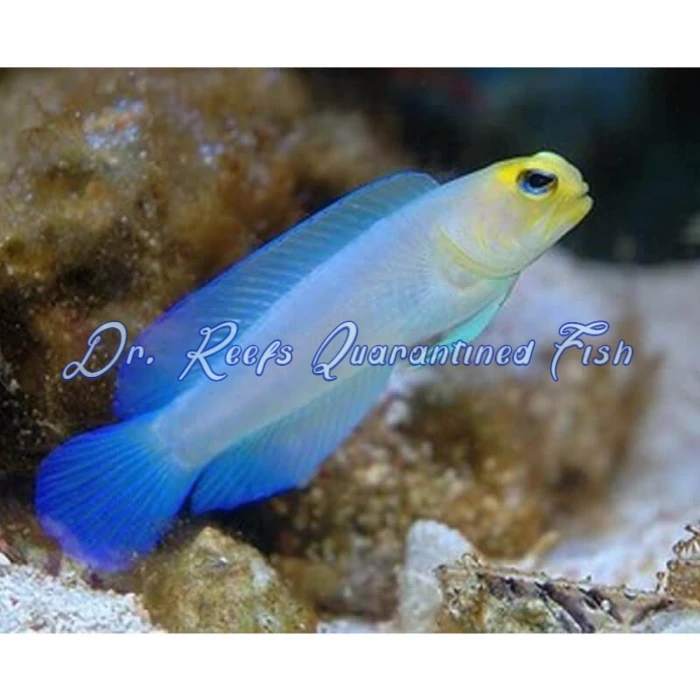
The Jawfish Pearly Yellowhead, available at Dr. Reef’s Quarantined Fish for $139.99, goes by the scientific name Opistognathus aurifrons. It is native to the tropical Western Atlantic, found from Florida down through the Caribbean and into the Gulf of Mexico. It lives in sandy rubble zones at the base of reefs, where it excavates vertical burrows and spends the vast majority of its life hovering just above the entrance.
The fish gets its common name from the bright yellow to pale gold coloration on its head and upper body, which fades to a pearlescent white-blue along the lower body and tail. The eyes are noticeably large relative to the body, giving it a wide-eyed, curious expression that reef keepers find completely irresistible. Adults reach about 4 inches in length, making them a manageable mid-sized addition to most reef systems.
The Yellowhead Jawfish is reef-safe, peaceful, and fully captive-compatible when given the right setup. It does not bother corals, does not chase other fish, and does not compete aggressively for food. What it does need is a very specific substrate setup to thrive. Get that right, and it will reward you for years.
The Burrowing Behavior: What to Expect
This is what makes the Yellowhead Jawfish genuinely one of a kind in the hobby. Within hours of being introduced to a new tank, this fish gets to work. It selects a spot in the sand, opens its enormous mouth, and begins scooping mouthfuls of substrate out of the ground, depositing them around the entrance to create a raised mound.
Over the following days and weeks, the burrow becomes increasingly sophisticated. The fish lines the walls with small pebbles, shell fragments, and rubble pieces, cementing them together to form a stable tunnel. It will rearrange these materials constantly. If you move rocks or disturb the substrate near its burrow, it will immediately begin rebuilding. Watching this construction project is one of the most fascinating daily shows in the hobby.
The Yellowhead Jawfish hovers vertically at its burrow entrance most of the time, facing upward with its body partly inside the hole. When food drifts past in the current, it darts out, grabs it, and retreats back to the burrow entrance. When startled, it drops tail-first into the burrow and disappears in a fraction of a second. That speed is remarkable to witness the first few times.
One of the most incredible behaviors of the entire family is mouthbrooding. Male Yellowhead Jawfish carry fertilized eggs in their mouths for up to two weeks until they hatch. The male cannot eat during this period and will visibly hold the egg mass in its distended jaw. This behavior has been successfully observed and documented in home aquariums, making the Yellowhead Jawfish an exciting species for hobbyists interested in captive breeding.
Tank Setup for the Yellowhead Jawfish
The substrate is everything. This is not optional advice. A Yellowhead Jawfish that cannot burrow is a stressed, unhealthy fish that will decline rapidly. Getting the substrate right before the fish arrives is the single most important thing you can do.
Substrate Depth and Composition
The substrate needs to be at least 4 to 6 inches deep in the area where the jawfish will burrow. This gives it enough material to excavate a complete vertical tunnel of 3 to 4 inches deep. Shallower substrates force the fish into partial burrows that collapse and cause chronic stress.
Texture matters just as much as depth. The ideal mix is a combination of fine to medium aragonite sand with small pieces of crushed coral, shell rubble, and mixed grain sizes. Pure fine sand is too unstable and collapses. Pure coarse substrate is too heavy to move. A layered mix gives the fish the combination of workable, packable material it needs to build a stable burrow.
Scatter a handful of small pebbles, shell chips, and rubble pieces on the surface near where you expect the burrow to form. The jawfish will immediately incorporate these into its construction. The first few days in a new tank can be chaotic as the fish frantically excavates and rebuilds, but this settles into a stable routine once the burrow is established.
Tank Size
A minimum of 30 gallons is recommended for a single Yellowhead Jawfish. The tank footprint matters more than height. A long, wide tank gives the fish more surface area to roam and more options for burrow placement away from rockwork.
If you want to keep a small group, which creates a genuinely stunning display of multiple burrows side by side, size up to at least 75 gallons. Groups of three to five fish coexist peacefully and the social dynamic of neighboring burrow holders is something you will never get tired of watching.
Tank Lid: Non-Negotiable
Yellowhead Jawfish are jumpers. This is one of the most important facts about this species. They are fast, they are reactive to sudden movement, and they will launch out of the water if startled or if they wander too close to the surface at night. A tight-fitting mesh lid or glass cover is absolutely required. There are no exceptions. Many hobbyists have lost beautiful, healthy jawfish to jumping, and it is entirely preventable.
Moderate, indirect flow works best. Strong direct flow aimed at the substrate can collapse burrows and prevent the fish from maintaining its home. Aim powerheads and return nozzles away from the jawfish’s preferred area of the tank.
Water Parameters
- Temperature: 72 to 78 degrees Fahrenheit
- Salinity: 1.023 to 1.025
- pH: 8.1 to 8.4
- Nitrates: Keep below 20 ppm
- Ammonia and Nitrite: 0 ppm
Feeding the Yellowhead Jawfish
Yellowhead Jawfish are carnivores that feed on zooplankton and small crustaceans in the wild. In captivity they adapt readily to frozen foods and will eat well once settled into their burrow.
Feed small portions of frozen mysis shrimp, enriched brine shrimp, and finely chopped krill two to three times per day. Use a target feeder or wave wand to direct food near the burrow entrance so the fish can grab it without having to leave its home. This reduces stress and ensures it is getting enough food rather than competing with faster-moving tank mates.
Once settled and comfortable, many Yellowhead Jawfish become bold enough to dart out into the water column for food during feeding time. This confident, active feeding behavior is one of the signs of a healthy, well-adjusted fish.
Tank Mates and Reef Compatibility
The Yellowhead Jawfish is fully reef-safe and will not bother corals, clams, or ornamental invertebrates. Its peaceful temperament makes it a good community fish, but tank mate selection still requires some thought.
Avoid fast, aggressive feeders that will out-compete the jawfish for food, and avoid large, boisterous fish that will stress it into hiding permanently. The best tank mates are small to medium peaceful species including firefish gobies, dartfish, small wrasses, clownfish, cardinalfish, and anthias. Keep away from large triggers, puffers, and groupers that may view the jawfish as a snack.
The Blue Dot Jawfish, also available at Dr. Reef’s for $199.99, makes a fascinating companion species if your tank is large enough to support two burrowing fish with separate territories.
Questions and Answers About the Yellowhead Jawfish
Q: How deep does the substrate need to be for a Yellowhead Jawfish?
A: At least 4 to 6 inches in the burrowing area. The fish needs enough depth to excavate a full vertical tunnel and feel secure. Shallower substrate causes the burrow to collapse and stresses the fish chronically.
Q: Do Yellowhead Jawfish jump out of tanks?
A: Yes, they absolutely do and will. A tight-fitting lid is non-negotiable for this species. Many healthy jawfish are lost to jumping, especially at night or when startled. Never keep a jawfish in an open-top tank.
Q: Can I keep multiple Yellowhead Jawfish together?
A: Yes, and it creates a beautiful display. In a tank of 75 gallons or more, a small group of three to five fish will establish neighboring burrows and coexist peacefully. Watching the social behavior between neighboring burrow holders is one of the hobby’s most rewarding experiences.
Q: What is the price of the Jawfish Pearly Yellowhead at Dr. Reef’s?
A: The Jawfish Pearly Yellowhead is $139.99 at Dr Reef’s Quarantined Fish. The Blue Dot Jawfish is also available at $199.99.
Q: Do Yellowhead Jawfish really hold eggs in their mouths?
A: Yes. Male Yellowhead Jawfish are mouthbrooders. The male carries the fertilized egg mass in his distended jaw for up to two weeks until hatching. He cannot eat during this time. This behavior has been observed and documented in home aquariums and is one of the most remarkable things in the reef hobby.
Q: Is the Yellowhead Jawfish reef-safe?
A: Completely. It will not bother corals, clams, or invertebrates. Its only impact on the reef is the occasional sand displacement around its burrow, which is easy to manage with good tank layout.
Q: What substrate mix works best for a Yellowhead Jawfish burrow?
A: A layered mix of fine to medium aragonite sand combined with small shell rubble and mixed-grain crushed coral. Scatter small pebbles and shell chips on the surface near the burrow site. Pure fine sand is too unstable. A mixed texture gives the fish the workable, packable material it needs for a stable tunnel.
Why Buy From Dr. Reef’s Quarantined Fish?
The Yellowhead Jawfish at Dr. Reef’s is priced at $139.99 and every single one goes through a full medical quarantine protocol before shipping. That matters enormously for this species. Jawfish that arrive stressed, hungry, or carrying parasites often refuse to burrow and stop eating, which leads to a rapid and heartbreaking decline.
A pre-quarantined, health-confirmed Yellowhead Jawfish from Dr. Reef’s arrives conditioned, eating, and far more ready to settle into a new tank quickly. That is the difference between a fish that starts burrowing within hours of introduction and one that hides in a corner and refuses to eat for two weeks.
Every order ships overnight via UPS, Tuesday through Thursday, for Wednesday through Friday delivery. Free shipping applies on orders over $500. Payments are accepted via PayPal, Stripe, and Venmo. A 24/7 email support team is available for any questions before or after your order.
Visit drreefsquarantinedfish.com today and bring home one of the most personality-packed fish in the saltwater hobby.