
Unicorn Tang for Sale: What Is That Horn Growing on Its Head?

Unicorn Tang for Sale: What Is That Horn Growing on Its Head?
Some fish are colorful, and some are rare. The Unicorn Tang is something else entirely. From the bony horn that literally grows out of its forehead over years of maturity to its sweeping tail streamers and commanding reef presence, this is a fish that stops people mid-sentence when they see it for the first time. It doesn’t just look unusual. It appears to be something that shouldn’t exist. And yet, it does, and it can live in your tank for decades if you set things up right.
What Is the Unicorn Tang?
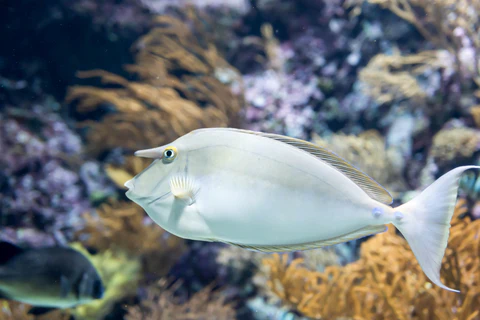
The Unicorn Tang (Naso unicornis) is a large, striking surgeonfish native to the Indo-Pacific, found across reefs from the Red Sea all the way to Hawaii. It has a streamlined, robust body with a blue-gray to olive base coloration, striking blue facial highlights, and a distinctive bright yellow mask around the mouth and eye region. Males develop elongated tail streamers as they mature, adding a graceful, flowing element to an already impressive silhouette.
Related Naso Species
The Blue Unicorn Tang (Naso brevirostris) is a closely related species that shares the same horn development and general body shape, with a slightly more pronounced blue coloration and shorter rostral horn. Both species belong to the Naso genus, the same group that includes the popular Naso Blonde Tang and the Vlamingii Tang, all of which are known for their large size, active swimming, and strong personalities.
The Horn Is Real. Here’s What It Actually Is.
The structure growing from the Unicorn Tang’s forehead isn’t decorative, and it isn’t a myth. It’s a rostral protuberance, a dense, bony projection that develops gradually from between the fish’s eyes as it ages. Juvenile Unicorn Tangs look like fairly ordinary surgeonfish. Give them time, and that changes completely.
By full adulthood, the horn is unmistakable: a solid, forward-pointing structure that gives the fish a genuinely prehistoric silhouette unlike anything else in the reef hobby. Its exact biological purpose hasn’t been definitively confirmed, though researchers believe it may play a role in species recognition or social signaling within groups. What’s certain is that no other commonly kept reef fish grows one, and that alone makes this species a conversation piece in any display system.
The Tank Size Conversation Nobody Wants to Skip
This is where the honest part of this article lives. The Unicorn Tang reaches 18 to 24 inches in the wild. Aquarium specimens tend to stay somewhat smaller, but not by enough to justify undersizing the tank. The minimum starting point for this species is 180 gallons, and that is a genuine minimum, not a conservative recommendation with room to fudge. A 250-gallon system or larger is where this fish genuinely thrives.
Why Space Is Non-Negotiable
The Unicorn Tang is an active, powerful swimmer that needs horizontal distance to cover. In a cramped system, it cannot express natural movement, and a fish that cannot move naturally is a fish under constant stress. Chronic stress in surgeonfish leads directly to immune suppression, disease susceptibility, and a shortened lifespan. The tank size conversation isn’t optional with this species.
Water Flow, Aquascaping, and Getting the Environment Right
Strong, consistent water flow is non-negotiable. Unicorn Tangs come from reef environments where the current is constant, and circulation is high, and replicating that in captivity keeps their respiration, behavior, and overall physiology functioning as it should. A sluggish, low-flow system is the wrong home for this fish.
Aquascaping should prioritize open swimming lanes over dense rockwork. Live rock provides grazing surfaces and structural complexity, but the emphasis needs to be on space rather than decoration. Think of the rock as framing the open water, not filling it. Stable parameters round out the setup: temperature between 74°F and 82°F, salinity at 1.023 to 1.025, and pH maintained between 8.1 and 8.4. These aren’t ranges to drift in and out of. They’re the baseline this fish was built for.
Feeding a Fish This Size the Right Way
Unicorn Tangs are primarily herbivores with a strong, consistent preference for macroalgae. In the wild, they graze extensively across leafy algae growing on reef structures, a feeding pattern that needs to be replicated in captivity, not just for nutrition but for long-term disease prevention. Surgeonfish kept on poor diets develop Head and Lateral Line Erosion, a degenerative condition that becomes visible as pitting and discoloration along the lateral line and head. A proper diet prevents it entirely.
Essential Herbivore Diet and Schedule
The feeding foundation should be nori sheets clipped inside the tank, dried macroalgae, spirulina-enriched pellets, and quality herbivore flake offered two to three times daily. Supplement with frozen mysis shrimp occasionally to provide protein variety. A fish this size has a substantial appetite, and the worst thing you can do is underfeed it and assume it’s grazing enough on its own. Consistent, varied, plant-forward feeding keeps this species in peak condition for the long term.
Why Quarantine Is Not a Step to Skip
Surgeonfish are among the most ich-susceptible fish in the reef hobby, and the Unicorn Tang is no exception. Wild-caught specimens go through significant stress during collection, holding, and shipping, and that stress suppresses immune response at exactly the moment the fish is most vulnerable. An unquarantined tang introduced directly into a display tank doesn’t just risk its own health. It risks exposing every other fish in the system to parasites.
At Dr. Reef’s Quarantined Fish, every Unicorn Tang goes through a full quarantine protocol: observation for normal behavior, active feeding confirmation, treatment as needed, and full acclimation before overnight shipping via UPS. The fish that leaves this facility has already cleared every critical threshold before it arrives at your door. For a fish this size, this long-lived, and this significant an investment, that process matters more than the price difference with an unquarantined alternative.
Q&A: Your Questions About the Unicorn Tang, Answered Directly
Q: I’ve never kept a tang this large. Is this a realistic fish for me to own?
A: If your tank meets the size requirement and your water quality is stable, yes, it is more realistic than many people assume. The Unicorn Tang isn’t fragile or particularly demanding in behavior. What it demands is space and a consistent diet. If you can provide both, this fish is hardy, long-lived, and far more manageable than its size might suggest. The challenge is infrastructure, not the animal itself.
Q: The horn, does it grow the whole time the fish is alive, or does it stop?
A: It continues developing through the fish’s life, becoming more pronounced as the animal ages. A young specimen will show little to no horn development. A fully mature male is unmistakable. Part of what makes this species so compelling as a long-term fish is watching that development happen over the years in your own system.
Q: How long will it actually live?
A: With proper care, large tangs regularly live 20 years or more in captivity. The Unicorn Tang is a decades-long commitment if kept correctly. That lifespan is one of the strongest arguments for doing everything right from the beginning, including the tank size, the quarantine, and the diet. You’re not setting up a fish for a few years. You’re setting up a centerpiece for the long run.
Q: Is it going to destroy my coral?
A: No. The Unicorn Tang is fully reef safe and has no interest in your coral. Its diet is algae, and its habitat is in open water. It’s one of the more trusted large fish in this regard, and you won’t spend your time watching it and wondering.
Q: How do I know the fish I’m buying is actually healthy before it ships?
A: At Dr. Reef’s Quarantined Fish, no Unicorn Tang ships until it has been observed through a full quarantine period, confirmed actively feeding, and showing normal behavior in a stable aquarium environment. If the fish isn’t ready, it doesn’t leave. That standard is what separates a fish that arrives and thrives from one that arrives and crashes within a week.
There Is No Other Fish Quite Like This One
That’s not marketing language. It’s a straightforward biological fact. No other commonly kept reef fish grows a bony horn from its forehead. No other species develops the combination of rostral projection, facial mask, and elongated tail streamers that make the adult Unicorn Tang look the way it does. It becomes more dramatic with every year it ages, and in a system sized correctly for it, it will be the fish every visitor to your home asks about.
Visit drreefsquarantinedfish.com to browse the full tangs collection and find the right tank mates for your large system. The fish that will define your display for the next two decades might already be there waiting.