
Banner Fish for Sale: Is This the Closest Alternative to a Moorish Idol?

Banner Fish for Sale: Is This the Closest Alternative to a Moorish Idol?
$179.99 — Free Shipping on Orders Over $500
The Moorish Idol is one of the most recognizable reef fish in the world, made famous partly by its role in popular culture and partly by how difficult it is to keep alive in captivity. Experienced hobbyists have long looked for an alternative that carries the same dramatic black-and-white banner silhouette without the punishing care requirements. The Schooling Bannerfish delivers exactly that. Dr. Reef’s Quarantined Fish offers it at $179.99 on drreefsquarantinedfish.com under Saltwater Fish, Butterflyfish.
Confirmed Specifications
| Field | Details |
| Scientific Name | Heniochus acuminatus / Heniochus diphreutes |
| Common Names | Schooling Bannerfish, Pennant Coralfish, False Moorish Idol |
| Care Level | Moderate |
| Temperament | Peaceful and social |
| Diet | Planktivore — frozen mysis, brine shrimp, marine pellets, finely chopped meaty foods |
| Reef Compatible | Yes with caution (H. diphreutes) / Not reef safe (H. acuminatus) |
| Max Adult Size | 7–8 inches |
| Water Temperature | 72–78°F |
| Salinity (sg) | 1.020–1.025 |
| pH | 8.1–8.4 |
| Minimum Tank Size | 125 gallons |
| Family | Chaetodontidae |
| Quarantine Duration | 30–45 days at Dr. Reef’s Tulsa facility |
| Price | $179.99 — free shipping on orders over $500 |
What Is the Schooling Bannerfish?
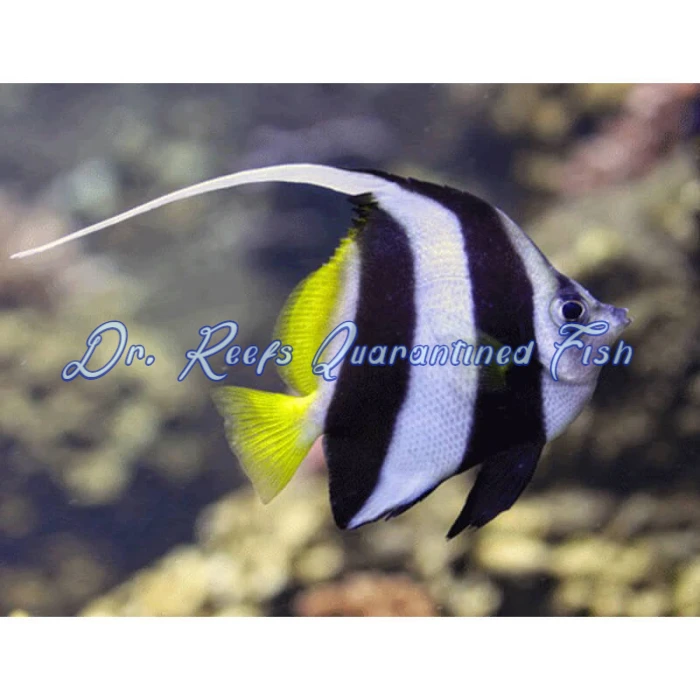
The Schooling Bannerfish is a butterflyfish from the family Chaetodontidae, native to the Indo-Pacific and the Red Sea. It has a white body with two broad black vertical stripes, a long white dorsal filament that streams backward, and bright yellow fins. The overall silhouette is strikingly similar to the Moorish Idol (Zanclus cornutus), which is why the Bannerfish is frequently called the False Moorish Idol in the trade.
Two species are commonly sold under this name. Heniochus diphreutes, the true Schooling Bannerfish, is generally considered reef safe and feeds primarily on zooplankton. Heniochus acuminatus, the Longfin Bannerfish, is more commonly available but not reef safe and will nip at coral polyps. When purchasing for a reef system, confirm the species with the vendor. Dr. Reef’s can clarify which species is in stock.
How Does It Compare to the Moorish Idol?
This is the question every hobbyist asks. Here is a direct comparison:
| Feature | Schooling Bannerfish |
| Appearance | Nearly identical silhouette to the Moorish Idol — white body, black stripes, long dorsal fin |
| Care Difficulty | Moderate. Much more forgiving than the Moorish Idol |
| Feeding | Accepts prepared foods readily once conditioned |
| Reef Safety | Heniochus diphreutes is reef safe; acuminatus is not |
| Price | Significantly more affordable than a Moorish Idol |
| Survival Rate | Far higher in captivity than the Moorish Idol with proper setup |
| Schooling Behavior | Can be kept in groups — the Moorish Idol cannot be reliably grouped |
The Moorish Idol is notoriously difficult to feed in captivity. It requires live sponge and coral polyp material in the wild and rarely makes a full transition to prepared foods. Its mortality rate in home aquariums is among the highest of any commonly sold marine fish. The Schooling Bannerfish, by contrast, feeds naturally on zooplankton and transitions to frozen and prepared foods with relative ease.
What Makes the Bannerfish Unique Beyond Its Appearance
It Actually Schools
Most fish called “schooling” species do not actually school in home aquariums. The Schooling Bannerfish genuinely forms natural group behavior when kept with others of the same species. In large display aquariums, groups of three to five specimens will swim synchronously, face the same direction in current, and move through the water column together. This is a rare behavior to observe in a home reef system and one of the most dramatic displays available in the hobby.
All specimens introduced together must be added at the same time to prevent territorial conflict between established and new individuals.
Juveniles as Cleaner Fish
Young Schooling Bannerfish act as cleaner fish in the wild, picking parasites from larger fish at cleaning stations. Some hobbyists report their Bannerfish continuing this behavior in captivity, particularly toward large fish that present themselves at a preferred spot in the tank.
Tank and Care Requirements
Minimum Tank Size
125 gallons for a single specimen. If you want to keep a group, plan for 200 gallons or more. These are active open-water swimmers and need significant horizontal space.
Tank Environment
- Open swimming areas in the middle and upper water column
- Moderate to strong water flow to simulate pelagic reef conditions
- Live rock for shelter but not packed densely
- Good protein skimmer and stable water chemistry
Water Parameters
- Temperature: 72–78°F
- Salinity: 1.020–1.025
- pH: 8.1–8.4
Diet and Feeding
The Schooling Bannerfish is a planktivore. It naturally picks small zooplankton from the water column in the wild and accepts a wide range of prepared aquarium foods once conditioned. Feed two to three times daily with:
- Frozen mysis shrimp
- Frozen enriched brine shrimp
- High-quality marine pellets
- Finely chopped seafood
- Nori and spirulina-based foods as supplementary grazing
Reef Compatibility: What You Need to Know
Heniochus diphreutes is considered reef safe with caution. It will not actively target coral polyps but may occasionally sample soft coral tissue if underfed. Keep feedings consistent and the risk is low.
Heniochus acuminatus is not reef safe and will nip at stony coral polyps, soft corals, and ornamental invertebrates. If your tank contains corals, confirm you are purchasing diphreutes, not acuminatus. The two look nearly identical but can be distinguished by snout length (diphreutes has a shorter, rounder snout) and body profile.
Why Dr. Reef’s Quarantine Process Matters Here
Butterflyfish as a family are susceptible to marine ich and bacterial infections during transport. They also need conditioning to prepared foods during quarantine to avoid the refusal-to-feed issues that cause early mortality. Dr. Reef’s holds the Schooling Bannerfish for 30 to 45 days at the Tulsa facility with full disease monitoring and food conditioning. The fish must be confirmed eating consistently before it is invoiced for shipping.
At $179.99, this is a professionally prepared specimen of one of the most visually striking and behaviorally interesting fish available in the hobby. Dr. Reef’s Quarantined Fish ensures you receive an animal ready to thrive from day one.
Frequently Asked Questions
Is it really as close to a Moorish Idol as people say?
Visually, yes. In terms of silhouette and color pattern, it is the nearest match in the hobby and far more reliably kept alive. For most hobbyists who want the look of a Moorish Idol in their reef tank, the Schooling Bannerfish is the practical answer.
Can I keep more than one in the same tank?
Yes, and this is one of the most recommended approaches. Keep a group of three or more in a large tank, all introduced at the same time. Schooling behavior in groups is one of this fish’s standout features.
Will it nip at my corals?
Heniochus diphreutes generally does not, particularly when well fed. Heniochus acuminatus will. Confirm which species you are purchasing before placing a coral-tank order.
How long does it live with proper care?
With a stable reef environment and consistent feeding, the Schooling Bannerfish can live 8 to 10 years or longer in a home aquarium.
The Bottom Line on the Schooling Bannerfish
The Schooling Bannerfish from Dr. Reef’s Quarantined Fish is the most practical way to get the Moorish Idol look in a home reef aquarium without the punishing care demands and near-certain failure rate of the real thing. At $179.99 with a full 30 to 45 day quarantine protocol, confirmed feeding record, and FedEx Priority Overnight shipping from Tulsa, this is a purchase backed by professional preparation. For hobbyists who want drama, movement, and one of the most recognizable silhouettes in the ocean living in their living room, Dr. Reef’s has the specimen ready to ship.
Order or inquire: drreefsquarantinedfish.com | (918) 964-3333 | support@drreefs.com