
Miniatus Grouper for Sale: Can This Predator Live with Other Fish?

Miniatus Grouper for Sale: Can This Predator Live with Other Fish?
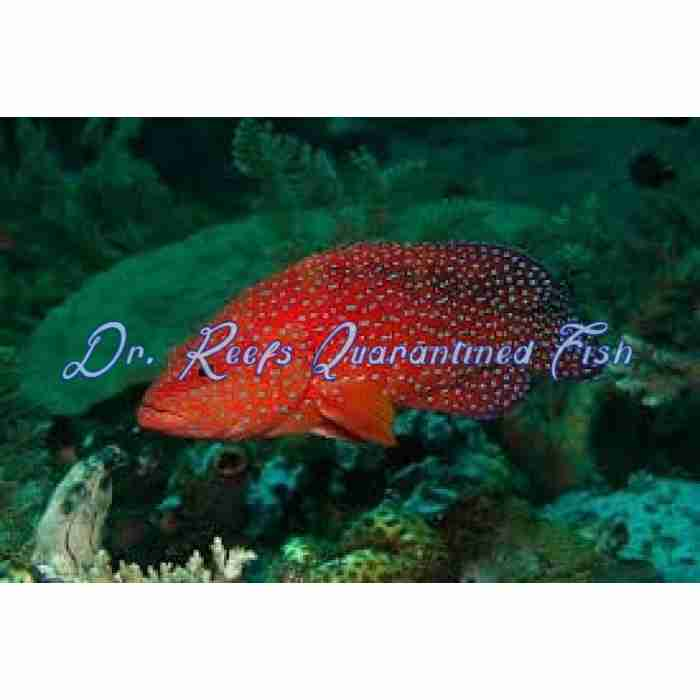
Few fish in the saltwater hobby stop people mid-sentence the way the Miniatus Grouper does. Its vibrant orange-red body covered in brilliant electric-blue spots is the kind of coloration that makes people question whether the fish is real. It is, and it is a predator. Whether you can keep it with other fish depends entirely on which fish you choose. This guide covers everything.
What Is the Miniatus Grouper?
The Miniatus Grouper, Cephalopholis miniata, is a predatory reef fish native to the Indo-Pacific, ranging from the Red Sea to Samoa. It inhabits coral reefs, lagoons, and reef slopes at depths of 3 to 500 feet, typically occupying areas with caves and crevices where it can ambush prey from sheltered positions. In the wild, it is a sit-and-wait predator that relies on its striking camouflage and patient positioning to catch smaller fish and crustaceans.
What Does It Look Like?
The Miniatus Grouper is one of the most visually spectacular fish available to reef hobbyists. Its body is a rich orange-red base color covered densely in brilliant blue spots that appear almost iridescent under aquarium lighting. The contrast between the warm orange-red and cool electric blue is dramatic and unlike almost any other marine fish. This is a fish that commands attention in any system.
How Big Does It Get?
Miniatus Groupers reach about 16 to 18 inches at full adult size. Juveniles are significantly smaller and more manageable, but this fish grows steadily and planning for its adult size is essential from the start.
Tank Size
A minimum of 180 gallons is recommended for a Miniatus Grouper, with larger being better as it approaches adult size. This is not a fish for small systems. It needs space to establish territory and to move comfortably without constant stress.
Water Parameters
Temperature between 74 and 80 degrees Fahrenheit, salinity at 1.023 to 1.025, pH between 8.1 and 8.4. Strong filtration is important because the Miniatus Grouper is a messy eater that produces significant waste. A good protein skimmer and robust biological filtration are essential.
Can It Live with Other Fish?
This is the central question for most buyers, and the answer is yes, with the right choices. The Miniatus Grouper is compatible with large tangs of 8 inches or more, large angelfish, large wrasses, lionfish of similar size, large butterflyfish, pufferfish, and triggerfish. The rule is straightforward: any fish small enough to fit in its mouth is at risk. This is not a fish that can be kept with small gobies, small clownfish, small dottybacks, or any other fish that would be bite-sized to an adult grouper.
Is It Reef Safe?
Partially. The Miniatus Grouper will not touch your corals, but it will eat fish and crustaceans. Shrimp, small crabs, and any small fish are all prey items. In a fish-only-with-live-rock system with appropriate tank mates, it is a spectacular centerpiece. In a reef with small fish and invertebrates, it is a predator problem waiting to happen.
Diet and Feeding
The Miniatus Grouper is a carnivore that should be fed meaty foods including frozen silversides, krill, prawns, and squid. It can be trained to accept these foods readily, especially when started as a juvenile. Feed two to three times per week for adults. Overfeeding increases waste load and can cause health issues.
Temperament
The Miniatus Grouper is bold and confident rather than outright aggressive toward fish it cannot eat. It will establish territory within the tank but generally coexists with appropriately sized tank mates without persistent conflict. Juveniles are typically less assertive than adults.
How Much Does a Miniatus Grouper Cost at Dr. Reef’s?
The Miniatus Grouper is available at Dr. Reef’s Quarantined Fish with pricing based on size. Visit drreefsquarantinedfish.com for current stock and pricing. All specimens are professionally quarantined, health-screened, and conditioned before shipping so you receive a fish that is ready to thrive from day one.
Quick Q and A
Q: Will a Miniatus Grouper eat my clownfish?
A: Almost certainly, unless the clownfish is very large. Any fish it can swallow is a meal.
Q: Can I keep two Miniatus Groupers together?
A: Not recommended unless the tank is very large. Two adults will compete for territory.
Q: Is it hard to keep?
A: Moderate care level for an experienced hobbyist. Water quality and tank size are the primary requirements.
Q: Will it eat my shrimp?
A: Yes. Ornamental shrimp are not safe with a Miniatus Grouper.
The Miniatus Grouper is one of the most visually stunning predatory fish in the saltwater hobby. Its blue-spotted orange body is genuinely unlike anything else available at any price. If your tank is large enough and your fish selection is appropriate, this is a centerpiece species worth serious consideration. Visit drreefsquarantinedfish.com to check current availability and bring home a professionally quarantined specimen today.