
Bumblebee Snails for Sale: Are They Good for Reef Tanks?

Bumblebee Snails for Sale: Are They Good for Reef Tanks?
The saltwater hobby is full of animals that punch well above their weight in terms of the work they do for your tank. The Bumblebee Snail is a perfect example. Tiny, strikingly patterned, and remarkably effective at a job most other clean-up crew members skip entirely. But like many specialized reef animals, it comes with specific strengths and specific limitations that every hobbyist should understand before adding them. This complete guide answers the big question honestly and tells you exactly what Bumblebee Snails can and cannot do for your reef.
What Is a Bumblebee Snail?
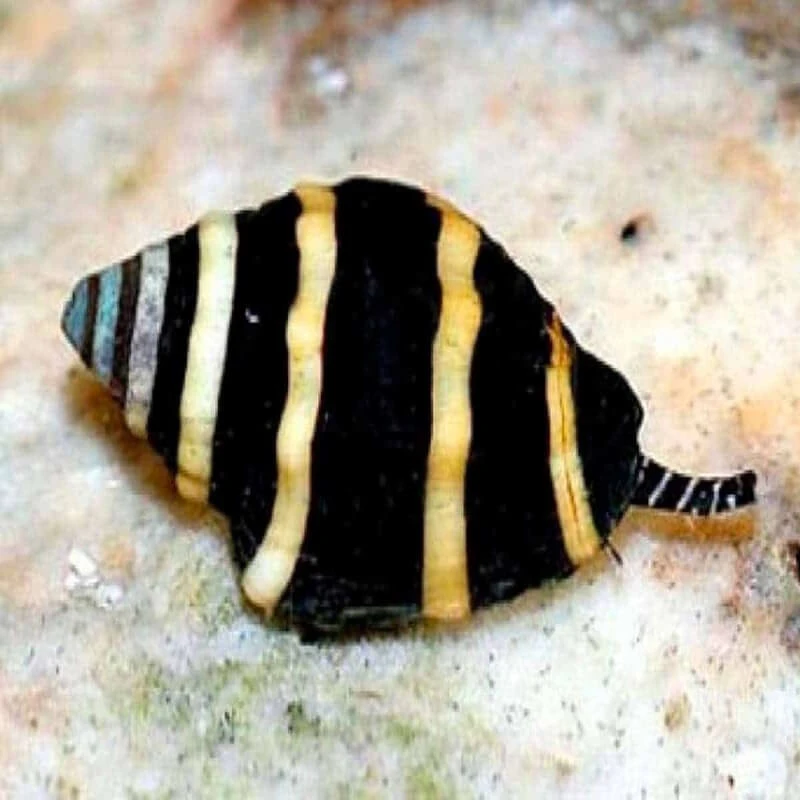
The Bumblebee Snail, known scientifically as Engina mendicaria, is a small marine gastropod native to the Indo-Pacific Ocean. It rarely grows larger than half an inch to three quarters of an inch, making it one of the smallest snails commonly available in the reef hobby. Its shell features bold alternating bands of black and yellow or black and white that create the bumblebee pattern it is named for. It is genuinely eye-catching for such a small animal.
What Do Bumblebee Snails Eat?
This is the most important question to answer before buying any clean-up crew member, and the Bumblebee Snail has a very specific answer.
Primary Prey: Detritus and Organic Waste
Bumblebee Snails are primarily detritivores. They burrow into the sand bed and consume decomposing organic matter, uneaten food particles, and bacterial films that accumulate in the substrate. This is genuinely valuable work that directly improves water quality and reduces nutrient buildup in the sand bed.
Secondary Prey: Other Snails and Worms
Here is where the Bumblebee Snail gets more complicated. These snails are predatory carnivores that will attack and eat small worms, other small snails, and slow-moving invertebrates when given the opportunity. They are particularly known for preying on vermetid snails, small bristle worms, and other sand-dwelling invertebrates that hobbyists sometimes want to eliminate.
Do Bumblebee Snails Eat Algae?
Minimally. Unlike Turbo Snails, Astrea Snails, or Cerith Snails that are primarily algae grazers, Bumblebee Snails are not efficient algae eaters. If your primary goal is algae control, other snail species serve that purpose more effectively. Bumblebee Snails earn their place as sand bed cleaners and worm controllers, not algae grazers.
Are Bumblebee Snails Reef Safe?
This requires an honest, nuanced answer.
Safe for Corals
Bumblebee Snails do not bother coral tissue. They are safe around all coral types and will not nip or disturb coral polyps.
Risky for Small Snail Species
Their predatory nature means they may attack and eat very small snail species like small Cerith Snails or baby snails from breeding populations. In a tank with a diverse snail clean-up crew including small species, Bumblebee Snails can reduce that population over time.
Beneficial Worm Control
Many hobbyists add Bumblebee Snails specifically because they prey on nuisance vermetid snails and small bristle worms. If those pests are a problem in your tank, Bumblebee Snails provide useful natural control.
Bumblebee Snail Pricing at Dr. Reef’s
At Dr. Reef’s Quarantined Fish, Bumble Bee Snails are priced at $39.99 to $69.99 at Dr.Reef’s Quarantined fish depending on quantity and package selected. Every snail goes through Dr. Reef’s professional quarantine process before shipping, which matters more than many hobbyists realize for invertebrates. Unquarantined snails can introduce pests, pathogens, and unwanted hitchhikers into your display tank just like unquarantined fish can. Dr. Reef’s quarantine process protects your entire system with every order.
Tank Requirements for Bumblebee Snails
Tank Size
Bumblebee Snails are adaptable and work well in tanks from 20 gallons and up. Their small size means even nano reef systems can comfortably house a small group.
Sand Bed
A sand bed is essential. These snails spend a significant portion of their time burrowing just below the sand surface hunting for detritus and prey. A sand bed of at least 1 to 2 inches gives them the substrate they need to express natural behavior and perform their cleaning role effectively.
No Sand Bed Alternative
In a bare bottom tank, Bumblebee Snails are far less effective and spend more time exposed on rock and glass surfaces where they find less food. They are genuinely best suited to sand bed systems.
Standard reef parameters work perfectly. Temperature between 72 and 78 degrees Fahrenheit. Salinity at 1.023 to 1.025. Stable water chemistry without sudden parameter swings keeps snails healthy and active.
How Many Bumblebee Snails Should You Add?
One Bumblebee Snail per 5 to 10 gallons of display volume is a reasonable starting point. Too many in a small tank can deplete their food source and lead to starvation or increased predation on desirable clean-up crew members.
Best Tank Mates for Bumblebee Snails
Compatible Clean-Up Crew Members
Larger snail species like Turbo Snails, Trochus Snails, and large Astrea Snails are safe companions since Bumblebee Snails target very small invertebrates. Hermit crabs, urchins, and starfish coexist peacefully with Bumblebee Snails.
Fish Compatibility
Most reef fish ignore Bumblebee Snails entirely due to their small size and hard shell. Aggressive wrasse species that hunt invertebrates may pick at them, so research tankmate compatibility before adding any small snail species to a tank with active wrasses.
What Makes Bumblebee Snails Genuinely Valuable
Deep Sand Bed Maintenance
Most hobbyists focus clean-up crew selection on visible algae and surface cleaning. The sand bed is often neglected. Bumblebee Snails work where others do not, keeping the substrate from becoming a nutrient trap that degrades water quality over time.
Natural Pest Control
Their appetite for vermetid snails and small bristle worms makes them a specialized tool for hobbyists dealing with those specific pests. Adding Bumblebee Snails to a tank with a vermetid problem provides steady natural control without chemical intervention.
Visual Interest
At half an inch of bold black and yellow patterning, Bumblebee Snails are surprisingly visible and decorative for their size. A small group moving across the sand bed creates genuine visual interest and shows guests that every corner of your reef is alive with activity.
Quick Q and A
Q: Will Bumblebee Snails eat my Cerith Snails?
A: They may prey on very small Cerith Snails. Larger, adult Cerith Snails are generally safe. Avoid mixing Bumblebee Snails with small or juvenile snail species.
Q: Do Bumblebee Snails need to be fed if there is not enough detritus in the tank?
A: In a very clean, low-nutrient tank they may struggle to find enough food. Supplemental feeding with small pieces of meaty foods placed near the sand bed helps sustain them in pristine systems.
Q: How much do Bumblebee Snails cost at Dr. Reef’s?
A: Bumble Bee Snails are priced at $39.99 to $69.99 at Dr.Reef’s Quarantined fish depending on package size, with professional quarantine included on every order.
Q: Are Bumblebee Snails good for nano reef tanks?
A: Yes. Their small size and low bioload make them well-suited to nano reef systems of 20 gallons or more with a sand bed.
Q: Can Bumblebee Snails escape the tank?
A: Like most snails, they can climb to the waterline. A well-fitted lid or rimless tank with low water level near the top helps prevent escapes.
Q: Are Bumblebee Snails better than Nassarius Snails for sand bed cleaning?
A: They serve overlapping but different roles. Nassarius snails are superior detritus scavengers and respond to meaty food smells. Bumblebee Snails add predatory worms and small snail control that Nassarius Snails do not provide. Many experienced hobbyists keep both species together for comprehensive sand bed maintenance.
Aquarium Snail Care Guide
Bumblebee Snails are not the right choice for every reef tank. They are not algae grazers, they can prey on small snail companions, and they need a sand bed to do their best work. But for hobbyists dealing with detritus buildup, vermetid snails, or nuisance worm populations, they are a specialized, highly effective natural solution. At $39.99 to $69.99 from Dr. Reef’s Quarantined Fish, every Bumblebee Snail arrives professionally quarantined and ready to go to work in your reef system. Visit Dr. Reef’s Quarantined Fish today and give your sand bed the cleaning crew it deserves.