
Giant Mantis Shrimp

Giant Mantis Shrimp for Sale: Powerful Predator Care Requirements
The Giant Mantis Shrimp is the undisputed heavyweight champion of the crustacean world. Powerful, intelligent, and visually extraordinary, this remarkable animal commands respect and fascination from every hobbyist who encounters one. At Dr. Reef’s Quarantined Fish, we are one of the very few sources in the country that properly conditions and sells healthy Giant Mantis Shrimp to experienced hobbyists who are ready to take on one of the most impressive animals the ocean has to offer.
What Is the Giant Mantis Shrimp?
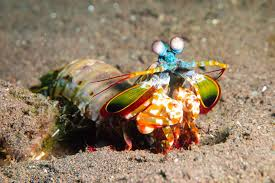
The term Giant Mantis Shrimp generally refers to larger species within the order Stomatopoda, with the Peacock Mantis Shrimp being the most well-known and frequently kept species in the hobby. The Peacock Mantis Shrimp, known scientifically as Odontodactylus scyllarus, can reach lengths of seven inches or more and is widely regarded as the most visually stunning Mantis Shrimp species available to hobbyists.
Its coloration is nothing short of extraordinary. The body displays a complex mosaic of greens, blues, reds, and oranges arranged in patterns that shift and shimmer as the animal moves. The compound eyes, which can move independently of each other and contain 16 types of photoreceptors compared to the three found in human eyes, are themselves a visual spectacle. Watching a fully grown Peacock Mantis Shrimp patrol its territory and hunt its prey is an experience that reef keepers never forget.
Other large Mantis Shrimp species occasionally available in the hobby include the Lysiosquillina maculata, commonly known as the Zebra Mantis Shrimp, which can reach truly impressive lengths of up to15 inches and is a spearer type rather than a smasher.
Understanding Smasher Versus Spearer Types
Giant Mantis Shrimp generally fall into one of two categories based on their hunting strategy, and understanding the difference is important for tank setup and feeding purposes.
Smasher types like the Peacock Mantis Shrimp use powerful club-like appendages called dactyl clubs to strike prey with incredible force. The strike of a large Peacock Mantis Shrimp has been measured at speeds comparable to a bullet leaving a gun barrel, and the impact force is capable of breaking aquarium glass if strikes are repeatedly directed at the same spot. This is not a theoretical risk. It is a real consideration that must be factored into housing choices for this species.
Spearer types use sharp, barbed appendages to impale fast-moving prey like fish and shrimp. They are typically slightly less dangerous to aquarium glass but are equally impressive hunters and just as fascinating to observe.
Why Giant Mantis Shrimp Require Specialized Care
Giant Mantis Shrimp are not animals that thrive in standard fish store conditions. They need individual housing, species-appropriate feeding, stable water quality, and regular observation by someone who understands their behavior and health indicators. Very few vendors in the country have the infrastructure and knowledge to properly care for large Mantis Shrimp, which is why healthy adult specimens are so difficult to find.
Dr. Reef’s Quarantined Fish is specifically set up to house and condition Giant Mantis Shrimp individually. Each animal receives its own dedicated system, daily observation, and a feeding program designed around its specific species and size. By the time a Giant Mantis Shrimp ships from Dr. Reef, it has a documented feeding history, confirmed health status, and the behavioral confidence that only comes from proper care and adequate recovery time after collection.
Tank Requirements and Housing Considerations
A Giant Mantis Shrimp needs a tank sized appropriately for its species and adult size. For a Peacock Mantis Shrimp, a minimum of 55 gallons is recommended, with larger systems strongly preferred. The tank must be constructed from acrylic rather than glass, or at minimum the animal must be housed in a way that prevents repeated strikes against glass panels. Many experienced keepers use thick acrylic tanks specifically chosen for their impact resistance.
Provide a deep sand bed of at least four to six inches for burrowing, along with PVC pipe sections and live rock rubble for den construction. The animal will spend significant time excavating and fortifying its burrow, which is a fascinating and entertaining behavior to observe. A heavy, weighted, and completely secure lid is absolutely non-negotiable. Giant Mantis Shrimp are powerful enough to force open improperly secured covers.
Feeding Your Giant Mantis Shrimp
Feeding a Giant Mantis Shrimp is one of the most spectacular experiences in the marine hobby. Large smasher species should be offered whole crabs, clams on the half shell, large shrimp, and other hard-shelled prey that allows them to exercise their natural striking behavior. Spearer species do best with live or fresh whole fish, large shrimp, and other fast-moving prey items.
Feed once daily and remove uneaten food promptly to maintain water quality. Overfeeding is a common mistake that leads to rapid water quality decline in a single-specimen tank. A well-maintained protein skimmer and regular water changes are essential for keeping the system clean and parameters stable long-term.
A Giant Mantis Shrimp from Dr. Reef’s Quarantined Fish is a once-in-a-hobby experience that will impress every person who sees your tank and challenge you to become a better, more attentive aquarist in the best possible way.