
Copperband Butterfly

Copperband Butterfly for Sale: Aiptasia-Eating Butterflyfish Care Guide
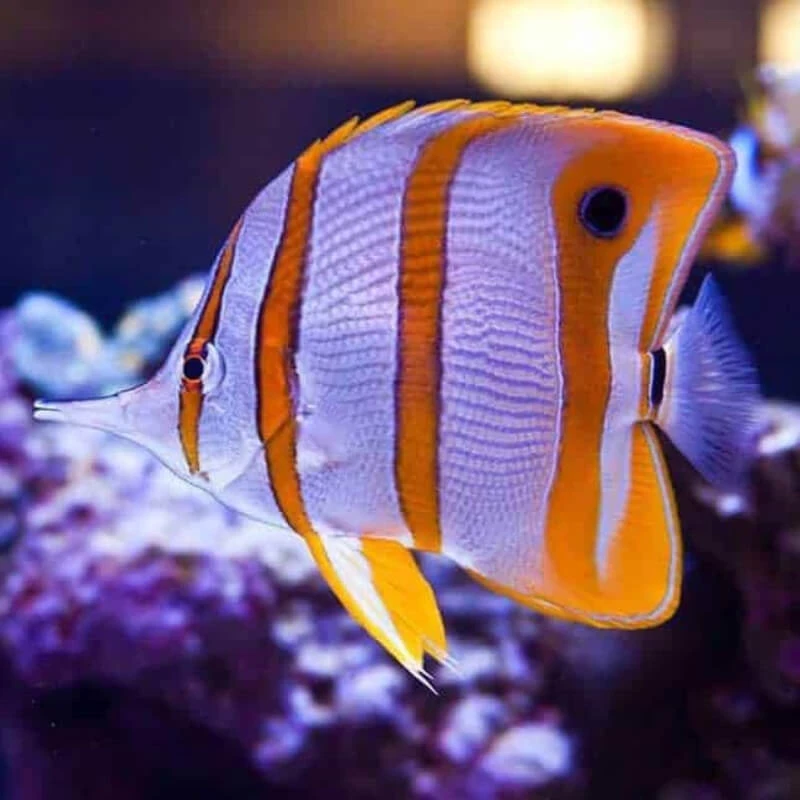
The Copperband Butterflyfish (Chelmon rostratus) occupies a unique position in the marine aquarium hobby. It is simultaneously one of the most visually striking fish available to reef keepers and one of the most practically useful. Famous for its willingness to consume Aiptasia anemones, a notoriously stubborn reef pest, the Copperband Butterfly is a fish that earns its place in the tank twice over: once through sheer beauty and again through genuine biological service. But it is also a species that demands respect, preparation, and ideally, a quarantined specimen from a trusted source like Dr. Reef’s Quarantined Fish.
Introducing the Copperband Butterflyfish
Native to the Indo-Pacific and ranging from the Andaman Sea to Australia and north to southern Japan, Chelmon rostratus inhabits coral-rich reef environments, rocky shorelines, and silty estuaries. It is instantly recognizable by its elongated snout, which it uses to probe crevices and extract hidden invertebrates, and its bold vertical banding pattern of copper and white with a distinctive false eyespot near the dorsal fin.
That elongated snout is not merely decorative. It is a highly specialized feeding tool shaped by millions of years of evolution for precisely the kind of foraging behavior that makes this fish so valuable in reef tanks with Aiptasia problems. The same snout that hunts worms and small crustaceans in the wild is equally effective at extracting Aiptasia polyps from the rockwork of a home aquarium.
Adults reach approximately 8 inches in length, though most aquarium specimens remain somewhat smaller. They are generally found singly or in bonded pairs in the wild and are not schooling fish.
The Aiptasia Connection
Aiptasia, sometimes called glass anemones or rock anemones, are one of the most persistent nuisance organisms in reef keeping. They reproduce rapidly, sting coral, and are remarkably difficult to eliminate through chemical or mechanical means alone. Many treatments provide temporary relief but fail to address the root of the problem.
The Copperband Butterflyfish is one of the few biological solutions that actually works for many hobbyists. When properly acclimated and hungry, Copperbands will systematically work through a tank’s Aiptasia population, picking them off from the rockwork with precise, targeted jabs of their elongated snout.
There is an important caveat here. Not every Copperband will eat Aiptasia. Individual fish vary, and a specimen that has been surviving on prepared foods in captivity may not immediately recognize Aiptasia as prey. The best results come from healthy, well-settled fish that have been given time to explore and forage naturally. Purchasing a quarantined specimen from Dr. Reef, one that is already eating well and in full health, dramatically improves the likelihood of success.
Tank Requirements
- Tank Size: A minimum of 75 gallons is recommended for a single Copperband Butterflyfish. Larger is always better. These fish are active swimmers that use the full volume of the tank and can become stressed in cramped conditions.
- Aquascape: Dense, varied rockwork that mimics a natural reef structure is ideal. The Copperband Butterfly uses crevices and overhangs for shelter and spends much of its day probing these areas for food. A well-aquascaped tank keeps this fish engaged and behaviorally healthy.
- Water Quality: The Copperband Butterflyfish is sensitive to water quality and does not tolerate elevated ammonia, nitrite, or high nitrate levels well. A mature, fully cycled tank with consistent parameters is essential. Target salinity of 1.023 to 1.025, temperature between 74 and 80 degrees Fahrenheit, and pH of 8.1 to 8.4. Regular water changes and efficient protein skimming are not optional for this species.
- Lighting: Moderate reef lighting is appropriate. The Copperband does not have specific lighting demands beyond what a standard reef system provides.
Reef Compatibility
The Copperband Butterflyfish is considered reef safe with caution, and understanding what that means in practice is important before purchase.
It will not harm stony corals under most circumstances, and many hobbyists keep Copperbands successfully in SPS and LPS reef systems. However, individual fish may occasionally nip at soft coral polyps, tube worms, feather dusters, or certain clam mantles. Monitoring behavior after introduction is important, and if nipping is observed, intervention may be necessary.
The flip side, of course, is its appetite for Aiptasia, which makes it a net positive for most established reef tanks where that pest is present.
Feeding the Copperband Butterfly
Feeding is where most Copperband Butterflyfish fail in captivity, and it is the primary reason why quarantine matters so much with this species. Wild-caught specimens that have never encountered aquarium foods can refuse prepared diets entirely and slowly decline despite appearing physically healthy.
In the wild, Copperbands feed on small worms, crustaceans, and invertebrates extracted from crevices. Replicating this in captivity requires patience and strategy.
Start with live or frozen Mysis shrimp, which closely resemble natural prey in texture and behavior when tumbling through the water column. Target feeding with a pipette or feeding stick placed directly near the fish’s snout is often more effective than broadcast feeding. Many Copperbands also accept frozen bloodworms, live black worms, and over time, high-quality pellets.
At Dr. Reef’s Quarantined Fish, every Copperband Butterflyfish goes through a feeding assessment during quarantine. Fish that are not eating reliably are not made available for sale. When you purchase a Copperband from Dr. Reef, you are getting a fish that has already cleared the most critical hurdle of captive adjustment.
Tankmates for the Copperband
Copperband Butterflyfish are peaceful toward most fish of similar or larger size and integrate well into mixed community reef tanks. Good tankmates include tangs, clownfish, gobies, dartfish, wrasses, and other butterflyfish of different species and comparable size.
Avoid housing with aggressive fish that may bully or outcompete the Copperband at feeding time. Because this species can be a hesitant feeder, any tank dynamic that increases competition or stress around food will make the situation worse.
Do not house two male Copperband Butterflyfish together in smaller systems, as territorial disputes can develop.
Acclimation Best Practices
The transition period after purchase is the highest-risk window for the Copperband Butterflyfish. Slow, careful acclimation using the drip method over 45 to 60 minutes minimizes osmotic and temperature shock. Keep the tank dark and quiet for the first several hours after introduction to reduce stress. Do not introduce the fish directly into a tank with aggressive inhabitants or heavy competition for territory.
In the first week, feed small amounts multiple times daily and observe closely. A Copperband that is actively moving through the rockwork and showing interest in its surroundings is acclimating well. One that hides continuously and shows no feeding interest within the first several days warrants closer monitoring.
Why Dr. Reef Is the Right Source
The Copperband Butterflyfish is one of the species where the difference between a quarantined and unquarantined specimen is most pronounced. The stresses of collection, transport, and repeated handling suppress immune function and appetite in ways that compound over time. An unquarantined Copperband arriving at your tank may already be in a precarious state, even if it appears physically normal.
Dr. Reef’s Quarantined Fish gives every Copperband the recovery and stabilization time it needs. Through a structured quarantine process that monitors health, confirms feeding, and treats proactively where indicated, Dr. Reef consistently delivers Copperband Butterflyfish that are ready for life in a home reef. That reliability is the foundation of Dr. Reef’s reputation and the reason hobbyists return again and again.
If you are dealing with an Aiptasia problem, or simply want one of the most elegantly beautiful fish available in the saltwater hobby, the Copperband Butterflyfish from Dr. Reef is a purchase you can make with genuine confidence.