
McCosker’s Flasher Wrasse

McCosker’s Flasher Wrasse for Sale – A Dazzling and Active Wrasse for Reef Aquariums
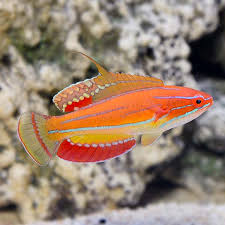
There is a moment that every aquarist who keeps a McCosker’s Flasher Wrasse (Paracheilinus mccoskeri) eventually witnesses, and it is the reason this fish has earned such devoted followings in the reef hobby. The male, for reasons of courtship or territorial display, suddenly erects his elongated dorsal fin and anal fin, intensifies his already vivid coloration, and begins darting through the water column in a display of iridescent brilliance that is difficult to describe adequately in words. It lasts only seconds. Then he folds back his fins and returns to his patrol. For many aquarists, seeing it for the first time is the moment they understand exactly what the fuss is about.
At Dr. Reef’s Quarantined Fish, every McCosker’s Flasher Wrasse we offer has completed our full quarantine protocol and is confirmed eating prepared foods before being made available. These fish can be sensitive during the initial adjustment period, and our process is specifically designed to bridge that gap before the fish ever ships to you.
The Visual Appeal of the McCosker’s Flasher Wrasse
The male McCosker’s Flasher Wrasse is one of the most colorful small fish available in the marine hobby. The body is predominantly orange, deepening toward the dorsal surface and lightening to near-yellow along the belly. Multiple horizontal blue lines run along the body and extend into the fins, creating a layered iridescence that shifts with movement and lighting angle. The dorsal fin is large and orange-based with a single elongated filament extending from the anterior portion, a feature that distinguishes it from the closely related Carpenter’s Flasher Wrasse. The anal fin carries a bold red band against the orange base.
Female coloration is significantly more subdued, lacking the enlarged fins and vivid patterning of the male. In a harem group, the visual contrast between the male in full display and the quieter females around him makes for one of the most dynamic spectacles a reef aquarium can offer. The species reaches approximately 3 inches at maturity, a size that suits a wide range of system sizes while still providing enough presence to anchor attention across the tank.
Tank Requirements and Care
A minimum aquarium size of 55 gallons is appropriate for a single specimen or a small harem, with larger systems of 75 gallons or more recommended when keeping multiple females alongside a male. The aquascape should provide substantial live rock with crevices, rubble zones, and overhangs that give the fish shelter and a sense of security. A sand substrate is essential, as McCosker’s Flasher Wrasses bury themselves in sand to sleep at night and will dive into the substrate when startled. Without a proper sandbed, the fish cannot complete this natural behavior and will be chronically stressed.
A tightly fitting lid is non-negotiable. These fish are accomplished jumpers, and they can clear even small gaps in a hood with accuracy and speed. Water parameters should be maintained at 72 to 78 degrees Fahrenheit, salinity at 1.020 to 1.025 SG, and pH between 8.1 and 8.4. Stable, well-oxygenated water with moderate flow suits this species well.
Social Structure and Harem Keeping
McCosker’s Flasher Wrasses are protogynous hermaphrodites, meaning all individuals are born female and the dominant fish in a group transitions to male. In captivity, the most rewarding and visually spectacular arrangement is a single male kept with a harem of three to five females. The presence of females actively stimulates the male’s flashing behavior, and a well-established harem group produces displays far more frequently than a solitary male kept alone.
When setting up a harem, introduce the females first and allow them to establish themselves in the system before adding the male. Be aware that in the absence of a male, the dominant female will begin transitioning to male within ten to fourteen days, so timing matters. Multiple males together will compete and cause stress unless the system is very large and territories can be adequately separated.
Feeding the McCosker’s Flasher Wrasse
McCosker’s Flasher Wrasses are active carnivores and zooplanktivores that accept a varied diet of frozen mysis shrimp, enriched frozen brine shrimp, copepods, and amphipods. They will also accept high-quality pellet and flake foods once acclimated. Feed multiple small portions throughout the day rather than one or two large offerings, as these are high-metabolism fish that graze continuously in the wild. A refugium stocked with copepods provides an excellent supplemental food source and supports the species’ natural hunting behavior throughout the day.
One compatibility note worth flagging: McCosker’s Flasher Wrasses are active pod hunters and will deplete copepod populations in a system. Aquarists keeping Mandarin Dragonets or Scooter Blennies alongside flasher wrasses should be aware of this competition for the same live food resource.
Reef Compatibility and Tank Mates
McCosker’s Flasher Wrasses are fully reef-safe and pose no threat to corals or sessile invertebrates. They integrate peacefully with the broad majority of community reef fish, including anthias, cardinalfish, dartfish, firefish, and small gobies. They are peaceful and somewhat shy by nature, and should not be housed with aggressive or fast-moving species that will stress them or outcompete them at feeding time. Only one male should be kept per system unless the tank is large enough to support clearly separated territories.
Browse our current McCosker’s Flasher Wrasse availability at Dr. Reef’s Quarantined Fish and add a properly quarantined, confirmed-feeding specimen to a system that is ready to showcase it properly.