
Longnose Butterflyfish

Longnose Butterflyfish for Sale – A Graceful and Reef-Safe Butterfly for Marine Aquariums
The butterflyfish family contains some of the most visually arresting fish in the ocean, but many of its members come with care requirements that make them genuinely unsuitable for home aquariums. The Longnose Butterflyfish (Forcipiger flavissimus) is the exception that experienced marine aquarists return to again and again. Hardy relative to its family, willing to accept prepared foods, and equipped with a feeding anatomy that sets it apart from almost every other fish in the hobby, the Longnose is the butterflyfish that actually works in a well-managed home system. For the aquarist who has wanted a butterfly without the anxiety that typically accompanies the purchase, this is where that conversation starts.
At Dr. Reef’s Quarantined Fish, every Longnose Butterflyfish we offer has completed our full quarantine protocol and is confirmed eating prepared foods before being made available. Butterflyfish are sensitive to the stresses of collection and shipping, and our process is designed to establish stable feeding behavior and confirm true health before any fish leaves our facility.
The Visual Appeal of the Longnose Butterflyfish
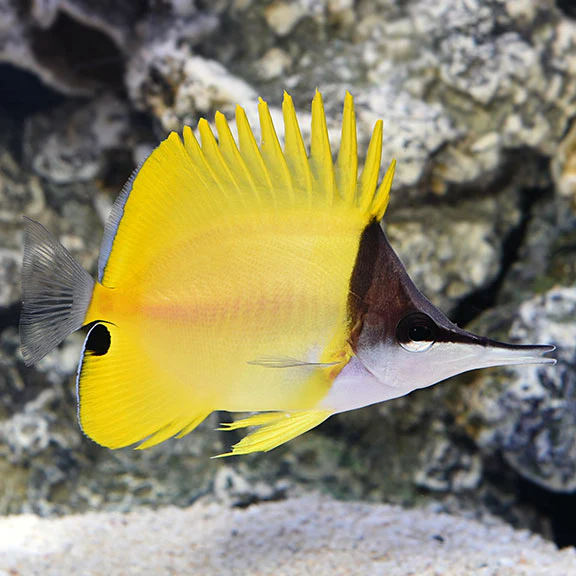
The Longnose Butterflyfish is immediately recognizable from across the room. The body is a saturated, unbroken yellow that catches light brilliantly under reef LEDs, and the head is divided horizontally into a clean black upper half and a bright white lower half, bisected precisely at eye level. The dorsal spines are long and pronounced, adding vertical drama to a silhouette that is already unlike anything else in the display. And then there is the snout: an elongated, forceps-like beak that extends well beyond the face in a way that looks almost architectural, a structure purpose-built for precision feeding in the tightest reef crevices.
In the wild, the Longnose reaches approximately 8.7 inches at full size. In the home aquarium it typically reaches 5 to 6 inches, a size that is substantial enough to read as a genuine centerpiece without overwhelming a well-proportioned display. It moves through the water column with the fluid, tilting motion characteristic of butterflyfish, always in gentle motion, always visually engaging.
Tank Requirements and Care
The Longnose Butterflyfish is best suited to an established system of at least 125 gallons, with ample live rock arranged into caves, crevices, and overhangs that give the fish both foraging surfaces and shelter. A mature system matters here for two reasons: water stability and microfauna availability. Butterflyfish are sensitive to ammonia and nitrite spikes, and a tank that has not completed its biological establishment is a tank that puts this species at unnecessary risk. The abundant copepod and amphipod populations that accumulate in established live rock also give the Longnose natural grazing opportunities throughout the day, which supports both its health and its behavioral confidence.
Water parameters should be maintained at 72 to 78 degrees Fahrenheit, salinity at 1.020 to 1.025 SG, pH between 8.1 and 8.4, and dKH between 8 and 12. Stable, well-oxygenated water with moderate flow suits this species well. Longnose Butterflyfish are not unusually demanding on the chemistry side once established, but they do not tolerate the kinds of swings that a newer or less consistently maintained system can produce.
Feeding the Longnose Butterflyfish
Feeding is where the Longnose Butterflyfish earns its reputation as the most aquarium-suitable member of its family. Unlike the majority of chaetodontids that feed obligately on coral polyps and cannot be sustained on prepared foods, the Longnose feeds on small crustaceans, tube worm tentacles, sea urchin tube feet, hydroids, and fish eggs in the wild, a diet of meaty invertebrates that translates well to frozen aquarium foods.
A diet of frozen mysis shrimp, frozen brine shrimp, and quality mixed meaty preparations forms the foundation of a healthy feeding regimen. Foods should be small enough for the narrow snout to handle, as the Longnose takes food with precision rather than engulfing it whole. Feed multiple small portions throughout the day rather than one or two large offerings, and target feed near the fish’s preferred patrol area to ensure it receives adequate nutrition in community systems where faster feeders may be competing for the same food. Soaking frozen preparations in a quality vitamin supplement supports long-term immune health and coloration, and is a worthwhile habit with any butterflyfish.
Reef Compatibility and Tank Mates
The Longnose Butterflyfish carries a reef compatibility rating of caution rather than outright incompatibility, and that distinction matters. Most individuals kept well-fed in established systems ignore stony and soft coral polyps entirely. The genuine risks are tubeworms, the tube feet of sea urchins, and other small ornamental invertebrates that fall within the fish’s natural prey profile. Aquarists keeping extensive SPS or LPS coral collections should monitor a new Longnose carefully during the settling period and make their own assessment of individual behavior before declaring the fish safe in their specific system.
As a community tank mate, the Longnose is peaceful toward most unrelated species of different body type and size. It integrates well alongside tangs, larger wrasses, angelfish, and cardinalfish. It can be assertive toward other butterflyfish, particularly conspecifics, and only one Longnose should be kept per system unless the tank is very large and the fish are introduced simultaneously. Avoid housing with highly aggressive or fast-moving species that will outcompete it at feeding time or subject it to persistent stress during the acclimation period.
One additional and genuinely useful trait worth noting: Longnose Butterflyfish have been observed feeding on Aiptasia anemones in the home aquarium, making them a potentially valuable biological control option for systems dealing with pest anemone outbreaks.
A Butterfly That Earns Its Place
The Longnose Butterflyfish is not the right fish for every system, and it should not be treated as an impulse purchase. It needs an established tank, consistent feeding, and thoughtful tank mate selection. What it offers in return is a level of elegance, movement, and visual presence that few fish at any price point can match, combined with a hardiness and dietary flexibility that makes it genuinely achievable for the intermediate to experienced marine aquarist. In the right system, it is one of the most rewarding fish in the hobby.
Browse our current Longnose Butterflyfish availability at Dr. Reef’s Quarantined Fish and add a properly quarantined, confirmed-feeding specimen to a system that is ready to showcase it properly.